Population density and habitat selection in the San Pedro Mártir rainbow trout in mountain streams of northwestern Baja California, Mexico
FULL RESEARCH ARTICLE
Gorgonio Ruiz-Campos1*, Mariana Solís-Mendoza2, Faustino Camarena-Rosales1, Asuncíon Andreu-Soler1, Edwin P. Pister3, and Iván A. Meza-Matty1
1 Universidad Autonoma de Baja California, Avenida Alvaro Obregon s/n, Nueva, 21100 Mexicali, B.C., Mexico
2 Centro de Investigación Científica y de Educación Superior de Ensenada, Carretera Tijuana-Ensenada 3918, Zona Playitas, 22860, Ensenada, B.C., Mexico
3 Desert Fishes Council, 437 E South Street, Bishop, CA, 93514, USA
*Corresponding Author: gruiz@uabc.edu.mx
Abstract
We assessed the population density and habitat selection of the southernmost rainbow trout subspecies, Oncorhynchus mykiss nelsoni, in three stream sites of the Sierra San Pedro Mártir, Baja California, Mexico. One-hundred-and-five habitat units (sections of the streams visually delimited on the basis of morphological and hydrological features) were sampled between February 2014 and April 2017, along a sample length of 2,980 m corresponding to 105 habitat units, which were classified into ten types. Mean population density (individuals/m2) was similar among the streams sampled (0.035–0.039/m2), as also over time for each stream, except for San Rafael Creek. Low gradient riffle was the habitat unit with the highest mean density of trout (0.151/m2). Of overall manner (dates and sites combined), population density was positively correlated to mean total length (TL), number of trout, and pH levels, and inversely correlated to total of dissolved solids. The total length of the trout was different among sample sites with the lowest and highest values in San Antonio de Murillo Creek and La Grulla Creek, respectively. Also, the total length of individuals among types of habitat units was different, with the highest values for MCP (mid-channel pool) and SRN (step run). Dates and sites pooled, the mean total length of individuals was positively correlated to population density, number of trout, habitat unit area, macrophyte cover, and inversely correlated to temperature. Low population densities (0.011–0.106/m2) combined with its small body size (38–216 mm TL) characterize this endemic trout in the southernmost part of species’ geographic range.
Key words: environmental variables, habitat unit, length, native trout, Oncorhynchus mykiss nelsoni
Citation: Ruiz-Campos, G., M. Solís-Mendoza, F. Camarena-Rosales, A. Andreu-Soler, E. P. Pister, and I. A. Meza-Matty. 2022. Population density and habitat selection in the San Pedro Mártir rainbow trout in mountain streams of northwestern Baja California, Mexico. California Fish and Wildlife Journal 108:e4.
Editor: Robert Sullivan, Region 1
Submitted: 31 May 2021; Accepted: 5 November 2021
Copyright: © 2022, Ruiz-Campos et al. This is an open access article and is considered public domain. Users have the right to read, download, copy, distribute, print, search, or link to the full texts of articles in this journal, crawl them for indexing, pass them as data to software, or use them for any other lawful purpose, provided the authors and the California Department of Fish and Wildlife are acknowledged.
Funding: The present study received financial support from the Universidad Autónoma de Baja California (17th Announcement of Internal Research Projects) and the National Commission for Natural Protected Areas (PROCER /CCER DRPBCPN/03/2016 grant).
Competing Interests: The authors have declared no competing interests.
Introduction
Quantification of population density, biomass, and length of the individuals, as well as the relationship between these variables and habitat heterogeneity is important to compiling an inventory of salmonid habitats in rivers and streams. This data enables identification of those habitat units with a higher carrying capacity as well as their associated abiotic and biotic features, determination of their productivity, and current condition of the corresponding ecosystem (Platts and McHenry 1988).
Assesssments of the quality of the salmonid habitats in which population density is related to their habitat condition and use of habitat units, which are defined as the sections of the river or stream that can be visually delimited based on physiographical (depth, substratum, and slope, etc.) and hydrological (current and discharge) features (Bryant et al. 1992). In this sense, at least 24 types of habitat units have been identified (USDA-USFS 1990) in the mountain streams of western North America that contain trout populations and are grouped into the three major categories of pool, riffle, and run (Bryant et al. 1992; Bain and Stevenson 1999).
Despite the numerous studies that have been carried out to determine the population density of trout in the streams of western North America (cf. Platts and McHenry 1988; Budy et al. 2019), there is practically no data on the density of native trout populations in northwestern Mexico in the literature (Hendrickson et al. 2003; Hendrickson and Tomelleri 2019). The San Pedro Mártir trout, Oncorhynchus mykiss nelson (Evermann 1908; Fig. 1), is endemic to the western slope of the Sierra San Pedro Mártir, Baja California, Mexico (Ruiz-Campos and Pister 1995; Ruiz-Campos 2017). This southernmost subspecies of rainbow trout (Behnke 2002) inhabits small streams ranging from 560–2075 m above sea level (masl) characterized by low summer flows and hot temperatures (Ruiz-Campos 1993, 2017). This subspecies is now under special protection (Jelks et al. 2008; Semarnat 2010) to mitigate anthropogenic threats to its habitats from from irrigation, deforestation of riparian vegetation, livestock grazing, mining, and the introduction of exotic species (Ruiz-Campos 2017).

The present study evaluated the population density and individual length of O. m. nelsoni by type of habitat units in three stream sites (San Antonio, San Rafael, and La Grulla) at different elevations in the Sierra San Pedro Mártir, Baja California, Mexico, as well as evaluating the correlation of this data with habitat variables. The information presented here will assist in the identification of habitats with a higher abundance of this subspecies. It will also serve as a source of reference for the future monitoring and conservation of populations, as well as programs aiming to improve the habitat of this taxon.
Methods
Study Area
The Sierra San Pedro Mártir (SSPM) is a batholithic formation (a large mass of intrusive igneous rock also called plutonic rock) extended from southern California (USA) to the southern peninsula of Baja California, Mexico (O’Connor and Chase 1989; Barajas 2018). The highest peak in this mountain system is Picacho del Diablo, standing with 3,096 masl (Barajas 2018). The headwaters of the SSPM are characterized by a series of perennial streams that drain into the Pacific Ocean and are intermittent in their middle and lower sections during the dry seasons (Tamayo and West 1964). From north to south San Rafael, San Telmo and Santo Domingo creeks are the most prominent (Fig. 2). The access to the sea by all these streams is blocked by sand bars, except during the high flows occurring after storms (Tamayo 1962). The riparian vegetation comprises mesophilic trees (plants dependent of soils moderately wet) such as Populus fremontii, P. tremuloides, Platanus racemosa, and Salix lasiolepis, shrubs such as Baacharis salicifolia, and herbaceous forms such as Hydrocotyle sp. and Berula erecta, which are found on the stream banks. The aquatic macrophytes of the region are represented by emerging Scirpus californicus and Typha domingensis and submerged Potamogeton natans, Nasturtium aquaticum and Ceratophyllum demersum forms (Ruiz-Campos 2017).

Assessment of Habitat and Population Density
We carried out nine sampling events at the three study sites between February 2014 and April 2017 (Fig. 2). These sampling sites, at all three of which the presence of the endemic trout O. mykiss nelsoni has been recorded, are located at different streams and elevations (San Antonio de Murillos Creek, 553–558 masl, 30⁰ 49’ 9.3’’ N, 115⁰ 37’ 46.6’’ W; San Rafael Creek, 1,230 masl, 31⁰ 05’ 43.0’’ N, 115⁰ 37’ 18.1’’ W to 1,254 m; and La Grulla Creek, 2,023–2,042 masl, 30⁰ 53’ 34.4’’ N, 115⁰ 28’ 53.4’’ W) encompassing this subspecies’ altitudinal distribution range (Ruiz-Campos and Pister 1995; Ruiz-Campos 2017). These stream sites were selected because contain representative habitats of the trout throughout their distribution range, and because these three sites have been repeatedly monitored for evaluation of trout abundance in different periods: 1987 to 2012 (San Rafael Creek), 1995 to 2010 (San Antonio de Murillos Creek), and 1990 to 1994 (La Grulla Creek) and (Ruiz-Campos 1989, 1993, 2017; Ruiz-Campos and Pister 1995; Ruiz-Campos et al. 1997). Due to the difficulty of accessing the subspsecies’ remote sites of distribution and the logistical challenges of transporting equipment and material by mule and horse, we sampled the sites at different dates in different years. At each site, we selected stream segments of variable length for the evaluation of the habitat units and population density. The length of transect in each stream was over 160 m in all the cases (range = 169–780 m, mean = 331 m), which are representative of the different types of habitats (Ruiz-Campos 1993; Ruiz-Campos et al. 1997; Ruiz-Campos 2017).
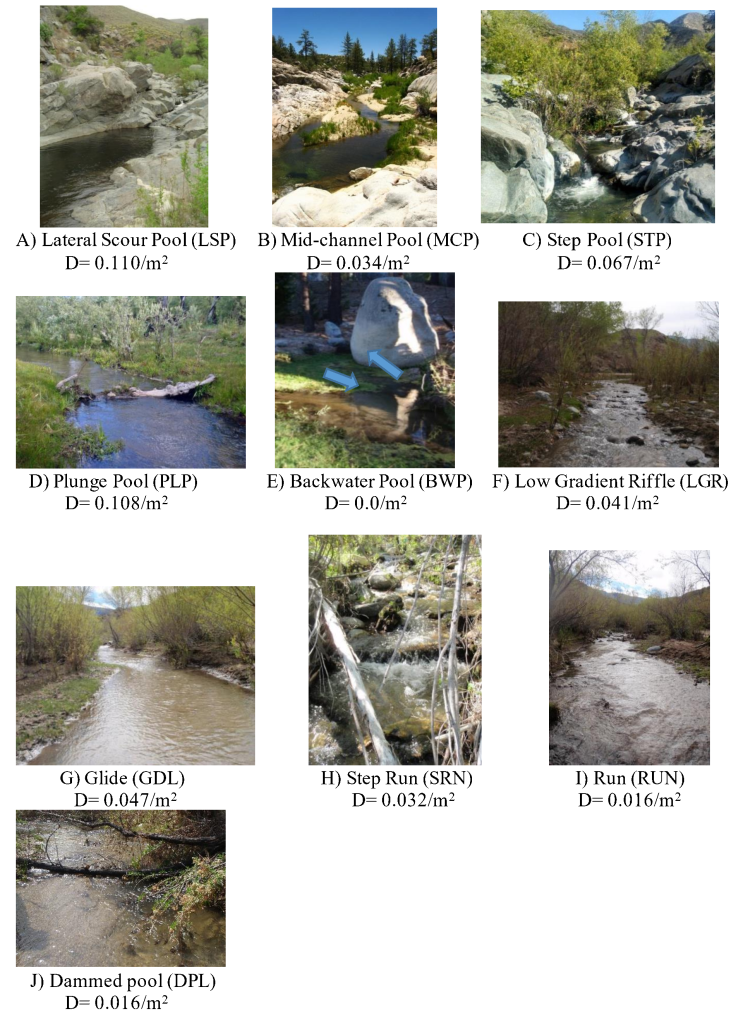
We characterized habitats following USDA-USFS (1990), Bryant et al. (1992), and Bain and Stevenson (1999) (Fig. 3). Here, habitat units are defined as the section of the stream that can be visually delimited based on morphology (depth, substratum, and slope, etc.) and hydrological features (discharge rate and flow velocity; Bryant et al. 1992). We identified each habitat unit (see section of results for description) along the length of each transect and then characterized in terms of the following variables: morphology (length and width, average depth, slope, and dominant substratum); hydrometry (velocity of flow and discharge); water quality (temperature, dissolved oxygen, pH, conductivity, and total dissolved solids); and biological variables (average total length and number of individuals and macrophyte coverage). All the habitat variables measured in the present study were based on those described by Dolloff et al. (1993), Bain and Stevenson (1999), and Cornell et al. (2008) (Appendix 1).
The depth and current velocity for each habitat unit were measured in a cross-section of the stream at 30 cm intervals, using a pleximeter (precision 0.5 cm) and a current meter (Swoffer 2100 model, precision 0.01 m/s, Swoffer.com/products.htm), respectively. The discharge was calculated as Q = [W * D * V] * CF (Hynes 1972), where Q = discharge rate (m3/s), W = average stream width (m), D = average depth (m), V = average speed of the current (m/s), and CF = constant friction for soft (0.9) and rugous (0.8) bottoms. We recorded physicochemical variables using a Hydrolab Surveyor multiparameter water quality sonde (Hydrolab Co., Austin, TX).
We evaluated the population density in each transect, which were of variable length, one day prior to the characterization of the habitats, in order to avoid disturbing the fish. The length of transects for trout sampling used in this study (169–780 m) was within the range recommended by Ruiz-Campos (1993, 2017) for the population monitoring and determination of the length structure of this trout subspecies. We deployed block nets prior to sampling to eliminate emigration from the habitat unit. An electro-fishing equipment (LR-24 Smith-Root, voltage range of 200–300 V) was used to collect the trout via two sweeps conducted in each habitat unit (Dolloff et al. 1993). All individuals captured in each habitat unit were counted and kept alive in a 20-l container, with their TL (mm) measured and their sex identified, after which they were released back into their respective habitat units. We measured TL as recommended by Anderson and Neumann (1996) because this measure is more commonly used by fishery biologists than standard length and generates less stress to the fish when measuring it. The average TL ± SD of individuals captured in each habitat unit was also calculated, while the population density for each habitat unit was expressed as the number of individuals per square meter.
In order to estimate the population density of trout per kilometer of stream, as well as the population size in each stream, we measured the length of stream containing suitable habitats, based on satellital images via Google Earth and observation in field.
Statistical Analysis
Because the density and total length values of the individuals registered in this study did not show a normal distribution according to the χ2 test of normality, we used nonparametric Kruskal-Wallis (H) and Mann-Whitney (U) tests to compare the population density and TL length values among the streams as well as among the types of habitat units. A Spearman rank correlation (rs), with a significance level of 0.05 (Sokal and Rohlf 2012), was also applied to determine the relationships, at habitat-unit level, between each habitat variable and population density and average individual TL. We used the Statistical software 5.0 (StatSoft, Inc., Tulsa, OK) for the statistical analyses.
Results
One-hundred-and-five habitat units pertaining to ten different habitat unit types were identified at three sites that comprised a total length of 2,980 m of the three streams sampled at three different elevations (San Antonio Creek, 553–558 m; San Rafael Creek, 1,230–1,254 m; and, La Grulla Creek, 2,023–2,042 m). We captured 410 individuals ranging from 38–216 mm TL (mean = 115.2 ± 42.7 mm) in the three streams during the study period, with average population density of 0.039/m2 (range = 0.011–0.106). We calculated the mean TL by site and habitat unit in each sampling event (Table 1).
Table 1. Mean trout density (number/m2) and mean total length of individuals (mm) by type of habitat unit in the streams of the Sierra de San Pedro Mártir, Baja California, Mexico, from February 2014–April 2017. See abbrevations of habitat units in methods.
| Date | Stream site | Habitat unit | Surface (m2) | # of trout | Mean trout density/m2 | Mean total length (mm) |
|---|---|---|---|---|---|---|
| 3 May 2014 | San Antonio | MCP | 804.5 | 9 | 0.011 | 83.1 ± 31.5 |
| 3 May 2014 | San Antonio | RUN | 233.2 | 7 | 0.030 | 93.8 ± 40.8 |
| 3 May 2014 | San Antonio | SRN | 626.6 | 19 | 0.030 | 75.7 ± 10.7 |
| 3 May 2014 | San Antonio | Total | 1664.2 | 35 | 0.021 | 82.6 ± 28.4 |
| 13 Apr 2015 | San Antonio | RUN | 1.9 | 8 | 0.019 | 85.3 ± 29.1 |
| 13 Apr 2015 | San Antonio | STP | 176.6 | 11 | 0.062 | 101 ± 22 |
| 13 Apr 2015 | San Antonio | SRN | 214.9 | 15 | 0.070 | 139.2 ± 18.1 |
| 13 Apr 2015 | San Antonio | DPL | 370.4 | 6 | 0.016 | 157.8 ± 36.2 |
| 13 Apr 2015 | San Antonio | LGR | 111.0 | 5 | 0.045 | 82.5 ± 14.8 |
| 13 Apr 2015 | San Antonio | MCP | 68.4 | 0 | 0.000 | N/A |
| 13 Apr 2015 | San Antonio | Total | 1353.3 | 45 | 0.033 | 116.9 ± 37.4 |
| 23 Feb 2014 | San Rafael | GLD | 1043.9 | 108 | 0.104 | 103.5 ± 33.2 |
| 23 Feb 2014 | San Rafael | LGR | 52.9 | 8 | 0.151 | 112.5 ± 32.5 |
| 23 Feb 2014 | San Rafael | Total | 1096.9 | 116 | 0.106 | 108.7 ± 32.9 |
| 21 Mar 2015 | San Rafael | GLD | 939.4 | 5 | 0.005 | 117.6 ± 13.6 |
| 21 Mar 2015 | San Rafael | SRN | 196.6 | 1 | 0.005 | 114 |
| 21 Mar 2015 | San Rafael | LGR | 165.7 | 3 | 0.018 | 118.1 ± 19.7 |
| 21 Mar 2015 | San Rafael | RUN | 929.6 | 8 | 0.009 | 130.6 ± 24.2 |
| 21 Mar 2015 | San Rafael | STP | 286.3 | 13 | 0.045 | 117.5 ± 16.9 |
| 21 Mar 2015 | San Rafael | Total | 2517.6 | 30 | 0.012 | 121.5 ± 19.0 |
| 24 May 2015 | San Rafael | PLP | 16.2 | 2 | 0.124 | 45 |
| 24 May 2015 | San Rafael | RUN | 998.4 | 16 | 0.016 | 158.5 ± 38.2 |
| 24 May 2015 | San Rafael | BWP | 18.4 | 0 | 0.000 | N/A |
| 24 May 2015 | San Rafael | SRN | 72.4 | 3 | 0.041 | 77.0 ± 18.4 |
| 24 May 2015 | San Rafael | LSP | 9.1 | 1 | 0.110 | 193 |
| 24 May 2015 | San Rafael | STP | 95.2 | 1 | 0.011 | 218 |
| 24 May 2015 | San Rafael | LGR | 38.4 | 0 | 0.000 | N/A |
| 24 May 2015 | San Rafael | Total | 1248.1 | 23 | 0.018 | 158.0 ± 49.5 |
| 26 Sep 2014 | La Grulla | MCP | 938.7 | 40 | 0.043 | 108.1 ± 46.7 |
| 26 Sep 2014 | La Grulla | GLD | 121.4 | 10 | 0.082 | 99.4 ± 48.1 |
| 26 Sep 2014 | La Grulla | Total | 1060.1 | 50 | 0.047 | 106.3 ± 46.6 |
| 9 Aug 2015 | La Grulla | GLD | 573.6 | 32 | 0.056 | 98.6 ± 44.1 |
| 9 Aug 2015 | La Grulla | MCP | 587.8 | 43 | 0.073 | 129.0 ± 36.8 |
| 9 Aug 2015 | La Grulla | Total | 1161.4 | 75 | 0.065 | 116.0 ± 42.6 |
| 17 Sep 2016 | La Grulla | MCP | 1118.8 | 17 | 0.015 | 149.5 ± 32.4 |
| 17 Sep 2016 | La Grulla | GLD | 412.7 | 0 | 0.000 | N/A |
| 17 Sep 2016 | La Grulla | Total | 1531.4 | 17 | 0.011 | 149.5 ± 32.4 |
| 29 Apr 2017 | La Grulla | GLD | 710.6 | 7 | 0.010 | 153.3 ± 24.4 |
| 29 Apr 2017 | La Grulla | MCP | 810.8 | 12 | 0.015 | 193.3 ± 30.6 |
| 29 Apr 2017 | La Grulla | Total | 1521.4 | 19 | 0.013 | 169.3 ± 32.7 |
| Grand Total | 410 | 0.039 | 115.2 ± 42.7 |
The ten types of habitat units identified (Fig. 3) corresponded to lateral scour pool (LSP, formed by flow impinging one streambank or against a partial channel obstruction), mid-channel pools (MCP, formed by mid-channel scour), dammed pools (DPL, water impounded from a complete or nearly complete channel blockage), step pools (STP, series of pools separated by short riffles or cascades), backwater pools (BWP, pool formed by log), plunge pools (PLP, pool found where stream passes over a complete or nearly complete channel obstruction and drops steeply into the streambed below, scouring out a depression), run (RUN, swiftly flowing reaches with little surface agitation and no major flow obstructions), glide (GLD, a wide uniform channel bottom with flow of low to moderate velocity), step run (SRN, a sequence of runs separated by short riffle steps), and low gradient riffle (LGR, shallow reaches with swiftly flowing, turbulent water with some partially exposed susbstrate). Six types of habitat units were classified for San Antonio de Murillos Creek (LGR, RUN, SRN, STP, PLP, and MCP), eight for San Rafael Creek (LGR, RUN, GLD, SRN, BWP, DPL, LSP, and STP), and two for La Grulla Creek (GLD and MCP).
By sampling event (all the types of habitat units combined), the highest average trout density (individuals/m2) was registered in La Grulla Creek (0.065) in August 2015, while the lowest average density (0.011) was obtained in September 2016 in this same site (Table 1). For habitat units (all sampling sites and events combined), the highest mean density occurred in LSP and PLP with 0.110 and 0.108 individuals/m2, respectively (Fig. 3).
Population Density
San Antonio de Murillos Creek.—The mean population density of trout in San Antonio de Murillos Creek was obtained via two sampling events with a value of 0.035 individuals/m2. In the first sampling event (3 May 2014), we collected 35 individuals in a 419 m stream segment with an average width of 6.4 m and a scanned area of 1,664 m², giving a population density of 0.021/m². By habitat unit, the population densities observed for this first sampling event were: SRN (0.03/m2), RUN (0.03/m2) and MCP (0.011/ m2) (Table 1). In the second sampling event (13 April 2015), 45 individuals were collected in a 307 m stream segment with an average width of 4.5 m and an area of 1,353 m², giving a population density of 0.033/m². The population density observed for this second sampling event, by type of habitat unit, was as follows: SRN (0.070/m2), STP (0.062), LGR (0.045/m2), RUN (0.019/m2), DPL (0.016/m2) and MCP (0.0/m2) (Table 1).
San Rafael Creek.—The mean population density in this creek during three sampling events was 0.039 individuals/m2. In the first sampling event (23 February 2014), we collected 116 individuals in a 217 m segment of stream with an average width of 4.0 m and a scanned area of 1,097 m², giving a population density of 0.106 individuals/m². By type of habitat unit, the density of trout was GLD (0.104.m2) and LGR (0.151/m2) (Table 1). In the second sampling event (21 March 2015), 30 individuals were collected in a 780 m stream with an average width of 2.9 m and an area of 2,518 m², giving a population density of 0.012/m². By type of habitat unit, the population density, in descending order was: STP (0.045/m2), LGR (0.018 m2), RUN (0.009/m2), SRN (0.005/ m2) and GLD (0.005/m2) (Table 1). In the third sampling event (24 May 2015), we caught 23 trout in a 439 m stream segment with an average width of 2.7 m and a surface area of 1,248 m2, giving a population density of 0.018/m2. By type of habitat unit, the population density, in decreasing order was: PLP (0.124/m2), LSP (0.110/m2), SRN (0.041/m2), RUN (0.016/m2), STP (0.011/ m2), BWP and LGR (0.0/m2) (Table 1).
La Grulla Creek.—The mean population density of the trout in La Grulla Creek recorded over four sampling events was 0.039 individuals/m2. In the first sampling event (26 September 2014), we collected 50 individuals in a 262 m segment of stream with an average width of 4.43 m and a surface area of 1,060 m², giving a population density of 0.047. The population densities observed for the two types of habitat units sampled during this first event were 0.082/m2 for GLD and 0.043/m2 for MCP (Table 1). In the second sampling event (9 August 2015), 75 individuals were collected in a 169 m segment of stream with an average width of 6.8 m and a surface area of 1,161 m², giving a population density of 0.065/m². By type of habitat unit, the population density for this second sampling event was 0.073/m2 for MCP and 0.056/m2 for GLD (Table 1). In the third sampling event (17 September 2016), we collected 17 individuals in a 179 m segment of stream with average width of 9.8 m and a surface area of 1,531 m2, giving a population density of 0.011/m2. By type of habitat unit, the population density for this third sampling event was 0.015 and 0.00/m2 for MCP and GLD, respectively (Table 1). In the fourth sampling event (29 April 2017), we captured 19 individuals in a 208 m segment with an average width of 6.2 m and a surface area of 1,521 m2, giving a population density of 0.013 individuals/m2. By type of habitat unit, GLD and MCP presented respective population densities, for this fourth sampling event of 0.010 and 0.015/m2 (Table 1).
Statistical Analyses
Population density among sampling sites and habitat units.—The population density (individuals/m2) was statistically similar among sites sampled, considering in each site all sampling events and types of habitat units (H = 1.0, n = 105, P = 0.619). Despite that, we found the population density among types of habitat units (all sampling sites and events pooled) to be statistically similar (H = 11.4, n = 105, P = 0.247), LGR, PLP and GLD, presented the highest densities (0.151, 0.124 and 0.104 individuals/m2, respectively).
The population density at the San Rafael Creek site was statistically different among the three sampling dates (H = 10.2, n = 51, P < 0.006), especially for the sampling conducted in February 2014. Moreover, at the La Grulla Creek site, the population density was similar among the four sampling dates (H = 5.4, n = 22, P = 0.146). Finally, the population density at the San Antonio de Murillos Creek site was similar for the two sampling dates (U = 75.5, P = 0.143).
Length of individuals among sampling sites and habitat units.—The mean total length of individuals in three stream sites during the study period was 102.31 ± 46.40 mm in San Antonio de Murillo Creek, 116.47 ± 36.14 mm in San Rafael Creek, and 120.08 ± 45.79 in La Grulla Creek (Fig. 4). The comparison of the total length of individuals among these stream sites (all the sampling events and types of habitat units combined), revealed significant differences (H = 13.1, n = 374, P = 0.002), with the highest median for La Grulla Creek. Furthermore, considering all the streams sampled and sampling events, the total length of individuals among types of habitat unit was different (H = 13.7, n = 357, P = 0.0335), with the highest medians for MCP, SRN and LGR.
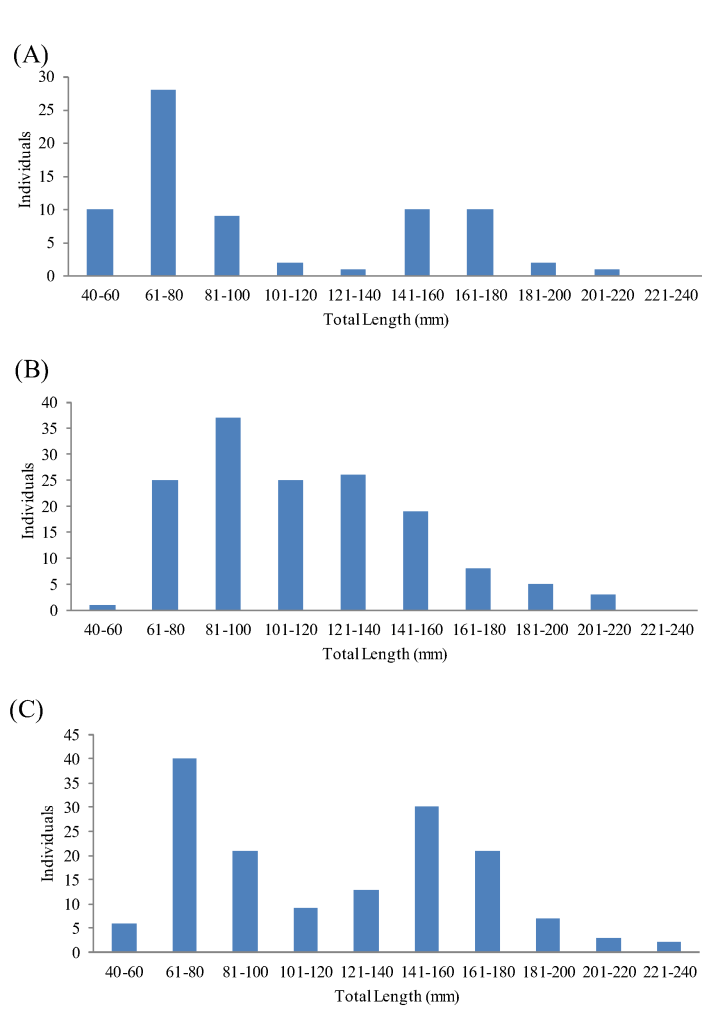
In each site, the total length of individuals among sampling events was different for San Rafael Creek (H = 20.2, n = 149, P < 0.001) and La Grulla Creek (H = 21.8, n = 152, P < 0.001) but similar in San Antonio de Murillos Creek (H = 1.0, n = 73, P = 0.326).
Relationship between population density and mean individual total length and the habitat variables.—The correlation analysis conducted on the population density by habitat unit (with all sampling sites and events combined, n = 105) and contrasted to each habitat variable (Table 2), showed a significant positive relationship (P < 0.05) with mean total length (rs = 0.584), number of trout (rs = 0.844), and pH (rs = 0.202), and an inverse correlation (P < 0.05) with total of dissolved solids (rs = –0.203). Number of trout showed a positive correlation to habitat unit area (rs = 0.371). Similarly, mean total length was observed to positively correlate with area of habitat unit (rs = 0.279), trout density (rs= 0.584), number of trout (rs = 0.689), and macrophyte cover (rs = 0.243), although it was inversely correlated with temperature (rs = –0.247).
| Variable of habitat | Mean individual total length (mm) | Density of trout (individuals/m2) |
|---|---|---|
| Type of habitat unit | 0.003 | 0.043 |
| Area of habitat unit | 0.279 | –0.048 |
| Depth | –0.054 | 0.013 |
| Velocity of current | –0.102 | 0.224 |
| Flow rate | –0.051 | 0.074 |
| Stream slope | –0.061 | –0.088 |
| Macrophyte cover | 0.243 | 0.033 |
| Temperature | –0.247 | –0.129 |
| pH | –0.004 | 0.202 |
| Dissolved oxygen | 0.038 | 0.096 |
| Conductivity | 0.004 | –0.152 |
| Total disolved solids | 0.057 | –0.203 |
| Number of trout | 0.680 | 0.843 |
| Mean total length | N/A | 0.584 |
The estimate population size of the trout for the studied streams based on occupiable habitat was as follows: La Grulla Creek with a total length of 14.5 km was 2,853 individuals (197 trout/km of stream); San Antonio Creek stream with a total length of 39.9 km was 4,398 individuals (110 trout/km of stream), and finally, the San Rafael Creek with a length of 21.8 km was 2,566 individuals (117 trout/km of stream).
Discussion
The San Pedro Mártir trout is represented by a small metapopulation distributed in first and second order creeks in the western slope of the Sierra San Pedro Mártir, Baja California, Mexico (Ruiz-Campos and Pister 1995; Ruiz-Campos 2017), with local populations estimated in this study between 110 and 197 trout/km of stream. Comparatively, the present study found an average population density of 0.039 individulas/m2 (min = 0.011, max = 0.106) for San Pedro Mártir rainbow trout, which is low but within the range (0.01–4.2) reported for salmonid populations in mountain streams in western North America (Platts and McHenry 1988). Comparatively, the population density of O. m. nelsoni is similar to that reported for other populations of rainbow trout at Colorado Plateau (0.07, Leiner 1995); Saghen Creek, California (0.01, Decker and Erman 1992), mountain streams in New Mexico (0.008–0.348, Leiner 1995), and streams in the Sierra Nevada, California (0.02–0.17; Knapp and Dudley 1990), but with a lesser density than those reported for a remote stream in the southern California (0.119–0.362; Barabe 2021).
The highest mean population density (0.106 individuals/m2) recorded in the San Rafael Creek in the sampling on 21 February 2021, is coincident with the peak of known spawning for this trout (Ruiz-Campos 2017), where the breeding adults trend to move along the stream in searching of sand-gravel beds for the building of redds especially toward glides (Ruiz-Campos 2017). This last type of habitat represented a higher proportion (95%) of the stream sampled. The low population density of trout in the streams of the SSPM is resulting from a combination of factores that characterize this southern aquatic habitat as the small size of the streams (width and depth), low biomass of prey (Ruiz-Campos 1993; Solís-Mendoza 2016), wide daily variation in temperature and dissolved oxygen, and reduced flows in the summer (Ruiz-Campos 2017; Meza-Matty et al. 2021).
Spatially, the stream sites sampled in this study that are representative of the subspecies’ altitudinal distribution range (Ruiz-Campos and Pister 1995), showed similar values of average population density, being an indicative of appropriate habitat conditions (Ruiz-Campos et al. 1997; Ruiz-Campos 2017). By total length of individuals, the largest trout were captured in the La Grulla and San Rafael creeks, where there are a higher frequency and surface of habitat units as pools (MCP), which are mainly used as foraging sites by the adult individuals (Ruiz-Campos 2017).
However, at each stream site, namely the sampling date, influenced the population density at both the San Rafael and La Grulla sites, mainly in terms of such variables as macrophyte cover (especially at La Grulla Creek), temperature, and area of habitat unit, and total length of individuals. In this sense, Hynes (1972) determined that the most important abiotic factors in salmonid survival in stream habitats are temperature, flow velocity, discharge, and escape cover. Lewis (1969) and Rinne (1982) identified pool volume to be significantly correlated with trout populations in Montana and New Mexico, respectively. Discharge rate has been successfully used to explain the biomass of brook trout in Michigan (Latta 1965), Atlantic salmon in Maine (Havey and Davis 1970), and brown trout in Wisconsin (White 1975), while a number of studies have identified cover as a limiting factor for trout populations (Binns and Eiserman 1979; Hunt 1974; Wesche 1980). Other authors have discovered relationships between trout populations and depth (Stewart 1970), invertebrate biomass (Murphy 1979), and large organic debris (Sedell et al. 1982).
In the streams sampled by the present study in the SSPM, the highest population densities occurred in types of habitat units with low frequency, which are of a small size and pertain to different types of pools, such as step pools and plunge pools. Ruiz-Campos (1993) pointed out that trout have a marked preference for inhabiting pools, as reflected in the higher population density found by the present study for this type of habitat. This was especially notable for MCP in La Grulla Creek (0.073 individuals/m2), in August 2015 (cf. Table 1), whose central erosion pools are characterized by high levels of macrophyte coverage that provides a higher quantity of prey as compared to glides and runs (Solís-Mendoza 2016).
The habitat units as lateral scour pools, step pools, or plug pools, which are known to be used as temporary thermal refuges by rainbow trout during the day in summer (Baltz et al. 1991; Roberts et al. 2013; Nusslé et al. 2015; Meza-Matty et al. 2021) because they are deeper and more thermally stable than the other habitat units in the streams. Thus, the high dissolved oxygen levels enable their resident individuals to maintain a lower level of metabolic expenditure (Jonsson et al. 1991).
The current habitat of the San Pedro Mártir rainbow trout is considered well preserved (Ruiz-Campos 2017) due to the inaccessibility and remoteness to human settlements of the species distribution, although having risk categories from medium-low to medium-high in the connectivity of their habitats based on the classification of Shepard et al. (2005) and Muhlfeld et al. (2015).
However, in recent years, the anthropogenic impact of agricultural activity has been increasing significantly in the lower parts of the basins of the coastal valleys found in the communities of Colonet, San Telmo, Camalú, and Vicente Guerrero in the region. A highwater demand is reported for these communities for the irrigation of crops via streambed wells or the channeling of flows from the upper part of the basins. This situation may lead to the eventual expansion of the use of water from those streams in which the subspecies of interest is distributed (San Antonio de Murillos Creek, Potrero Creek, La Zanja Creek, and San Rafael Creek). Therefore, it is essential that, in the short term, appropriate prevention measures are taken to ensure the conservation of the habitats of this trout and other native aquatic forms.
The present study will serve as a baseline for the future monitoring of the population density of the San Pedro Mártir rainbow trout and the quality and quantity of its habitats. The determination of the population density in each one of the streams studied by type of habitat unit will allow to identify the carrying capacity of trout in each one of them (productivity), as well as the microhabitats preferred by this endemic subspecies. The use of measurements of total length in trout for the monitoring of the population structure turns out to be more practical and less stressful than other body measurements (standard length and weight) when handling the live individuals and they must return to the capture sites.
Additionally, this study will provide an indispensable source of information to assist in elucidating the environmental and anthropogenic factors that modulate the population density of this subspecies, including the effects of the imminent global climatic change that will reduce the geographic distribution of this endemic trout (Ruiz-Campos 2017; Meza-Matty et al. 2021) and other trout species in southeastern North America (Zeigler at al. 2019). These monitoring efforts will assist in establishing the abundance patterns of this trout subspecies in the short, medium, and long term, by means of habitat unit and population density inventories that should be carried out at a minimum of every three years (Hunter 1990).
Acknowledgments
We thank E.O. Flores, J.G. Sánchez, J. Corral, J. Marco, I. Solís, B.P. Díaz, A.A. Guevara, C.A. Ballesteros, O. Acosta, Germán Ruiz, M.A. Pimentel, D. Ceseña, S. Aranda, G. Rivas, and S.A. Celaya for their support in the sampling efforts conducted in the field. Our thanks to local ranchers (R. Arce and I. Salazar) for their logistical support in the transport of equipment and personnel to the study sites via mule and horse. The present study received financial support from the Universidad Autónoma de Baja California (17th Announcement of Internal Research Projects) and the National Commission for Natural Protected Areas (PROCER /CCER DRPBCPN/03/2016 grant). Collecting permit for trout specimens was provided by Dirección General de Vida Silvestre, Secretaría de Medio Ambiente y Recursos Naturales, Mexico (number of permit SGPA/DGVS 02017/17). This work is dedicated to the memory of our friend and colleage Carlos Yruretagoyena-Ugalde, who died on August 29, 2021, who contributed with the first limnological studies in the Sierra San Pedro Mártir. Kevin B. Rogers, Robert M. Sullivan and other two anonymous reviewers made very useful comments and provided specific litetarture that allowed us to improve the content and scope of this manuscript.
Literature Cited
- Anderson, R. O., and R. M. Neumann. 1996. Length, weight, and associated structural indices. Pages 447–482 in B. R. Murphy and D. W. Willis, editors. Fisheries Techniques. 2nd edition. American Fisheries Society, Bethesda, MD, USA.
- Bain, M. B., and N. J. Stevenson. 1999. Aquatic habitat assessment: common methods. American Fisheries Society, Bethesda, MD, USA.
- Baltz, D. M., B.Vondracek, L. R. Brown, and P. B. Moyle. 1991. Seasonal changes in microhabitat selection by Rainbow Trout in a small stream. Transactions of the American Fisheries Society 120:166–176.
- Barabe, R. M. 2021. Population estimate of wild Rainbow Trout in a remote stream of southern California. California Fish and Wildlife Journal 107:21–32.
- Barajas, A. M. 2018. El origen. Pages 23–36 in E. Garduño and E. Nieblas, coordinators. Semeel Jak: Historia Natural y Cultural de la Sierra de San Pedro Mártir. Tirant Lo Blanch, México City, México.
- Behnke, R. J. 2002. Trout and Salmon of North America. The Free Press, New York, NY, USA.
- Binns, N. A., and F. M. Eiserman. 1979. Quantification of fluvial trout habitat in Wyoming. Transactions of the American Fisheries Society 108:215–228.
- Bryant, M. D., B. E.Wright, and B. J. Davies. 1992. Application of a hierarchical habitat unit classification system: stream habitat and salmonid distribution in Ward Creek, Southeast Alaska. Research Note PNW-RN-508, U.S. Department of Agriculture, U.S. Forest Service, Pacific Northwest Research Station, Portland, OR, USA.
- Budy, P., K. B. Rogers, Y. Kanno, B. E. Penaluna, N. P. Hitt, G. P. Thiede, J. Dunham, C. Mellison, W. L. Somer, and J. DeRito. 2019. Distribution and status of trout and char in North America. Pages 193–250 in J. L. Kershner, J. E. Williams, R. E. Gresswell, and J. Lobon-Cervia, editors. Trout and Char of the World. American Fisheries Society, Bethesda, MD, USA.
- Cornell, J. E., M. Gutiérrez, A. D. Wait, and H. O. Rubio-Arias. 2008. Ecological characterization of a riparian corridor along the Río Conchos, Chihuahua, Mexico. Southwestern Naturalist 53:96–100.
- Dolloff, C. A., D. G. Hankin, and G. H. Reeves. 1993. Basinwide estimation of habitat and fish populations in streams. General Technical Report SE-83, U.S. Department of Agriculture, U.S. Forest Service, Southeastern Forest Experiment Station, Asheville, NC, USA.
- Evermann, B. W. 1908. Descriptions of a new species of trout (Salmo nelsoni) and a new cyprinodont (Fundulus meeki) with notes on the other fishes from Lower California. Proceedings of the Biological Society of Washington 21:19–30.
- Havey, K. A., and R. M. Davis. 1970. Factors influencing standing crops and survival of juvenile salmon at Barrows Stream, Maine. Transactions of the American Fisheries Society 99:297–311.
- Hendrickson, D. A., and J. R. Tomelleri. 2019. Mexican trout: treasures of the Sierra Madre. Pages 251–278 in J. L. Kershner, J. E. Williams, R. E. Gresswell, and J. Lobón-Cerviá, editors. Trout and Char of the World. American Fisheries Society, Bethesda, MD, USA.
- Hendrickson, D. A., H. Espinosa-Pérez, L. T. Findley, W. Forbes, J.R. Tomelleri, R. L. Mayden, J. L. Nielsen, B. Jensen, G. Ruiz-Campos, A. Varela-Romero, A. Van Der Heiden, F. Camarena-Rosales, and F. J. García-De León. 2003. Mexican native trouts: a review of their history and current systematic and conservation status. Reviews in Fish Biology and Fisheries 12:273–316.
- Hunt, R. L. 1974. Annual production by brook trout in Lawrence Creek during eleven successive years. Technical Bulletin 82, Wisconsin Department of Natural Resources, Madison, WI, USA.
- Hunter, C. R. 1990. Better Trout Habitat: A Guide to Stream Restoration and Management. Island Press, Washington. D.C.
- Hynes, H. B. N. 1972. The ecology of running waters. Liverpool University Press, Liverpool, UK.
- Jelks, H. L., S. J. Walsh, N. M. Burkhead, S. Contreras-Balderas, E. Díaz-Pardo, D. A. Hendrickson, J. Lyons, N. E. Mandrak, F. Mccormick, J. S. Nelson, S. P. Platania, B. A. Porter, C. B. Renaud, J. J. Schmitter-Soto, E. B. Taylor, and M. L. Warren, Jr. 2008. Conservation status of imperiled North American freshwater and diadromous fishes. Fisheries (Bethesda) 33:372–407.
- Jonsson, B., J. H. L. Abée-Lund, T. J. Heggbert, A. J. Jensen, B. O Johnsen, T. F. Naesje, and M. Saettem. 1991. Longevity, body size, and growth in anadromous brown trout (Salmo trutta). Canadian Journal of Fisheries Aquatic Sciences 48:1838–1945.
- Knapp, R. A., and T. L. Dudley. 1990. Growth and longevity of golden trout, Oncoryhynchus aguabonita, in their native streams. California Fish and Game 76:161–173.
- Latta, W. C. 1965. Relationship of young-of-the-year trout to mature trout and groundwater. Transactions of the American Fisheries Society 94:32–39.
- Leiner, S. 1995. Biomass and density of brown and rainbow trout in New Mexico streams. Ribarstvo 53:3–24.
- Lewis, S. L. 1969. Physical factors influencing fish populations in pools of a trout stream. Transactions of the American Fisheries Society 98:14–17.
- Meza-Matty, I. A., G. Ruiz-Campos, L.W. Daesslé, A. Ruiz-Luna, A. A. López-Lambraño, F. Camarena-Rosales, and K. R. Matthews. 2021. Daily, seasonal, and annual variability of temperature in streams inhabited by the endemic San Pedro Martir trout (Oncorhynchus mykiss nelsoni), in Baja California, Mexico, and the predicted temperature for the years 2025 and 2050. Journal of Limnology 80(2):2001.
- Muhlfeld, C. C., S. E. Albeke, S. L. Gunckel, B. J. Writer, B. B. Shepard, and B. E. May. 2015. Status and conservation of interior redband trout in the western United States. North American Journal of Fisheries Management 35:31–53.
- Murphy, M. L. 1979. Predator assemblages in old-growth and logged sections of small Cascade streams. Thesis, Oregon State University, Corvallis, OR, USA.
- Nusslé, S., K. R. Matthews, and S. M. Carlson. 2015. Mediating water temperature increases due to livestock and global change in high elevation meadow streams of the Golden Trout Wilderness. PLoS ONE 10(11):e0142426.
- O’Connor, J. E., and C. G. Chase. 1989. Uplift of the Sierra San Pedro Mártir Baja California. Tectonics 8:833–844.
- Platts, W. S., and M. L. McHenry. 1988. Density and biomass of trout and char in western streams. General Technical Report INT-241, U.S. Forest Service, Ogden, UT, USA.
- Roberts, J. J., K. D. Fausch, D.P. Peterson, and M. B. Hooten. 2013. Fragmentation and thermal risks from climate change interact to affect persistence of native trout in the Colorado River basin. Global Change Biology 19(5):1383–1398.
- Rinne, J. W. 1982. Movement, home range, and growth of a rare southwestern trout in improved and unimproved habitats. North American Journal of Fisheries Management 2:150–157.
- Ruiz-Campos, G. 1989. Repoblación natural por trucha arcoiris (Salmo gairdneri nelsoni) en un transecto del Arroyo San Rafael, Noroeste de la Sierra San Pedro Mártir, Baja California, México. Southwestern Naturalist 32:552–556.
- Ruiz-Campos, G. 1993. Bionomía y ecología poblacional de la trucha de la Sierra San Pedro Mártir, Oncorhynchus mykiss nelsoni. Dissertation, Universidad Autónoma de Nuevo León, México.
- Ruiz-Campos, G. 2017. La trucha arcoíris de la Sierra San Pedro Mártir: bionomía, ecología poblacional, hábitat y conservación. Editorial Tirant Lo Blanch, México City, México.
- Ruiz-Campos, G., and E. P. Pister. 1995. Distribution, habitat, and current status of the San Pedro Mártir rainbow trout, Oncorhynchus mykiss nelsoni (Evermann). Bulletin of the Southern California Academy of Sciences 94:131–148.
- Ruiz-Campos, G., E. P. Pister, and G. A. Compeán-Jiménez. 1997. Age and growth of Nelson’s trout, Oncorhynchus mykiss nelsoni, from Arroyo San Rafael, Sierra San Pedro Mártir, Baja California, México. Southwestern Naturalist 42:74–85.
- Sedell, J. R., J. E. Yuska, and R. W. Speaker. 1982. Habitats and salmonid distribution in pristine, sediment-rich river valley systems: South Fork Hoh and Queets River, Olympic National Park. Pages 36–46 in W. R. Meehan, T. R. Merrell, and T. A. Hanley, editors. Fish and Wildlife Relationships in Old-growth Forest: Proceedings of a Symposium. American Institute of Fishery Biologists, Morehead City, NC, USA.
- Secretaría de Medio Ambiente y Recursos Naturales (Semarnat). 2010. Norma Oficial Mexicana NOM-059-SEMARNAT2010, Protección ambiental-Especies nativas de México de flora y fauna silvestres-Categorías de riesgo y especificaciones para su inclusión, exclusión o cambio-Lista de especies en riesgo. Diario Oficial de la Federación, 30 de diciembre de 2010, Segunda Sección, México.
- Shepard, B. B., B. E. May, and W. Urie. 2005. Status and conservation of westslope cutthroat trout within the Western United States. North American Journal of Fisheries Management 25:1426–1440.
- Solís-Mendoza, M. 2016. Caracterización del hábitat de la trucha arcoíris (Oncorhynchus mykiss nelsoni) en la Sierra de San Pedro Mártir, Baja California, y su relación con la densidad y estructura poblacional. Thesis, Centro de Investigación Científica y de Educación Superior de Ensenada, Ensenada, Baja California, México.
- R. R., and F. J. Rohlf. 2012. Biometry: The Principles and Practice of Statistics in Biological Research. 4th edition. W. H. Freeman and Co, New York, NY, USA.
- Stewart, P. A. 1970. Physical factors influencing trout density in a small stream. Dissertation, Colorado State University, Fort Collins, CO, USA.
- Tamayo, J. L. 1962. Geografía general de México. Segunda edición, tomo II: Geografíafísica. Instituto Mexicano de Investigaciones Económicas, México.
- Tamayo, J. L., and R. C. West. 1964. The hydrography of Middle America. Pages 84–121 in I. R. Wauchope, editor. Handbook of Middle America. Vol. 1. University of Texas Press, Austin, TX, USA.
- U.S. Department of Agriculture – U.S. Forest Service (USDA-USFS). 1990. Pacific Southwest Region habitat typing field guide. U.S. Department of Agriculture, U.S. Forest Service, Portland, OR, USA.
- Wesche, T. A. 1980. The WRRI trout cover rating method: development and application. Water Resources Series 78. University of Wyoming, Water Resources Research Institute, Laramie, WY, USA.
- White, R. J. 1975. Trout population responses to streamflow fluctuation and habitat management in Big Roche-a-Cri Creek, Wisconsin. Verhandlungen Internationale Vereinigung fur Theoretishce and Angewandte Limnologie 19:2469–2477.
- Zeigler, M. P., K.V. Rogers, J. J. Roberts, A. S. Todd, and K. F. Fausch. 2019. Predicting persistence of Rio Grande Cutthroat trout populations in an uncertain future. North American Journal of Fisheries and Management 39:819–848.