Precocious sexual maturity in juvenile California Central Valley spring-run Chinook Salmon
RESEARCH NOTE
Ryan Revnak*
California Department of Fish and Wildlife, Northern Region, 601 Locust Street, Redding, CA 96001, USA
*Corresponding Author: ryan.revnak@wildlife.ca.gov
Published 12 April 2023 • www.doi.org/10.51492/cfwj.109.4
Key words: Central Valley spring-run Chinook Salmon, Deer Creek, precocious sexual maturity, Sacramento River
| Citation: Revnak, R. 2023. Precocious sexual maturity in juvenile California Central Valley spring-run Chinook Salmon. California Fish and Wildlife Journal 109:e4. |
| Editor: Patricia Bratcher, Northern Region |
| Submitted: 16 September 2022; Accepted: 14 November 2022 |
| Copyright: ©2023, Revnak. This is an open access article and is considered public domain. Users have the right to read, download, copy, distribute, print, search, or link to the full texts of articles in this journal, crawl them for indexing, pass them as data to software, or use them for any other lawful purpose, provided the authors and the California Department of Fish and Wildlife are acknowledged. |
| Competing Interests: The author has not declared any competing interests. |
Precocious sexual maturity in juvenile male Chinook Salmon (Oncorhynchus tshawytscha) is a curious phenomenon first documented in the Sacramento River, California in 1902 (Rutter 1904). Little data exist regarding the prevalence of this life history among salmon populations, or the extent which it contributes to population diversity. This work provides a record of precocious sexual maturity in male Central Valley spring-run Chinook Salmon parr collected in Deer Creek, Tehama County, California. These are the first observations of this life history in Central Valley spring-run Chinook Salmon (CV spring-run) in the natural environment and adds to the body of knowledge regarding population diversity in CV spring-run.
CV spring-run exhibit a wide range of life histories with most diversity occurring in the juvenile life stages (Goertler 2020). Unlike adult salmon, precociously mature male juvenile Chinook Salmon do not always die after spawning. In a controlled study of 76 sexually mature parr that were collected from Fall Creek, a tributary of the Klamath River, and artificially spawned, it was found that after a five-month holding period all fish had survived spawning and continued to grow as well as control fish (Robertson 1957). Rutter (1904) determined that milt from precocious male parr salmon is identical to that of adult males and have successfully fertilized eggs from adult females in controlled settings. During these experiments there was no difference in fertilization, hatching rates or appearance of alevins.
The collection site of this subject is Deer Creek, Tehama County, California (40⁰09’51” N, 121⁰35’16” W). Deer Creek is home to one of four remaining independent populations of CV spring-run (Johnson and Lindley 2016). Deer Creek originates near the summit of Butt Mountain in the Lassen National Forest at approximately 2,200 m in elevation. Deer Creek flows for approximately 97 km passing through meadows and dense forests before descending rapidly through a steep rock canyon into the Sacramento Valley and enters the Sacramento River approximately two kilometers west of the town of Vina (39⁰55’16” N, 121⁰05’48” W), at an elevation of approximately 55 m. Upper Deer Creek Falls, located approximately at river km 77, is the natural limit of anadromy in Deer Creek. Downstream of Upper Falls Deer Creek contains approximately 66 km of holding, spawning, and juvenile rearing habitat for CV spring-run. CV spring-run are the only race of Chinook present in the upper Deer Creek watershed. The high elevation habitats in Deer Creek are isolated from fall-run Chinook by low summer and fall flows and high water temperatures that prevent geographic co-occurrence and maintains genetic and phenotypic diversity of the population (NMFS 2014).
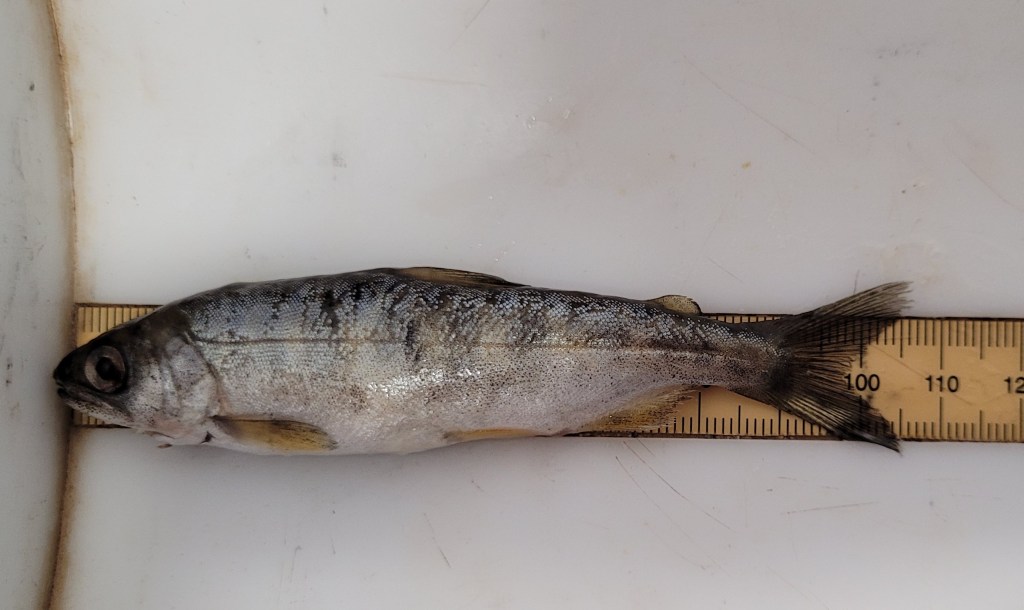
On 27 September 2021, while conducting an CV spring-run spawner survey (redd survey) in upper Deer Creek approximately 1.2 km downstream of Lower Deer Creek Falls (40⁰10’05” N, 121⁰34’52” W), I recovered and examined one sexually mature juvenile CV spring-run carcass (Fig. 1). The juvenile male carcass was found in the tail-out of a pool adjacent to a freshly excavated redd. A post-spawn adult female CV spring-run carcass was observed in the same pool. These were the only two CV spring-run observed in this pool. The juvenile male specimen was approximately 99 mm fork length, typical for a sub-yearling parr. Based on the location (upper Deer Creek canyon) during the time of the survey, it is assumed that 99mm Chinook parr was progeny of brood-year 2020 and had lived for approximately six to nine months in Deer Creek before sexual maturation. The juvenile male CV spring-run appeared to have died of natural causes and produced milt during examination of the body.
Cordoleani et al. (2021) suggest that uncommon phenotypes and behaviors may serve a heighted role for species imperiled by rapid warming. This research determined that yearling or late outmigrants, which make up a relatively small portion of the juvenile population have an outsized contribution to adult returns. Precocious sexual maturity of juvenile male CV spring-run provide a new and interesting component to current population monitoring and assessment of CV spring-run in Deer Creek. CV spring-run adult spawning escapement estimated annual total population has averaged 311 (40–708) since 2008 (Table 1). An estimated 282 adult spring-run spawned in Deer Creek in 2021.
Table 1. Estimated annual Central Valley spring-run spawner escapement in Deer Creek from 2008 to 2021 (Azat 2022).
| Year | Spring-run Chinook Escapement |
| 2008 | 140 |
| 2009 | 213 |
| 2010 | 262 |
| 2011 | 271 |
| 2012 | 734 |
| 2013 | 708 |
| 2014 | 641 |
| 2015 | 99 |
| 2016 | 268 |
| 2017 | 219 |
| 2018 | 104 |
| 2019 | 373 |
| 2020 | 40 |
| 2021 | 282* |
*Estimate for 2021 was generated using ground based redd survey expansion. Estimates for all other years were generated using adult holding snorkel survey.
Very little underwater observational data exists regarding spring-run spawning behavior in Deer Creek. However, observations of precocious male salmon parr in tributaries to the Salmon River, Idaho, made by Gebhards (1959) noted that adult males may be frequently away from the female during the periods in which she lays her eggs and covers them. While the precocious male salmon parr are in constant attendance, they may play an important role in fertilization of eggs. Further study is needed to understand the how significant this life history is to the annual spawning population.
CV spring-run in Deer Creek have been recognized as having a diverse range of life histories (Goertler 2020). Recognition of the existence precocious juvenile males may help better understand complex dynamics and population diversity of CV spring-run. It also presents challenges to current management efforts and monitoring strategies aimed at recovering spring-run in Deer Creek and elsewhere in the Central Valley. It is difficult to find the carcasses of post-spawned parr during standard ground-based spawner surveys, and sub-adult salmon that have not migrated out of freshwater cannot be counted passing weirs or fish ladders. This makes it very difficult to account for the contribution to the annual spawning population using standard survey methods. As noted above, unlike adult salmon, precociously mature male juvenile Chinook Salmon do not always die after spawning. The fact that the majority of precociously mature males do not die after spawning makes it even more challenging to determine the contribution of this life history on population level using conventional monitoring methods.
Acknowledgments
We thank the Fisheries staff at California Department of Fish and Wildlife Northern Region Interior Fisheries Program, and the field staff at the Red Bluff Fisheries Office (Pacific States Marine Fisheries Commission) for making these monitoring efforts possible. We also thank F. Cordoleani for her passion for spring-run, and the staff at National Oceanic and Atmospheric Administration Southwest Fisheries Science Center for their help and support over the years. Finally, our thanks to B. Harvey and P. Nelson at California Department of Water Resources, for their interest in this topic, which was the genesis of this report.
Literature Cited
- Azat, J. 2022. GrandTab 2022.07.20. California Central Valley Chinook Population Database Report. California Department of Fish and Wildlife, Sacramento, CA, USA. Available from: http://www.calfish.org/ProgramsData/Species/CDFWAnadromousResourceAssessment.aspx
- Cordoleani, F., C. Phillis, A. Sturrock, A. FitzGerald, A. Malkassian, G. Whitman, P. Weber, and R. Johnson. 2021. Threatened salmon rely on a rare life history strategy in a warming landscape. Nature Climate Change 11:982–988.
- Gebhards, S. 1959. Biological notes on precocious male Chinook salmon parr in the Salmon River drainage, Idaho. The Progressive Fish Culturist 7(92):121–123.
- Goertler, P. A., F. Cordoleani, J. Notch, R. Johnson, and G. Singer. 2020. Life history variation in Central Valley spring-run Chinook. Delta Stewardship Council, Sacramento, CA, USA. Available from: https://deltacouncil.ca.gov/pdf/science-program/fact-sheets/2020-10-06-life-history-variation-chinook-salmon.pdf
- Johnson, R. C., and S. Lindley. 2016. Central Valley recovery domain. Pages 83–108 in T. H. Williams, B. C. Spence, D. A. Boughton, R. C. Johnson, L. G. Crozier, N. J. Mantua, M. R. O’Farrell, and S. T. Lindley, editors. Viability Assessment for Pacific Salmon and Steelhead Listed under the Endangered Species Act: Southwest. U.S. Department of Commerce, NOAA Technical Memorandum NMFS-SWFSC-564. National Oceanic and Atmospheric Administration, Seattle WA, USA. Available from: https://repository.library.noaa.gov/view/noaa/3139
- National Marine Fisheries Service (NMFS). 2014. Recovery plan for the evolutionary significant units of Sacramento River winter-run Chinook salmon and Central Valley spring-run Chinook salmon, and the distinct population segment of Central Valley steelhead. Sacramento Protected Resources Division, Sacramento, CA, USA.
- Robertson, O. H. 1957. Survival of precociously mature king salmon male parr (Oncorhynchus tshawytscha), juveniles after spawning. California Fish and Game 43:119–130.
- Rutter, C. 1904. Natural history of the Quinnat salmon: a report on investigations in the Sacramento River, 1896–1901. Bulletin United States Fish Commission. Kessinger Publishing, LLC, Whitefish, MT, USA.