

FULL RESEARCH ARTICLE
Daniel A. Airola1*, James Jones2, Shannon Skalos3, Charles Hunter2, James A. Estep4, Richard Williams5, and Kathy Kayner6
1 Conservation and Research Planning, Sacramento, CA 95864, USA https://orcid.org/0000-0001-6725-4230
2 East Bay Municipal Utility District, 1 Winemaster Way, Lodi, CA 95240, USA
3 California Department of Fish and Wildlife, Wildlife Branch, 1010 Riverside Parkway, West Sacramento, CA 95605, USA https://orcid.org/0000-0003-1229-8580
4 Estep Environmental Consulting, 3202 Spinning Rod Way, Sacramento, CA 95833, USA
5 Independent Researcher, El Dorado Hills, CA 95762, USA
6 Independent Researcher, Sacramento, CA 95816, USA
*Corresponding Author: d.aiola@sbcglobal.net
Published 23 March 2025 • doi.org/10.51492/cfwj.111.3
Abstract
Over much of its range, the bald eagle (Haliaeetus leucocephalus) has substantially recovered from declines in the mid–late 1900s, which resulted from habitat loss, human persecution and disturbance, and contamination by the pesticide DDT. The species remains listed as endangered under the California Endangered Species Act (CESA). The species’ distribution, abundance, reproductive success, and habitat requirements have received little attention in recent years, perhaps because of a widespread belief that the bald eagle population is healthy in California. We evaluated the status of the bald eagle in the central part of interior California by conducting surveys, largely from publicly accessible roads near water bodies, and by accumulating records collected by others from 2011 through 2024. We estimate that the known bald eagle population in this region increased by annual average of 19% from four known nesting pairs in 2011 to 31 pairs in 2024. We documented 189 nesting attempts, of which 133 were adequately monitored over the whole nesting season. Seventy-seven percent of nesting attempts successfully fledged young, and productivity averaged 1.29 young/occupied nesting territory, both of which are consistent with a sustainable and increasing population. Eagles in this region constructed their nests in a variety of tree species, with the largest proportions in gray pine (Pinus sabiniana; 73%)and Fremont cottonwood (Populus fremontii; 15%), both of which were used infrequently as nest trees in California during the 1970s and 1980s. Nests were constructed at an average of 0.36 km from water bodies suitable for foraging, and most were away from roads and individual residences (x̄ > 1 km), denser development (x̄ > 4.0 km), and other potential sources of human disturbance (other than water-based recreational use). The population increase we documented, despite continued potential threats from climate-induced wildfire, human disturbance, electrocution, and lead and rodenticide poisoning, suggests a need for bald eagle surveys and status evaluations elsewhere in California to determine if delisting under CESA may be warranted.
Key words: bald eagle, Haliaeetus leucocephalus, habitat, population, reproductive success, status
| Citation: Airola, D. A., J. Jones, S. Skalos, C. Hunter, J. A. Estep, R. Willimas, and K. Kaynor. 2025. Bald eagle population increase, reproductive success, and nesting habitat in central interior California. California Fish and Wildlife Journal 111:e3. |
| Editor: Katherine Mille, Wildlife Branch |
| Submitted: 7 August 2024; Accepted: 9 October 2024 |
| Copyright: ©2025, Airola et al. This is an open access article and is considered public domain. Users have the right to read, download, copy, distribute, print, search, or link to the full texts of articles in this journal, crawl them for indexing, pass them as data to software, or use them for any other lawful purpose, provided the authors and the California Department of Fish and Wildlife are acknowledged. |
| Competing Interests: The authors have not declared any competing interests. |
Introduction
Historically, the bald eagle (Haliaeetus leucocephalus) bred throughout much of California, nesting in at least 26 counties, but declined in numbers and geographic range because of persecution, habitat destruction, introduction and use of DDT, and lead poisoning (Kiff 1980; Detrich 1985; USFWS 1986). Despite legal protection following passage of the Bald Eagle Protection Act in the 1940s, which banned direct killing of eagles, declines in numbers continued in much of California over the 1950s to 1970s. It was evident that “a major catastrophe had struck California’s bald eagles” during this period, although the details and progress of the decline could “only be inferred from the scanty records of the period” (Detrich 1985).
By the late 1960s and early 1970s, the bald eagle no longer nested in central California and the remaining breeding population was “confined to the interior mountains of the northern one-third of the state” (Detrich 1985). The statewide nesting population then consisted of only 26 pairs concentrated in eight forested northern California counties (Thelander 1973; Detrich 1985). All nests were in ponderosa pine (Pinus ponderosa) and mixed-conifer forests, with nests mainly constructed in ponderosa pines (71%), sugar pines (P. lambertiana; 16%), incense cedars (Calocedrus decurrens; 5%) and the remaining 8% in five different montane conifer species (Lehman 1979; Lehman et al. 1980).
Following conclusive evidence linking DDT accumulation to eggshell thinning and reproductive failure (Ratcliffe 1967; Hickey and Anderson 1968), the bald eagle was listed in 1967 as endangered under the federal Endangered Species Preservation Act within the southern two-thirds of the U.S. and then was listed in 1975 under the federal Endangered Species Act as threatened or endangered within all of the lower 48 states. The southern bald eagle (H. l. leucocephalus) was listed under the California Endangered Species Act (CESA) in 1971. DDT was banned for use in the U.S. in 1972, and populations began to recover (Grier 1982; Beuhler 2022). Subsequently, intensified survey efforts began to detect more nests in California, including some that had been established within areas that clearly had been previously unoccupied, totaling 65 known territories in nine counties by 1985 (Lehman 1983; Detrich 1985). Still, during this period, virtually all nests were in large conifers within ponderosa pine and mixed-conifer forests.
The Recovery Plan for the Pacific population of the bald eagle identified recovery targets within the western U.S. (USFWS 1986). Goals established to guide and measure population recovery included: a minimum of 800 breeding pairs, >65% nesting success, average annual productivity of at least 1 young per active breeding pair, breeding population goals met for at least 80% of management zones, and no decline in major winter concentrations. In 2007, the species met these goals and was delisted federally in the entire U.S. based on a substantial population increase that exceeded goals established in each of the five regional recovery plans (Federal Register 72 FR 37346).
Despite a substantial increase in the California nesting population over 1970 through 1990 (Jurek 1990) and subsequently (Sorenson et al. 2017; https://wildlife.ca.gov/Conservation/Birds/Bald-Eagle), the bald eagle remains listed as Endangered in California under CESA. The California Department of Fish and Wildlife (CDFW) recently noted that “population estimates are lacking” and “continued monitoring is essential to determine the trend for bald eagles” (https://wildlife.ca.gov/Conservation/Birds/Bald-Eagle).
Although bald eagles are believed to have nested historically along rivers in the Central Valley and surrounding foothills, few records exist (Detrich 1985). Several early records document bald eagles nesting within the central portion of the Central Valley, including the lower Sacramento River, Sacramento-San Joaquin Delta, and foothills of the Sierra Nevada (Detrich (1985). A nest was reported on the Sacramento River near Sacramento in 1849 (Heerman 1857). The next known nests from this region were one at Don Pedro Reservoir, Tuolumne County, in 1935 and a possible nest at Hogan Reservoir, Calaveras County in 1954 (Detrich 1985). A nest was observed on the north side of Camanche Reservoir, Amador County, in the late 1960s (Detrich 1985). Jurek (1990), however, reported no occupied nesting territories over 1970–1990 in the Central Valley or surrounding foothills south of Butte County.
Our central interior California study area partially overlaps with two regions identified in the Pacific Bald Eagle Recovery Plan (USFWS 1986): the lower elevation portion of the Sierra Nevada region and the northern portion of the plan’s San Joaquin Valley region (which also includes the Sacramento-San Joaquin Valley and southern Sacramento Valley). The recovery plan reported that no bald eagle pairs nested in these regions as of 1985 and set goals of 15 breeding pairs in the entire Sierra Nevada region and none in the San Joaquin Valley region. Within our study area, the plan (Appendix 1 p. 138 of recovery plan) identified the number of “target recovery territories” as four for Camanche/New Hogan Reservoir area and none for any other areas (see Study Area for list of reservoirs). Thus, it is evident that the recovery plan authors did not expect colonization of areas along rivers in the Central Valley or most reservoirs in the Sierra Nevada foothills.
The bald eagle breeding population has expanded more recently in California, with 108 known nesting territories known within 28 counties in 1990 (Jurek 1990) and 375 known territories in 41 counties by 2016 (https://wildlife.ca.gov/Conservation/Birds/Bald-Eagle, https://nrm.dfg.ca.gov/FileHandler.ashx?DocumentID=112187&inline). Thus, although the California population shows signs of recovering, few studies have assessed recent regional or statewide population status. Airola (2007) documented a 3% average annual rate of increase in a long-established local population in the northern Sierra Nevada over 1998–2006. Sorenson et al. (2017) documented recovery over 1992–2012 of the bald eagle population in central coastal California, which was augmented by a captive propagation program, with an average annual increase of 18%. Pandolfino et al. (2021) reported colonization of Sacramento County, within our study area, between the periods 1988–1993 and 2016–2020.
The first bald eagle nests found in decades outside of the northernmost California counties were in the early 1980s in a California sycamore (Plantanus racemosa) along the upper Sacramento River, Shasta County, and in a gray pine (Pinus sabiniana) in lower elevation foothill woodland at Stony Gorge Reservoir, Glenn County. Detrich (1985) suggested that many unoccupied areas along lowland rivers and at reservoirs had potential to support nesting bald eagles and that acceptance of gray pines for nesting “…could be a key in continued re-expansion of the bald eagle nesting population.”
Here, we document range expansion, population increase, reproductive success, and nesting habitat characteristics in the interior part of Central California based on nesting territories reported over 2011–2024. We use this information to assess the status of the bald eagle population in this region to contribute to a fuller understanding of the species’ statewide status and the appropriate level of protection and management. This information is important as a baseline, considering the wide range of ongoing and emerging potential threats to the species, including habitat loss and human disturbance, collisions with vehicles and wind turbines, electrocution, exposure to lead and rodenticides, and infectious diseases (Kagan 2021; Niedringhaus et al. 2021; Slabe et al. 2022; Nemeth et al. 2023).
Methods
Study Area
We evaluated bald eagle breeding status in the Sierra Nevada foothills (i.e., below the conifer-forest belts at <700 m elevation) and the Central Valley (hereafter central interior California). The study area extended from eastern Yolo and western Sutter counties in the north to northern Tuolumne County in the south (Fig. 1) where we simultaneously conducted surveys and monitoring of Ospreys (Pandion haliaetus; Airola and Estep 2024). Major focal survey areas encompassed lands along the Sacramento, lower American, and Cosumnes rivers, the Sacramento Ship Channel, and Prospect Slough within Sutter, Yolo, Sacramento, and Solano counties, and lands surrounding reservoirs in the Sierra Nevada foothills in Placer, Sacramento, El Dorado, Amador, Calaveras, and Tuolumne counties, including Lake Natoma, Folsom Reservoir, Lake Clementia, Pardee Reservoir, Camanche Reservoir, New Hogan Reservoir, Ross Reservoir, Salt Springs Valley Reservoir, New Melones Reservoir, and Tulloch Reservoir (Fig. 1). Most of these reservoirs were constructed or expanded between 1955–1979 (except Salt Springs Valley [built in 1880], Ross [1896], and Pardee [1929]) to store runoff for flood control, irrigation, and domestic and industrial water supply, hydropower generation, and recreational use.
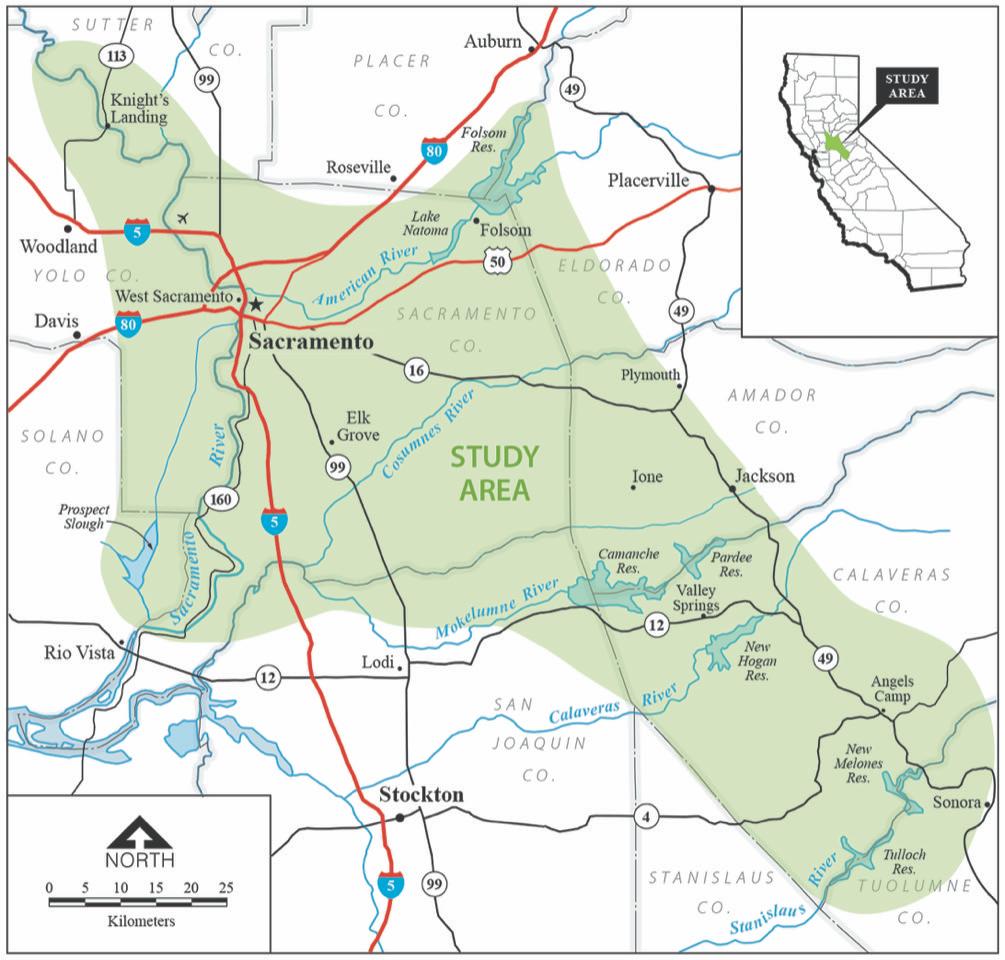
Much of the study area other than immediately than around major reservoirs is privately owned, which restricted our access to public these areas and others visible from public roads. The climate is Mediterranean, with temperatures varying over the 1–500 m elevation range of nests within the study area. Generally, temperatures may regularly drop below freezing at night during the early portion of the nesting season (January) and may regularly exceed 30oCduring thelatter portion of the nesting season (June). Vegetation was mostly dominated by oak-gray pine woodland, chaparral, annual grassland, and open water in the foothills and by agriculture, managed wetland, and development at lower elevations.
Data Collection and Analysis
We combined bald eagle nest monitoring data that we collected from 2011 through 2024 with that we obtained from others for this period including the California Department of Parks and Recreation, East Bay Municipal Utility District, U.S. Bureau of Reclamation, and those who monitored individual nests (see Acknowledgments). We acquired records from CDFW’s California Natural Diversity Database (CNDDB) and bald eagle database (which accumulates monitoring reports conducted under its three-visit monitoring guidelines; CDFW 2017), eBird (ebird.org), agency records, individual monitors, and our own observations. Observations were derived from years of driving roads in this region searching for bald eagles, ospreys (Pandion haliaetus), and tricolored blackbirds (Ageliaus tricolor; Airola et al. 2023, Airola and Estep 2024) and from annual eagle wintering and breeding surveys and incidental to management activities conducting by resource managers on and around major reservoirs (Folsom, Pardee, Camanche, and New Melones). In 2024, we undertook substantial efforts to identify potential nesting sites, reach out to individuals who were independently monitoring eagle nests, and conduct protocol-level (i.e., full season) surveys at all known nest sites. We and collaborators surveyed most nests sites from the ground and in a few cases from boats using binoculars and spotting scopes.
We use standard methods and terminology to characterize nest territories and reproductive success (Postupalsky 1974; Steenhof 1987; USFWS 2009; Brown et al. 2013). A nest territory is a location with a pair of birds and a nest site, which may include multiple nearby nests used in different years. Occupied territories are those in which a pair of eagles was present, or any subsequent reproductive activity was observed. A successful nest is one in which at least one young fledged (i.e., achieved >80% of adult size, or Stage 3d of Carpenter 1990), and productivity refers to the number of young produced per occupied nest.
We estimated the number of occupied territories each year by counting those at which eagles were present. Coverage of some territories was incomplete in some years. Therefore, in determining the number of territories occupied each year, we included those that were unmonitored in years between years when they were reported occupied (Fig. 2). We consider this treatment reasonable, because it was most likely that sites with long-term occupancy were occupied during unmonitored periods rather than abandoned and later recolonized. We also separately identified territories that were found in previously surveyed areas (“new nests”), and those whose year of establishment was uncertain. We calculated an estimated average annual rate of nesting population increase over 2011–2024 using the numbers of occupied and presumed-occupied territories to calculate an annual rate of population increase over each year from 2011–2024 and averaged these values to determine an average annual population increase.

In assessing nesting success and productivity, we included data only from reports of nesting pairs located prior to or during early incubation and then throughout the nesting period (“adequately monitored) to avoid excluding pairs that may have failed before they were detected (Brown et al. 2013). All territories included in reproductive success assessments were monitored at least three times in each year, consistent with CDFW’s (2017) three-visit survey guidelines. In 2024, we visited nest sites an average of 6 (+2.7 SD) times.
Eagle pairs in their first breeding year are typically less successful and productive than older pairs. As a result, a high proportion of new pairs in an expanding population can decrease measures of overall productivity and create a misleading indication of population health (Wittig et al. 2024). We identified pairs that were in their first breeding season where we were confident that they had not nested within the territory previously. We determined that a territory was established in a given year based on a pair’s presence at a highly visible nest after years in which repeated surveys of the area and its surroundings had been made during wintering eagle surveys (when resident birds would be attending nests), regular boat and land surveys for breeding eagles, first observation of nesting birds by birders or landowners at sites that had been frequently and consistently visited in past years, and observation of 4-year olds (identified by plumage) building nests, but not egg-laying, late in the year prior to when breeding was first observed. (See Appendix 1 (PDF) for documentation of the basis by which we identified territories where eagles were in their first nesting season). We compared the productivity of eagle pairs in their first breeding season to that of older pairs to determine its potential effect on overall productivity of the population.
We identified the condition of nest trees (live, live with dead section at nest sites, and snag) for 25 nests where we recorded the status at the time of use. Thus, some formerly used nest trees that were snags in 2024 were not included if we did not know they were snags when they were first used. We identified minimally suitable aquatic foraging habitat as water bodies >2 ha in size, based on our observation of use in the study year and prior years. We measured distances of nests to aquatic foraging habitat from Google Earth (https://www.google.com/earth). To evaluate potential effects of human disturbance on nest site selection, we measured distances from nests to three disturbance indicators as previously used by Airola (2007): the nearest regularly used paved road (”road”), the nearest human residence or business (“residence”), and the nearest residential or commercial community with >20 dwelling units with lots < 0.4 ha (“development”). Other than distance from shoreline, we did not have information to evaluate potential human disturbance by boating and shoreline activities.
Results
Population Growth
Eagles nested at a variety of situations, including 11 different reservoirs, along the Sacramento, American, and Cosumnes rivers; and along the Sacramento Ship Channel and adjacent managed wetlands in the Yolo Bypass and in Prospect Slough (Fig. 1). Four nests were known in 2011 (Fig. 2). We documented with confidence the year of nest territory establishment for 10 territories, while others were likely discovered within several years of their establishment. Over this period the number of known bald eagle territories is estimated to have increased by nearly seven times (675%) from 4 in 2011 to 31 in 2024, or by an estimated average annual increase of 19% per year (Fig. 2).
Nesting Success and Productivity
We documented 189 nesting attempts over the 14-year period. Of 133 nesting attempts monitored adequately, 103 (77%) were successful, and productivity averaged 1.29 young per occupied nest (Table 1). Annual success ranged from 33% to 86%, and productivity ranged from 0.67 to 1.43, but success was >74% and productivity >1.07 for all years since 2019, during which at least 10 pairs were monitored.
Table 1. Nesting success and productivity of bald eagle pairs in central interior California 2011–2024.
| Year | Total Known Nests | No. Nests Adequately Monitored | Number Successful | Young Fledged | % Nests Successful | Young Fledged/ Occupied Nest |
| 2011 | 4 | 4 | 3 | 8 | 75% | 2.00 |
| 2012 | 5 | 2 | 2 | 2 | 100% | 1.00 |
| 2013 | 4 | 2 | 2 | 3 | 100% | 1.50 |
| 2014 | 6 | 2 | 2 | 3 | 100% | 1.50 |
| 2015 | 10 | 3 | 1 | 2 | 33% | 0.67 |
| 2016 | 9 | 4 | 2 | 4 | 50% | 1.00 |
| 2017 | 11 | 5 | 4 | 7 | 80% | 1.40 |
| 2018 | 11 | 7 | 4 | 9 | 57% | 1.29 |
| 2019 | 17 | 13 | 11 | 17 | 85% | 1.31 |
| 2020 | 14 | 10 | 8 | 11 | 80% | 1.10 |
| 2021 | 20 | 14 | 11 | 15 | 79% | 1.07 |
| 2022 | 19 | 14 | 12 | 20 | 86% | 1.43 |
| 2023 | 28 | 23 | 17 | 30 | 74% | 1.30 |
| 2024 | 31 | 31 | 24 | 40 | 77% | 1.29 |
| Total | 189 | 133 | 103 | 171 | — | — |
| Average | — | — | — | — | 77% | 1.29 |
Only 10 territories were monitored adequately during their known first year of establishment (8% of all nesting attempts, although an additional 11 nests may have been monitored during their first year of nesting). Success of these known first-year pairs was lower than success for pairs known to have nested previously (40% vs. 81%; χ21 =9.08, P = 0.003, N = 10 and 113 nesting attempts,). Similarly, productivity of first year nesting pairs was lower than of previously nesting pairs (0.60 vs 1.34 young fledged /occupied nest; χ22 = 7.62 P = 0.022).
Nesting Habitat
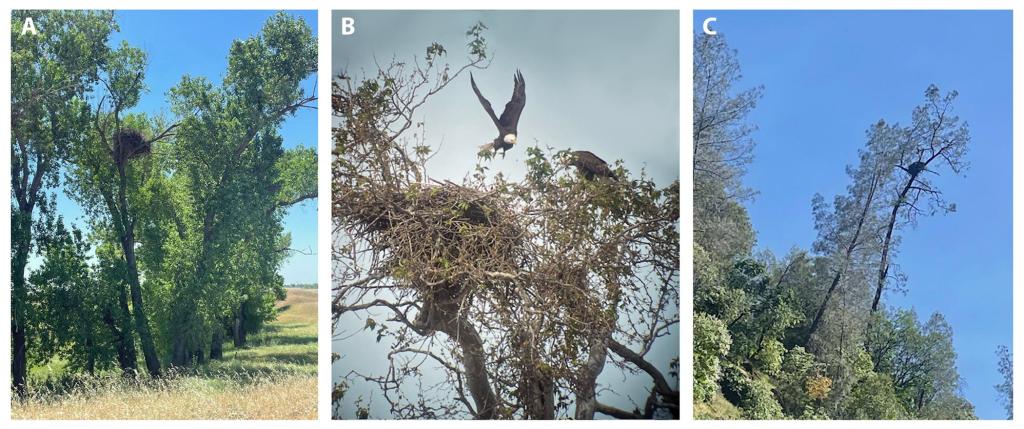
Eagles used a variety of tree species as nest sites. The 41 nest trees for which the species was known included gray pine (73%), Fremont cottonwood (15%), ponderosa pine (7%), western sycamore (2%), and coast redwood (Sequoia sempervirens; 2%). Nearly all trees were large, dominant, and live trees with a multi-branch structure supporting the nest and partial canopy that shaded the nest (Fig. 3), Only 3 (12%) of 25 nest trees examined were in dead portions of a live trees, and one in a dead tree (4%), although the dead tree was likely alive when initially selected as a nest tree and then continued to be used after it died.
The 40 bald eagle nests with specific known locations (out of 47 total known nests) were mainly close to large water bodies (Table 2, Fig. 1), primarily large reservoirs (surface area = 200–5,000 ha), rivers, or wetland areas, but a few nests were in areas lacking large water bodies but with smaller ponds (<35 ha). Nest distance from a waterbody >2 ha in area averaged 0.36 km; 16 nests (40%) were within 0.1 km of a waterbody, 21 (52%) were >0.1 to 1.0 k, and only three (8%) were >1.0 km away.
Eagle nests occurred at varied distances from the nearest paved road (x̄ = 1.19 km) and residence (x̄ = 1.20 km; Table 2). Only four nests (10%) were <0.1 km from a paved road and three were <1 km from a residence. Nests tended to be farther from development (x̄ = 4.21 km) than from roads and individual residences, with only two nests within 0.3 km of a developed area.
Table 2. Distances (km) of 40 bald eagle nests to the nearest water body considered suitable for foraging (i.e., >2 ha) and to potential sources of human disturbance in central interior California.
| Statistic | Distance to Water | Distance to Paved Road | Distance to Residence | Distance to Developmenta |
| Average (SD) | 0.37 (0.8) | 1.19 (1.2) | 1.20 (0.8) | 4.21 (3.4) |
| Range | 0.01–5.24 | 0.01–4.98 | 0.01–3.37 | 0.00–12.4 |
a residential or commercial community with >20 dwelling units with lots < 0.4 ha
Discussion
Population Growth and Reproductive Success
We likely did not locate all the nesting bald eagles in our region, but our results nonetheless confirm the general reports (https://wildlife.ca.gov/Conservation/Birds/Bald-Eagle) and local evidence (Pandolfino et al. 2021) indicating that the bald eagle, after being nearly entirely or most eliminated in central interior California, has recently expanded its range and increased its population to reoccupy the area and colonize newly available reservoir habitat. The substantial increase in the known nesting population, recent continued addition of new territories, and high recent nesting success and productivity (Table 1; Fig. 2), above the targets for population size, nesting success, and productivity identified in the federal recovery plan (USFWS 1986), all indicate a population that is likely to continue to expand in this region.
The recent establishment of nesting territories in areas where aquatic foraging habitat within 5 km was limited, such as at Ross Reservoir, Calaveras County (31 ha), and Apple Ranch Mitigation Area, Sacramento County (5 ha) may be an indicator that the highest quality habitat may be approaching saturation. Average nesting success (50%, 33%) and productivity (0.50, 0.67) respectively at these two sites over two years of monitoring also has been low, consistent with other studies of effects of food abundance and distance to foraging habitat (Hansen 1987; Gende et al. 1997). Osprey territories established within this same study area where small stock ponds provide the primary foraging habitat also have had lower reproductive success and productivity than territories on larger water bodies (Airola and Estep 2022, 2023, 2024).
The average 19% annual rate of estimated increase of the nesting eagle population we calculated is determined ultimately only by the number of nests present in 2011 (4) and 2024 (31). Thus, delays in identifying nests within this period do not affect the overall rate of increase, because it would inflate the rate in one year and lower it in another and thus balance out one another. The rate of increase is sensitive to the number of nests documented in 2011, but even if the true number were double the four nests that we knew, the rate of increase would still be 10% (calculated using a compounding formula).
The 19% annual increase in the numbers of nesting bald eagles in central interior California since 2011 is consistent with results from the reestablished population in central coastal California (18%; Sorenson et al. 2017), and generally with recovery observed elsewhere since the banning of DDT use (Grier 1982; Saalfeld et al. 2009; Winder and Watkins 2020; Beuhler 2022; Castle et al. 2023). Notably, the expansion of the population to central interior California was not predicted in the species’ recovery plan (USFWS 1986), although others recognized its likelihood (Detrich 1985).
The expansion of the bald eagle breeding range and population into central interior California, presumably from occupied areas to the north, appears to have lagged behind that of the osprey, which was also substantially affected by DDT, persecution, and habitat loss (Henny et al. 1978, 2010). The osprey population increased dramatically in central interior California beginning in the 1990s (Airola and Pandolfino 2022) and has since leveled off, with a modest 4.2% annual increase over 2020-2024 (Airola and Estep 2024). The causes for bald eagle range and population expansion in central interior California likely mirror the factors attributed to the osprey increase in this region (Airola and Estep 2022, 2023; Airola and Pandolfino 2022) and elsewhere in California (Airola and Estep 2024), including banning of DDT, reduced persecution and lead poisoning, and habitat protection and management. The resulting increased reproduction rate and recruitment has then allowed expansion into areas of suitable foraging habitat created by construction of reservoirs on major rivers.
Nesting Habitat
As predicted (Detrich 1985), bald eagles in central interior California have readily adopted a variety of tree species for nesting that were not used in California during the 1970s–1980s. Large gray pines, which typically have multi-branch and open canopy structure (Fig. 3) grow abundantly near many reservoirs, providing many highly suitable nest sites. Gray pine is important to bald eagles in this region because ponderosa pine, one of the other main tree species used for nesting (Lehman 1979; Lehman et al. 1980; Detrich 1985), has a limited distribution, occurring primarily only on cooler north-facing slopes (D. Airola, pers. obs.). Ponderosa pine is becoming less common over time at lower elevations, due to warming climate and increased wildfire extent and intensity (Thorne 2022).
Not surprisingly, bald eagle nests were mostly located near larger waterbodies except for one nest (at Apple Road Mitigation Site) which was located 5.4 km from the nearest waterbody >2.0 ha. Thus, nearly all bald eagle pairs in central interior California appear to be dependent on waterbodies for fish and water bird prey as is typical (Beuhler 2022), rather than on terrestrial prey (e.g., Bove et al. 2024).
Distances from nests to potential sources of disturbance may provide rough indicators of eagle tolerances to human activity in this region. In nearly all cases, the roads, residences, and development closest to nests were present before eagles selected their nest sites. The nest distances to these disturbance sources tended to be higher than found in some other studies (see references in Buehler [2022]) and most nests were further than the 200-m buffer distance prescribed for human activities near nests in the National Bald Eagle Management Guidelines (USFWS 2007). Eighty-three percent of nests were >200 m from roads, 88% were >200 m from residences, and 95%, were >200 m from development. This pattern may suggest that this new population has not developed tolerance for human activity observed elsewhere where populations have been breeding for a longer period and human density is higher (Airola 2007; Goulet et al. 2021; Gedir et al. 2023), or that they are selecting areas away from disturbance during this initial colonization period.
Without further analysis of patterns and proportion of roads and residences in the study area, however, we cannot exclude the possibility that the distances to sources of disturbance to nests that we observed may simply reflect the rural character of most of the study area rather than active selection by eagles of areas away from disturbance. Our assessment also did not directly measure reactions of eagles to the disturbance sources we identified, nor the effects of on-water and shoreline recreation, which is intense, but not quantified, at some of the occupied reservoirs.
Potential for Interactions with Ospreys
The osprey’s greater tolerance for nesting in areas near roads and human development and their predominant use of roadside utility poles for nesting (Airola and Estep 2022) may reduce direct and resource-based interspecific competition at reservoirs where they co-occur. The increase in the nesting bald eagle population has potential to affect the reestablished osprey population in this region. Bald eagles and ospreys are widely known to compete for food and space (Ogden 1975; Cruz et al. 2019). For example, the establishment of nesting eagles at Kent Lake, Marin County, California contributed to a decline in the osprey population there (Evens and Brake 2022).
We observed few direct encounters between the species, consisting of eagles attempting to steal prey from ospreys or ospreys vocalizing and diving at eagles establishing a new nest near their nest. Osprey populations also are continuing to increase in central interior California, although at a lower rate than the bald eagle (i.e. average annual rate of 4.8% over 2000–2024 [Airola and Estep 2024] versus 19% for bald eagles over 2011–2024), suggesting that space is still available to accommodate growth in both species.
Eagles generally tend to nest further from sources of human activity than ospreys (Gerrard et al. 1976) including, in our study area, from roads (x̄ = 1.2 km vs. 0.1 km for ospreys; Airola and Estep 2022). This difference, however, is likely due to the osprey’s predominant use of utility poles for nesting sites in this region, which tend to be located along roads, while all eagle nests were in trees. Eagles, however, have shown an ability to adapt to human disturbance in California (Airola 2007) and elsewhere (Newbrey et al. 2005; Winder and Watkins 2020; Castle et al. 2023), which could increase future conflicts. These dynamics deserve further monitoring.
Management Implications
The increase in the bald eagle population in central interior California, substantially beyond what was predicted in the species Recovery Plan (USFWS 1986), documents recovery of the species in California beyond the one other area in which recent status has been evaluated (Sorenson et al. 2017). Summarizing available data from other regions of the state is warranted to determine if populations elsewhere are also increasing substantially. Documenting this recovery is worthwhile to demonstrate the success of protection efforts under CESA and other protective designations, including the federal Bald and Golden Eagle Protection Act, Migratory Bird Treaty Act, and state Fully Protected Species designation. Such documentation could lead to some relaxation of compliance requirements and resulting restrictions on activities, which the California bald eagle population appears capable of tolerating. Indeed, recent changes to California’s Fully Protected Species and CESA (California Senate Bill 147; https://legiscan.com/CA/text/SB147/id/2833511) recently authorized CDFW to issue incidental take of Fully Protected Species, including bald eagles, when implementing certain infrastructure projects.
Notwithstanding the successful colonization and reproductive success of the bald eagle population in our study area and elsewhere in California, threats and management needs remain, including increased incidence of fire under climate warming, which threatens nesting habitat; local disturbance of nesting pairs by boaters, shoreline recreationists, and photographers; as well as electrocution (Kagan 2021), lead poisoning (Slabe et al. 2022), rodenticides (Niedringhaus et al. 2021) and avian influenza (Nemeth et al. 2023).
Acknowledgments
We thank P. Sanders (U.S. Bureau of Reclamation; New Melones) and B. Boulton (New Melones) and D. Beard and J. Paul (California Department of Parks and Recreation; Folsom Lake) for data on nests at reservoirs. Thanks also to those who contributed information on individual nests, including P. Anderson, M. Eaton, S. Hebrard, D. Kopp, S. Meadows, N. Misikia, J. Myers, M. Scofield, J. Trochet, and D. Wood. We thank K. Spencer, K. Keiser, B. Acord, and M. Gogol-Prokurat at the CNDDB and M. Sullivan at Folsom State Recreation Area for providing access to records. R. Hart, J. Traphagan, and Westervelt Ecological Services provided access to nest sites and H. Sanders assisted with boat surveys. M. Estep prepared the figures. We thank two anonymous reviewers and K. Miller for their useful comments. D. Airola thanks P. Detrich, R. Lehman, and D. Harlow for their key early work on bald eagles in Northern California and for training and mentorship.
Literature Cited
- Airola, D. A. 2007. Bald eagle nesting in relation to human disturbance sources in the Lake Almanor region, California. Transactions of the Western Section of the Wildlife Society 43:19–26
- Airola, D. A., and J. A. Estep. 2022. Habitat use and reproductive success of ospreys in central interior California. California Fish and Wildlife Journal 108:e7. www.doi.org/10.51492/cfwj.108.7
- Airola, D. A., and J. A. Estep. 2023. Osprey reproduction increases in central California with recovery from drought in 2022. Central Valley Birds 26:18–24.
- Airola, D. A., and J. A. Estep. 2024. Osprey population trend and reproductive success over a five-year period in central interior California. Western Birds 55:183–192
- Airola, D. A., J. Harris, C. Conard, L. A. Douglas, and E. C. Beedy. 2023. Breeding population status of the tricolored blackbird in the central foothills of the Sierra Nevada 2014–2021. Central Valley Birds 26:53–68.
- Airola, D. A., and E. R. Pandolfino. 2022. Osprey colonization history and recent breeding and wintering status in the Central Valley, California. Central Valley Birds 25:1–18.
- Bove, D. J., H. A. Anderson, M. A. Smith, and T. A. Kuhn. 2024. Nesting bald eagle population numbers, density, territorial resources, and relationship to human development in northern Colorado’s Front Range. Western Birds 55:2–27. doi.org/10.21199/WB55.1.1
- Brown, J. L., K. Steenhof, M. N. Kochert, and L. Bond. 2013. Estimating raptor nesting success: old and new approaches. Journal of Wildlife Management 77:1067–1074. doi.org/101002/wmg.566
- Buehler, D. A. 2022. Bald Eagle (Haliaeetus leucocephalus). Version 2.0 In: Birds of the World (P. G. Rodenwald and S. G. Mlodinow, editors.). Cornell Lab of Ornithology Ithaca, NY, USA. doi.org/10.2173/bow.baleag.02
- California Department of Fish and Wildlife (CDFW). 2017. Bald Eagle Breeding Survey Instructions. Wildlife Branch, Sacramento, CA, USA.
- Carpenter, G. P. 1990. An illustrated guide for identifying developmental stages of bald eagle nestling in the field. San Francisco Zoological Society, San Francisco, CA, USA.
- Castle, J. R., D. Brown, K Watson, K Slankard, and T. Allen. 2023. Changes in bald eagle nesting distribution and nest-site selection in Kentucky during 1986–2019. Northeastern Naturalist 30:59-74. doi.org/10.1656/045.030.0107
- Cruz, J., S. K. Windels, W. E. Tjogmartin, S. M. Crimmins, L. H. Grim, J. H. Larson, and B. Zuckerberg. 2019. Top-down effect of repatriating Bald Eagles hinder jointly recovering competitors. Journal of Animal Ecology 88:1054–1065. doi.org/10.1111/1365–2656.12990
- Detrich, P. J. 1985. The status and distribution of bald eagle in California. Thesis, California State University, Chico, CA, USA.
- Evens, J., and A. J. Brake. 2022. Osprey shift from nesting in trees to artificial structures in the San Francisco Bay Area, California. Northwestern Naturalist 103:259–262. doi.ogr/10.1898/1051-1733-103.3.259
- Gedir, J. V., B. A. Millsap, P. E. Howell, T. W. Wittig, H. M. White, and E. R. Bjerre. 2023. Nest success of bald eagles exposed to anthropogenic activities in the United States. Journal of Fish and Wildlife Management 14:283–293. doi.org/10.3996/JFWM-23-007
- Gende, S. M., M. F. Wilson, and M. Jacobson. 1997. Reproductive success of bald eagles (Haliaeetus leucocephalus) and its association with habitat or landscape features and weather in southeast Alaska. Canadian Journal of Zoology 75:1595–1604. doi.org/10.1139/z97-786
- Gerrard, J. M., D. W. A. Whitfield, and W. J. Maher. 1976. Osprey-bald eagle relationships in Saskatchewan. Blue Jay 34:240–247.
- Goulet, R., D. M. Bird, and D. Hancock. 2021. Aspects of the ecology of urban-nesting bald eagles (Haliaeetus leucocephalus) in British Columbia. Journal of Raptor Research 55:65–78.
- Grier, J. W. 1982. Ban of DDT and subsequent recovery of reproduction in bald eagles. Science 218:1232–1235. doi.org/10.1126/science.7146905
- Hansen, A. J. 1987. Regulation of bald eagle reproductive rates in southeast Alaska. Ecology 68:1387–1392.
- Heerman, A. L. 1857. Report upon the zoology of the route. Pacific Railroad Surveys 10(4). Available from: https://quod.lib.umich.edu/m/moa/AFK4383.0006.004/95?rgn=full+text&view=image
- Henny, C. J., D. J. Dunaway, R. D. Mallette, and J. R. Koplin. 1978. Osprey distribution, abundance, and status in western North America: 1. The Northern California population. Northwest Science 52:261–270.
- Henny, C. J., R. L. Grove, J. L Kaiser, and B. I. Johnson. 2010. North American osprey populations and contaminants: historic and contemporary perspectives. Journal of Toxicology and Environmental Health, Part B 13:579–603.
- Hickey, J. J., and D. W. Anderson. 1968. Chlorinated hydrocarbons and eggshell changes in raptorial and fish-eating birds. Science 162:271–273. doi.org/10.1126/science.162.3850.271
- Jurek, R. M. 1990. California bald eagle breeding population survey and trend, 1970–90. Nongame Bird and Mammal Section Report 90-03. California Department of Fish and Game, Sacramento, CA, USA.
- Kagan, R. A. 2021. Electrocution of raptors on power lines: a review of necropsy methods and findings. Veterinary Pathology 53:1030–1036. doi.org/10.1177/0300985816646431
- Kiff, L. F. 1980. Historical changes in resident populations of California Island raptors. Pages 651–673 in D. M. Power, editor. The California Islands: Proceedings of a Multidisciplinary Symposium. Santa Barbara Museum of Natural History, Santa Barbara, CA, USA.
- Lehman, R. N. 1979. A survey of selected habitat features of 95 bald eagle nest sites in California. Wildlife Management Branch Administrative Report 79-1. California Department of Fish and Game, Sacramento, CA, USA.
- Lehman, R. N. 1983. Breeding status and management of bald eagles in California – 1981. Wildlife Management Branch Administrative Report 83-1. California Department of Fish and Game, Sacramento, CA, USA.
- Lehman, R. N., D. E. Craigie, P. L. Collins, and R. S. Griffen. 1980. An analysis of habitat requirements and site selection criteria for nesting bald eagles in California. Wilderness Research Institute, Arcata, CA, USA.
- Nemeth, N. M., M. G. Ruder, R. L. Poulson, R. Sargent, S. Breeding, M. N. Evans, J. Zimmerman, R. Hardman, M. Cunningham, S. Gibbs, and D. E. Stallknecht. 2023. Bald eagle mortality and nest failure due to clade 2.3.4.4 highly pathogenic H5N1 influenza, a virus. Scientific Reports 13:191. doi.org/10.1038/s41598-023-27446-1
- Niedringhaus, K. D., M. M. Nemeth, S. Gibbs, J Zimmerman, L. Shender, K. Slankard, H. Fenton, B. Charlie, M. F. Dalton, E. J. Elsmo, R. Poppenga, B. Millsap, and M. G. Ruder. 2021. Anticoagulant rodenticide exposure and toxicosis in bald eagles (Haliaeetus leucocephalus) and golden eagles (Aquila chrysaetos) in the United States. PLOS ONE 16(4):e02461134. doi.org.10.1371/journal.pone.0246134
- Newbrey, J. L., M. A. Bozen, and N. D. Neimuth. 2005. Effects of lake characteristics and human disturbance on the presence of piscivorous birds in northern Wisconsin, USA. Waterbirds 28:478–486. doi.org/10.1675/1524-4695
- Ogden, J. C. 1975. Effects of bald eagle territoriality on nesting ospreys. Wilson Bulletin 87:496–505.
- Pandolfino, E. R., L. A. Douglas, T. D. Manolis, and C. Conard. 2021. Sacramento County Breeding Birds: A Tale of Two Atlases and Three Decades of Change. Special Publication No. 2, Central Valley Bird Club, Davis, CA, USA.
- Postupalsky, S. 1974. Raptor reproductive success: some problems with methods, criteria, and terminology. Pages 21–31 in F. N. Hammerstrom, Jr., B. E. Harrell, and R. R. Olendorff, editors. Raptor Management Techniques. Raptor Research Report No. 2. Raptor Research Foundation, Vermillion, SD, USA.
- Ratcliffe, D. A. 1967. Decrease in eggshell weight in certain birds of prey. Nature 215:208–210.
- Saalfeld, S. T., W. C. Conway, R. Maxey, C. Gregory, and B. Ortego. 2009. Recovery of nesting bald eagles in Texas. Southeastern Naturalist 8:83-92. doi.org/10.1656/058.008.0108
- Slabe, V. A., J. T. Anderson, B. A. Milsap, J. L. Cooper, A. R. Harmata, M. Restani, R. H. Crandall, B. Bodenstein, P. H. Bloom, and 20 others. 2022. Demographic implications of lead poisoning for eagles across North America. Science 375:779–782. doi.org/101126/science.abj3068
- Sorenson, K. J., L. J. Burnett, and M. M. Stake. 2017. Restoring a bald eagle breeding population in central California and monitoring 25 years of regional population growth. Journal of Raptor Research 51:145–152. doi.org/10.3356/JRR-16-35.1
- Steenhof, K. 1987. Assessing raptor reproductive success and productivity. Pages 157–170 in B.G. Pendleton, B. G., B. A, Millsap, K.W. Cline, and D.M Bird, editors. Raptor Management Techniques Manual. National Wildlife Federation, Washington, D.C., USA.
- Thelander, C. 1973. Bald eagle reproduction in California 1972–1973. Wildlife Management Branch Administrative Report 73-5. California Department of Fish and Game, Sacramento, CA, USA.
- Thorne, J. 2022. Ponderosa pine forest retreat. Pages 193–198 in L. Zelse and Y. Garcia, editors. Indicators of Climate Change in California. 4th edition. California Office of Environmental Health Hazard Assessment, California Environmental Protection Agency, Sacramento, CA, USA. https://oehha.ca.gov/media/epic/downloads/ibs_ppfr2018.pdf
- U.S. Fish and Wildlife Service (USFWS). 1986. Pacific Bald Eagle Recovery Plan. Portland, OR, USA.
- U.S. Fish and Wildlife Service (USFWS). 2007. National Bald Eagle Management Guidelines. Washington, D.C., USA. www.fws.gov/sites/default/files/documentes/national-bald-eagle-management-guidelines_0.pdf
- U.S. Fish and Wildlife Service (USFWS). 2009. Post-delisting Monitoring Plan for the Bald Eagle (Haliaeetus leucocephalus) in the contiguous 48 states. Division of Endangered Species and migratory Birds and State Programs, Midwest Regional Office, Twin Cities, MN, USA.
- Winder, V. L., and M. A. Watkins. 2020. Thirty years of bald eagle population recovery and nesting ecology in Kansas, 1989–2019. Journal of Raptor Research 54:255–264. doi.org/10.3356/0892-1016-54.3.255
- Wittig, T. W., O. E. Howell, and K. E. Clark. 2024. Nest construction costs bald eagles time but not breeding success or productivity. Journal of Raptor Research 58:70–84. doi.org/10.3356/JRR22-112