

RESEARCH NOTE
Justin Garwood*, Grace Cunningham, Forest Peri, and Raziel Lederman-Beach
California Department of Fish and Wildlife, Northern Region, 5341 Ericson Way, Arcata, CA 95521, USA https://orcid.org/0009- 0009-7402-3145 (JG)
*Corresponding Author: justin.garwood@wildlife.ca.gov
Published 23 March 2025 • doi.org/10.51492/cfwj.111.2
Key words: fishery impacts, invasive predator, Klamath Mountains, Rana cascadae, Salvelinus fontinalis, Trinity Alps
| Citation: Garwood, J., G. Cunningham, F. Peri, and R. Lederman-Beach. 2025. Brook Trout predation on dispersing Cascades frogs shows invasive fish populations can impact amphibian recruitment from the broader landscape. California Fish and Wildlife Journal 111:e2. |
| Editor: Jennifer Olson, Watershed Restoration Grants Branch |
| Submitted: 27 October 2024; Accepted: 26 November 2024 |
| Copyright: ©2025, Garwood et al. This is an open access article and is considered public domain. Users have the right to read, download, copy, distribute, print, search, or link to the full texts of articles in this journal, crawl them for indexing, pass them as data to software, or use them for any other lawful purpose, provided the authors and the California Department of Fish and Wildlife are acknowledged. |
| Competing Interests: The authors have not declared any competing interests. |
To expand recreational fisheries across the western United States, thousands of formerly fishless mountain lakes were stocked with nonnative salmonids by the 1960s, including over 2,000 mountain lakes in California (Bahls 1992; Pister 2001). Through predation and competition, nonnative salmonids have reshaped ecological communities in these lake ecosystems and are correlated with widespread declines in amphibian abundance and distribution (Bradford 1989; Knapp et al. 2001; Pilliod and Peterson 2001; Kats and Ferrer 2003; Welsh et al. 2006). Despite these apparent amphibian population declines, documentation of direct amphibian predation by invasive salmonid predators in natural habitats is lacking for most species, including the Cascades frog (Rana cascadae).
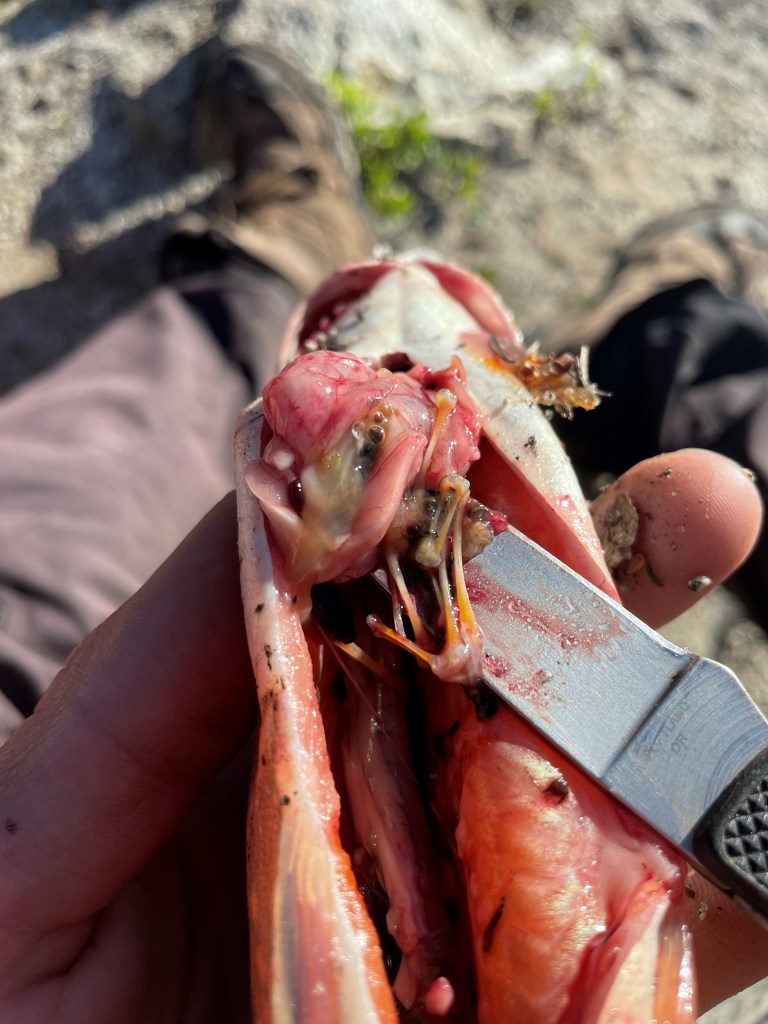
Most direct salmonid predation records on frogs in the western U.S. come from Sierra Nevada yellow-legged frogs (Rana sierrae) (RASI) in the Sierra Nevada, California. Needham and Vestal (1938) describe a 249 mm long nonnative golden trout (Oncorhynchus aguabonita) from a mountain lake with an adult RASI in its stomach. Additionally, they described another adult golden trout swimming with an adult RASI oriented sideways in its mouth. Nonnative rainbow trout (O. mykiss) were also observed consuming adult and juvenile RASI in Sierra Nevada lakes, including one adult RASI dissected from the stomach of an adult rainbow trout (Roland Knapp, pers. comm). Vredenburg (2004) also documented rainbow trout consuming RASItadpoles inside constructed net field enclosures at three Sierra Nevada mountain lakes. Duff (1976) found multiple Anuran (ssp.) tadpoles in a stomach in a Trinity Alps mountain lake that had an abundance of tadpoles along the lake shore. Bradford (1989) described Oncorhynchus (spp.) and Brook Trout (Salvelinus fontinalis) also striking at RASI tadpoles after they were placed in a lake with these nonnative salmonids. Similarly, Grasso et al. (2010) found Brook Trout consumed over 80% of available Pacific chorus frog (Pseudacris regilla) tadpoles during controlled feeding trials. Pilliod (2001) found a nonnative cutthroat trout (O. clarkii ssp.) consumed a Columbia spotted frog (Rana luteiventris) metamorph in an Idaho mountain lake after inspecting the trout’s stomach contents. Lastly, in 2022, we dissected a juvenile Cascades frog from the stomach of an adult Brook Trout that was captured in a monofilament gill net at a Trinity Alps mountain lake (Fig. 1).
To reduce historical impacts of invasive salmonids on aquatic breeding amphibians in the Klamath Mountains (Welsh et al. 2006; Pope 2008), we initiated a restoration program in 2023 to remove Brook Trout from multiple mountain lakes and ponds. We chose restoration waters having high regional conservation value for native aquatic breeding amphibians, while also having marginal angler use. Restoration site 26187 (California Lakes Water ID) is a pond with a depth of 1.95 m and a surface area of 0.43 ha located at 2,158 m elevation in the northern Trinity Alps (41.2143°, –122.7923°), Siskiyou County, CA (Fig. 2A). Between 2023 and 2024, we used monofilament gill nets to remove 668 Brook Trout from site 26187, highlighting a high-density fish population relative to the small size of the pond. On 20 September 2024, we removed 119 Brook Trout from seven gill nets that we deployed the previous evening (example catch in Fig. 2B). While processing the fish, we opportunistically found two recently metamorphosed young-of-the-year Cascades frogs that were deceased in the stomach of an adult Brook Trout measuring 250 mm total length (Fig. 2C).
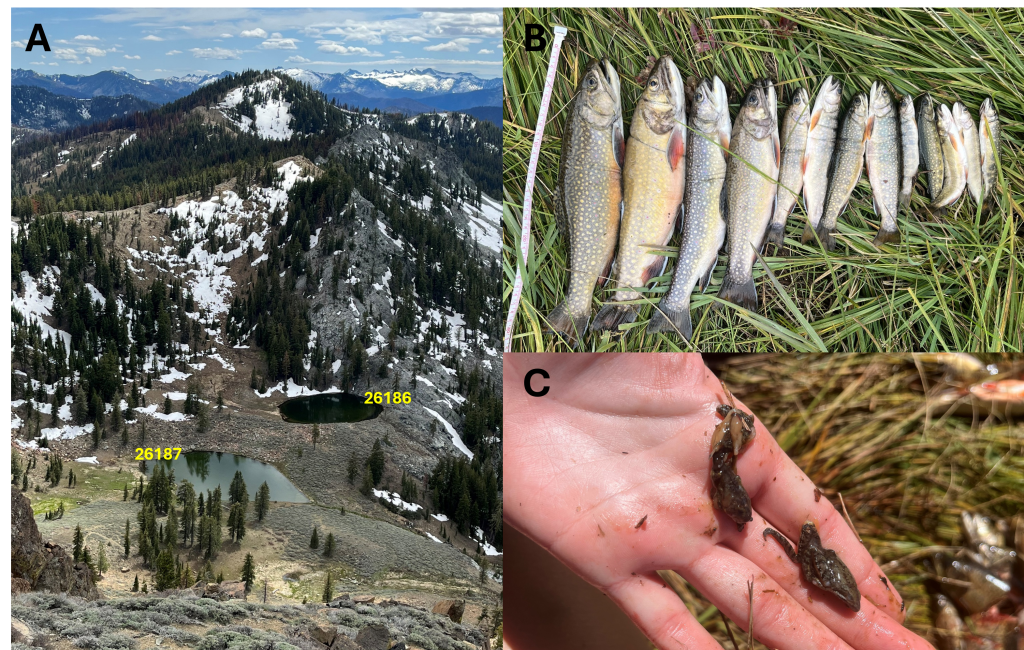
Based on four multi-day restoration trips, and three formal amphibian surveys across the summer of 2024, we did not detect any Cascades frog eggs or tadpoles at site 26187 (Table 1). The nearest fishless Cascades frog breeding pond (site 26186) is located 43 meters west of site 26187 (Fig. 2A, Table 1). The two ponds are at similar elevations in the same drainage but are not connected by streams. With multiple surveys dating back to 2001, pond 26186 has been a reliable breeding location for Cascades frogs while pond 26187 was only used for breeding in one out of the seven survey years (Table 1).
Table 1. Presence (Y) or absence (N) of Cascades frogs, Cascades frog breeding evidence, and Brook Trout during visual encounter surveys results at adjacent ponds in the northern Trinity Alps during seven survey years between 2001 and 2024.
| Site | Year | Cascades Froga | Cascades Frog Breedingb | Brook Trout |
| 26186 | 2001 | Y | Y | N |
| 26186 | 2006 | Y | Y | N |
| 26186 | 2012 | Y | Y | N |
| 26186 | 2021 | Y | Y | N |
| 26186 | 2022 | Y | Y | N |
| 26186 | 2023 | Y | Y | N |
| 26186 | 2024 | Y | Y | N |
| 26187 | 2001 | N | N | Y |
| 26187 | 2006 | Y | N | Y |
| 26187 | 2012 | Y | Y | Y |
| 26187 | 2021 | Y | N | Y |
| 26187 | 2022 | N | N | Y |
| 26187 | 2023 | Y | N | Y |
| 26187 | 2024 | Y | N | Y |
bCascades frog eggs or tadpoles detected at site indicating reproduction
In systems invaded by salmonids, fishless sites are often smaller with less amphibian carrying capacity than larger lakes chosen for fish stocking (Denoèl et al. 2016). Studies have also found that amphibian distributions and abundances are lower at fishless sites in invaded basins relative to fishless basins indicating amphibian population impacts caused by salmonid predators reach beyond the invaded waters (Pilliod and Peterson 2001; Pilliod et al. 2010). Juvenile Cascades frogs are highly aquatic but have high rates of dispersal between separate lake, pond, and meadow habitats in mountain lake basins (Garwood 2009). Our isolated observation of Brook Trout predation on Cascades frogs that had recently emigrated from a separate breeding site shows that invasive salmonids likely influence broader Cascades frog population recruitment and related gene flow through habitat exclusion and additive mortality.
Acknowledgments
We thank David Pilliod and Roland Knapp for providing helpful documentation on invasive trout predation in the western US. We also thank the California Department of Fish and Wildlife’s Northern Region Fisheries Program for funding this project. Sam Plemons provided useful comments that improved this research note.
Literature Cited
- Bahls, P. F. 1992. The status of fish populations and management of high mountain lakes in the western United States. Northwest Science 66:183–193.
- Bradford, D. F. 1989. Allotopic distribution of native frogs and introduced fishes in high Sierra Nevada lakes of California: implication of the negative effect of fish introductions. Copeia 1989:775–778.
- Denoèl, M., P. Scimè, and N. Zambelli. 2016. Newt life after fish introduction: extirpation of paedomorphosis in a mountain fish lake and newt use of satellite pools. Current Zoology 62(1):61–69. https://doi.org/10.1093/cz/zov003
- Duff, C. 1976. Tangle Blue Lake, Trinity County. Unpublished filed note. California Department of Fish and Wildlife, Arcata, CA, USA.
- Garwood, J. 2009. Spatial ecology of the Cascades frog: identifying dispersal, migration, and resource uses at multiple spatial scales. Thesis, Humboldt State University, Arcata, CA, USA.
- Grasso, R. L., R. M. Coleman, and C. Davidson. 2010: Palatability and antipredator response of Yosemite toads (Anaxyrus canorus) to nonnative brook trout (Salvelinus fontinalis) in the Sierra Nevada Mountains of California. Copeia 2010:457–462. https://doi.org/10.1643/CH-09-033
- Kats, L. B., and R. P. Ferrer. 2003. Alien predators and amphibian declines: review of two decades of science and the transition to conservation. Diversity and Distributions 9:99–110. https://doi.org/10.1046/j.1472-4642.2003.00013.x
- Knapp, R., K. Matthews, and O. Sarnelle. 2001. Resistance and resilience of alpine lake fauna to fish introductions. Ecological Monographs 71:401–421. https://doi.org/10.1890/0012-9615(2001)071[0401:RAROAL]2.0.CO;2
- Needham, P. R., and E. H. Vestal. 1938. Notes on growth of golden trout (Salmo aqua-bonita) in two High Sierra lakes. California Fish and Game 24:273–279.
- Pilliod, D. S. 2001. Ecology and conservation of high-elevation amphibian populations in historically fishless watersheds with introduced trout. Dissertation, Idaho State University, Pocatello, ID, USA.
- Pilliod, D. S., and C. R. Peterson. 2001. Local and landscape effects of introduced trout on amphibians in historically fishless watersheds. Ecosystems 4:322–333. https://doi.org/10.1007/s10021-001-0014-3
- Pilliod, D. S., B. R. Hossack, P. F. Bahls, E. L. Bull, P. S. Corn, G. Hokit, B. A. Maxell, J. C. Munger, and A. Wyrick. 2010. Non-native salmonids affect amphibian occupancy at multiple spatial scales. Diversity and Distributions 16:959–974. https://doi.org/10.1111/j.1472-4642.2010.00699.x
- Pister, E. P. 2001. Wilderness fish stocking: history and perspective. Ecosystems 4:279–286. https://doi.org/10.1007/s10021-001-0010-7
- Pope, K. 2008. Assessing changes in amphibian population dynamics following experimental manipulations of introduced fish. Conservation Biology 22:1572–1581. https://doi.org/10.1111/j.1523-1739.2008.00998.x
- Vredenburg, V. T. 2004. Reversing introduced species effects: experimental removal of introduced fish leads to rapid recovery of a declining frog. Proceedings of the National Academy of Sciences 101:764–7650. https://doi.org/10.1073/pnas.0402321101
- Welsh, H., K. Pope, and D. Boiano. 2006. Sub-alpine amphibian distributions related to species palatability to non-native salmonids in the Klamath Mountains of northern California. Diversity and Distributions 12:298–309. https://doi.org/10.1111/j.1366-9516.2006.00254.x