

RESEARCH NOTE
Jordan M. Buxton*, Marissa L. Wulff, Veronica L. Violette, Danielle L. Palm, Matthew J. Young, and Frederick Feyrer
U.S. Geological Survey, California Water Science Center, 3115 Ramco Street, Suite 180, West Sacramento, CA 95691-5761, USA https://orcid.org/0000-0002-7233-0944 (JMB) https://orcid.org/0000-0003-0121-9066 (MLW) https://orcid.org/0000-0002-7390-4655 (VLV) https://orcid.org/0000-0003-3045-5287 (DLP) https://orcid.org/0000-0001-9306-6866 (MJY) https://orcid.org/0000-0003-1253-2349 (FF)
*Corresponding Author: jbuxton@usgs.gov
Published 29 December 2025 • doi.org/10.51492/cfwj.111.20
Key words: Lavinia exilicauda chi, Chi, Clear Lake Hitch, gillnet, Lower Blue Lake, native fish
| Citation: Buxton, J. M., M. L. Wulff, W. L. Violette, D. L. Palm, M. J. Young, and F. Feyrer. 2025. Status of Clear Lake Hitch in Lower Blue Lake, Lake County, California, 2024. California Fish and Wildlife Journal 111:e20. |
| Editor: Travis Apgar, Water Branch |
| Submitted: 18 March 2025; Accepted: 5 May 2025 |
| Copyright: ©2025, Buxton et al. This is an open access article and is considered public domain. Users have the right to read, download, copy, distribute, print, search, or link to the full texts of articles in this journal, crawl them for indexing, pass them as data to software, or use them for any other lawful purpose, provided the authors and the California Department of Fish and Wildlife are acknowledged. |
| Funding: Funding was provided by U.S. Fish and Wildlife Service via Inter-Agency Agreement 4500172951. |
| Competing Interests: The authors have not declared any competing interests. |
Clear Lake Hitch (Lavinia exilicauda chi) is a native minnow found primarily in Clear Lake, Lake County, California that is listed as threatened under the California Endangered Species Act and has been petitioned for listing under the United States Endangered Species Act. Management interest in Clear Lake Hitch originates, in part, from historical accounts which indicate it was formerly highly abundant and an important resource for Native American Tribes (Moyle 2002; CDFW 2014). A variety of factors are thought to have contributed to a substantial decline in Clear Lake Hitch abundance. These factors include the loss and degradation of stream habitat used for spawning and rearing caused by changes in land and water use in the watershed, and the loss and degradation of lacustrine habitat caused by shoreline development, reclamation of wetlands, and broad-scale changes to biological and physio-chemical components of Clear Lake (Moyle 2002; CDFW 2014).
Clear Lake Hitch migrate upstream from Clear Lake into ephemeral streams within the Clear Lake watershed for spawning in spring (Moyle 2002; Feyrer 2019). Although Clear Lake Hitch are present in various perennial waterbodies within the Clear Lake watershed (e.g., Thurston Lake; Ewing 2015e, 2020), our understanding of Clear Lake Hitch distribution is data limited. To better understand the distribution of Clear Lake Hitch within the watershed for improved conservation and management efforts, a study was conducted to determine the distribution of Clear Lake Hitch in Lower Blue Lake, Lake County, California.
Lower Blue Lake is located approximately 10 km northwest of Clear Lake. It is connected to Upper Blue Lake by a creek that is seasonally inundated, and the two lakes collectively are known as the Blue Lakes (Fig. 1). Lower Blue Lake is approximately 1 km long and 0.2 km wide and is intermittently connected to Clear Lake by Scotts Creek in the spring of wet years. Clear Lake originally drained through Cache Creek in the east until a lava flow blocked the drainage and rerouted the outflow westward through the Cold Creek drainage to the Russian River (Mauldin 1968). The Cold Creek drainage was eventually blocked either due to a landslide or the buildup of fluvial debris and the outflow through Cache Creek was restored (Suchanek et al. 2002). The Blue Lakes and Tule Lake are situated between Clear Lake and the Cold Creek drainage and are remnants of this geological history. This hydrological connectivity subsequently facilitated the colonization of the Russian River by Central Valley fish species (Hopkirk 1973, 1988). Lower Blue Lake was previously surveyed for Clear Lake Hitch in 2015 and 2024 (Ewing 2015a; 2025), with no individuals observed. Staff from the Robinson Rancheria Pomo Indians of California rescued Clear Lake Hitch stranded in isolated stream pools and translocated the individuals to Upper Blue Lake from Cooper Creek (n = 295) in 2022 (Santana 2022), and from Scotts Creek (n = 12) and Middle Creek (n = 890) in 2023 (Childers 2023a,b). To our knowledge, there has not been any translocations of Clear Lake Hitch into Lower Blue Lake.
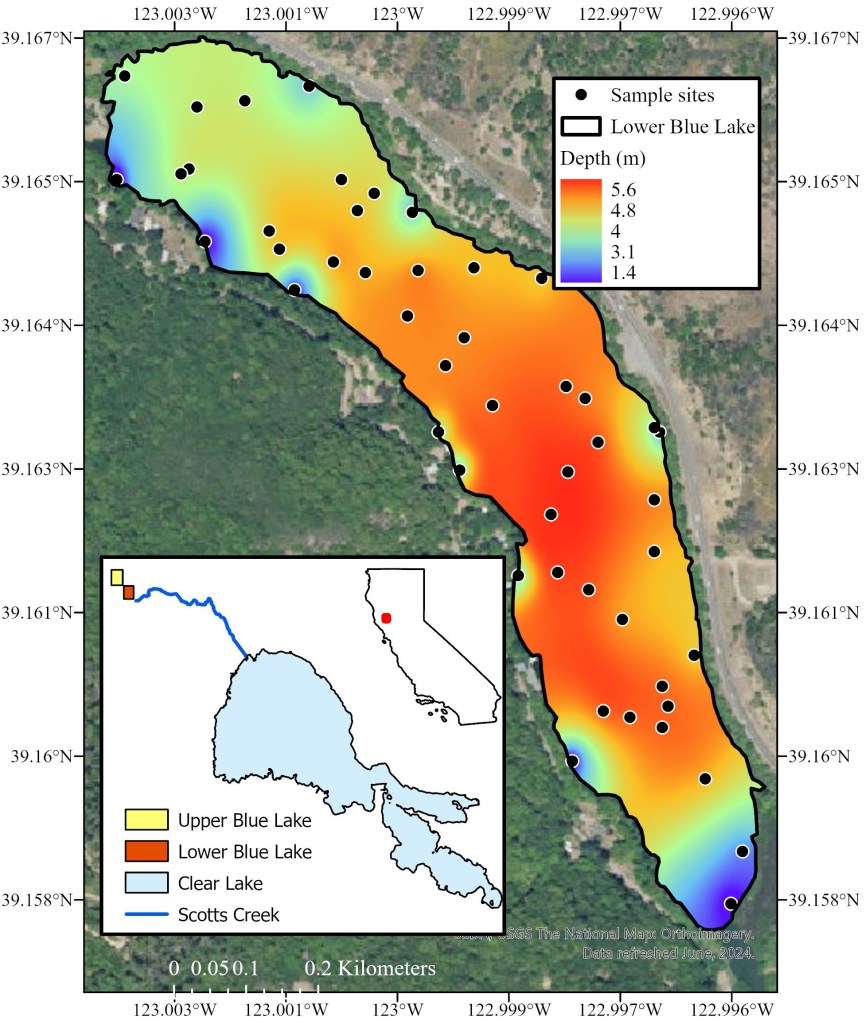
We conducted sampling was conducted from 22–24 October 2024, to determine the distribution of Clear Lake Hitch in Lower Blue Lake. Sampling methods mirrored those used to monitor the Clear Lake Hitch population within Clear Lake (Feyrer et al. 2025). Sampling involved short duration (~ 50 minutes) sets of experimental, multi-mesh monofilament gillnets during daytime hours. The gillnets were similar to the American Fisheries Society’s proposed standardized gillnet (Bonar et al. 2009; Hubert et al. 2012), with the addition of suspended surface nets and modifications to mesh size based on previous sampling experience targeting Central Valley Hitch (Lavinia exilicauda exilicauda) and other native minnows in the Sacramento-San Joaquin Delta (Feyrer et al. 2015, 2025; Wulff et al. 2022). The gillnets measured 45.7 m in length with five equal-length panels of stretch mesh in the following sizes: 38 mm, 51 mm, 64 mm, 76 mm, and 89 mm. Gillnets deployed on or near the lake bottom were 1.8 m in height while gillnets suspended below the surface were 3.6 m in height. The core study design involved probabilistic sampling stratified across four approximately equal area regions of Lower Blue Lake to ensure sample effort (number of gillnet deployments) was distributed evenly across the entire lake. We chose sites in the field greater than 50 m from other sites and distributed throughout each quadrant. All data collected during the study are available from Wulff et al. (2025).
We measured individual Clear Lake Hitch captured during sampling for standard length (mm) and classified them as either juveniles (standard length < 175 mm) or adults (standard length ≥ 175 mm) consistent with Feyrer et al. (2019). Other fishes captured during the sampling event were also identified and measured. Data on the catches of those fishes are detailed in Wulff et al. (2025) and included Threadfin Shad (Dorosoma petenense; n = 75), Black Crappie (Pomoxis nigromaculatus; n = 32), Largemouth Bass (Micropterus salmoides; n = 31), Bluegill (Lepomis macrochirus; n = 4), Common Carp (Cyprinus carpio; n = 2), and White Catfish (Ameiurus catus; n = 1).
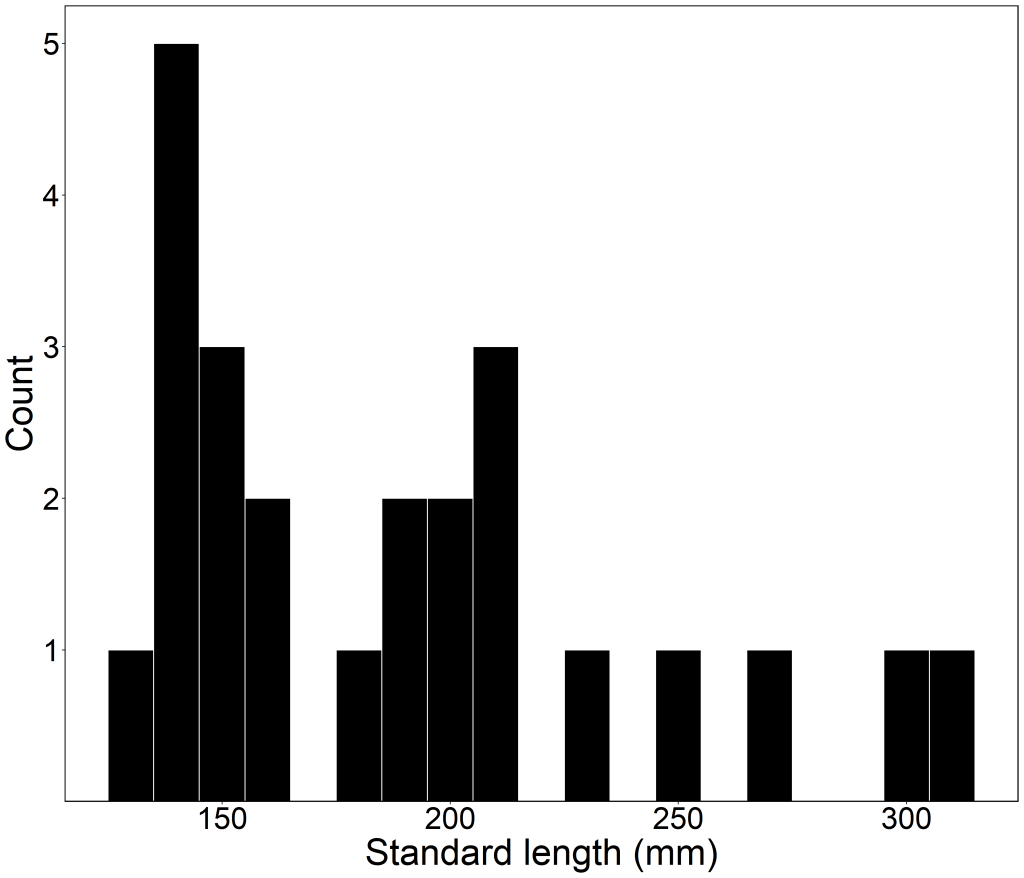
We conducted a total of 49 gillnet deployments and captured a total of 24 Clear Lake Hitch ranging in size from 133 to 310 mm (Table 1, Fig. 2; Wulff et al. 2025). All Clear Lake Hitch were released alive at the site of capture, except for 12 individuals across the range of observed sizes that were retained for life history studies. The mean catch rate (count per gillnet per hour) of adult Clear Lake Hitch (0.30) and juvenile Clear Lake Hitch (0.26) in our 2024 samples of Lower Blue Lake were comparable to our catch rates of Clear Lake Hitch during long-term monitoring studies in Clear Lake, especially during 2023 and 2024 (Fig. 3; Palm et al. 2023; Feyrer et al. 2025)
Table 1. Summary of key variables measured during Clear Lake Hitch (Lavinia exilicauda chi) sampling in Lower Blue Lake, Lake County, California, in October 2024. Water quality parameter values are means ± one standard deviation. Data is summarized from Wulff et al. (2025).
| Parameter | Value |
| Sampling effort, gillnet deployments | 49 |
| Sampling effort, minutes | 2,522 |
| Adult Clear Lake Hitch captured | 13 |
| Juvenile Clear Lake Hitch captured | 11 |
| Water temperature (°C) | 17.4 ± 0.4 |
| Specific conductance (µS/cm) | 234.2 ± 0.5 |
| Turbidity (FNU) | 7.6 ± 1.9 |
| Chlorophyll a (µg/L) | 19.5 ± 2.5 |
| Dissolved oxygen concentration (mg/L) | 8.0 ± 0.6 |
| pH | 7.9 ± 0.1 |

Water quality conditions of Lower Blue Lake were characterized concurrently with the fish sampling. We measured the following water quality parameters with handheld YSI EXO2 sondes (Yellow Springs Instruments, Yellow Springs, Ohio, USA) at the exact position of each individual gillnet (2 m below the surface for surface suspended nets and 1 m from the bottom for nets at the lake bottom): temperature (°C), dissolved oxygen concentration (mg/L), specific conductance (µS/cm at 25 °C), turbidity (FNU), chlorophyll a concentration (µg/L), and pH. Mean water quality conditions observed during the sampling event are provided in Table 1.
Lower Blue Lake appeared to provide suitable habitat at the time of sampling for Clear Lake Hitch in that our study did not observe any instances of hypoxia (dissolved oxygen concentration < 3.0 mg/L), which is an important driver of habitat volume for Clear Lake Hitch in Clear Lake (Feyrer et al. 2019b). However, to confirm year-round suitability, additional measurements of Lower Blue Lake water quality should be conducted during summer when vertical stratification and hypoxia are most likely to occur. Notably, surveys in Lower Blue Lake in November 2015 and 2024 did not encounter Clear Lake Hitch (Ewing 2015a, 2025). The absence of Clear Lake Hitch observed by Ewing (2025) might have been because sampling was conducted by boat electrofishing, which might be less efficient at capturing Clear Lake Hitch than gillnets. The different results between this study and Ewing (2025) might also indicate intermittent presence of Clear Lake Hitch in Lower Blue Lake, though we are not aware of any physical means by which Clear Lake Hitch could emigrate from Lower Blue Lake sometime between October 2024 and November 2024. The presence of multiple size classes indicates persistent use of the habitat, although further evaluation is warranted (Fig. 2). Similarly, further study of other perennial water bodies where Clear Lake Hitch have not been observed, such as Adobe Reservoir (Ewing 2015b,c) and Upper Blue Lake (Ewing 2014, 2022), or observed sparingly, such as Highland Springs Reservoir (Ewing 2015d), may provide further insight into Clear Lake Hitch distribution.
Given that Clear Lake Hitch are endemic to the Clear Lake watershed, it is important for effective conservation and management to understand the contribution of Lower Blue Lake (and other perennial water bodies) to the population dynamics and overall resilience of Clear Lake Hitch. The presence of both juvenile and adult-sized individuals suggests either successful reproduction within or near Lower Blue Lake and/or the migration of Clear Lake Hitch from intermittently connected water bodies such as Clear Lake or Upper Blue Lake. Our observations suggest that Clear Lake Hitch can successfully reproduce and persist in a range of habitats, further supported by prior findings of persistent Clear Lake Hitch in Thurston Lake (e.g. Ewing 2015e, 2020). These populations may be important for species resilience across the landscape in the face of environmental alteration and climate change. Importantly, it is unlikely that the population of Clear Lake Hitch within Lower Blue Lake is completely ecologically segregated from the population of Clear Lake Hitch within Clear Lake. When streamflow in Scotts Creek is sufficient, it is plausible that adult Clear Lake Hitch may move between Lower Blue Lake and Clear Lake, and juvenile Clear Lake Hitch in Lower Blue Lake may move downstream into Clear Lake. The degree to which such movements between Lower Blue Lake (or other perennial water bodies) and Clear Lake occur is not well understood; although, the notion is of high relevance for species management.
Although direct evidence is lacking, it is plausible that upstream perennial water bodies could contribute to variability in the abundance of Clear Lake Hitch within Clear Lake. For example, an unexpected increase in abundance of Clear Lake Hitch within Clear Lake was observed in 2023 after the population had been depressed for several years (Fig. 3; Palm et al. 2023; Feyrer et al. 2025). This observation in 2023 was consistent across surveys and size classes (Feyrer et al. 2025) with no clear mechanism for the observed increase in abundance. Individuals comprising the population of Clear Lake Hitch in Clear Lake originate from a variety of natal sources across the watershed (Feyrer et al. 2019a). The relative contribution of individuals from specific ephemeral tributaries (or upstream perennial habitats) likely varies interannually with precipitation patterns, lake levels, and climatic variability. These observations highlight that more comprehensive study is warranted to determine the distribution of Clear Lake Hitch across the watershed, their connectivity to the population of individuals within Clear Lake, and the drivers of Clear Lake Hitch population dynamics as a whole.
Acknowledgments
Funding was provided by U.S. Fish and Wildlife Service via Inter-Agency Agreement 4500172951. The support of E. Hull and A. Aguilera of the U.S. Fish and Wildlife Service made this work possible. We thank D. Santana-Cazares of the Habematolel Pomo of Upper Lake for access to the field site and A. De Palma-Dow of the Lake County Land Trust and A. Hansen from the U. S. Geological Survey for helpful comments on early drafts of this manuscript. Clear Lake Hitch sampling was authorized by scientific collection permits and associated memorandums of understanding issued by the California Department of Fish and Wildlife. Any use of trade, firm, or product names is for descriptive purposes only and does not imply endorsement by the U.S. Government.
Literature Cited
- Bonar, S. A., W. A. Hubert, and D. W. Willis. 2009. Standard methods for sampling North American freshwater fishes. American Fisheries Society. Bethesda, MD, USA.
- California Department of Fish and Wildlife (CDFW). 2014. A Status Review of Clear Lake Hitch (Lavinia exilicauda chi). Report to the Fish and Game Commission, Sacramento, CA, USA. https://nrm.dfg.ca.gov/FileHandler.ashx?DocumentID=86747
- Childers, C. 2023a. Clear Lake Hitch Rescue from Middle Creek downstream of HWY 20 bridge September 7th–18th, 2023. Robinson Rancheria, Nice, CA, USA.
- Childers, C. 2023b. Clear Lake Hitch Rescue from Scotts Creek at Draxton Vineyard August 11th and 18th, 2023. Robinson Rancheria, Nice, CA, USA.
- Ewing, B. 2014. Upper Blue Lake General Fish Survey. California Department of Fish and Wildlife, Sacramento, CA, USA. Available from: https://nrm.dfg.ca.gov/FileHandler.ashx?DocumentID=91244 (Accessed: 14 March 2025)
- Ewing, B. 2015a. Lower Blue Lake (Lake County) Electrofishing survey. California Department of Fish and Wildlife, Sacramento, CA, USA. Available from: https://nrm.dfg.ca.gov/FileHandler.ashx?DocumentID=112306 (Accessed: 14 March 2025)
- Ewing, B. 2015b. Adobe Reservoir Gillnet Survey. California Department of Fish and Wildlife, Sacramento, CA, USA. Available from: https://nrm.dfg.ca.gov/FileHandler.ashx?DocumentID=111201 (Accessed: 14 March 2025)
- Ewing, B. 2015c. Adobe Creek and Adobe Reservoir (Lake County) Fish Observations. California Department of Fish and Wildlife, Sacramento, CA, USA. Available from: https://nrm.dfg.ca.gov/FileHandler.ashx?DocumentID=108447 (Accessed: 14 March 2025)
- Ewing, B. 2015d. Highland Springs Reservoir (Lake County) Electrofishing Survey (2015). California Department of Fish and Wildlife, Sacramento, CA, USA. Available from: https://nrm.dfg.ca.gov/FileHandler.ashx?DocumentID=111563 (Accessed: 14 March 2025)
- Ewing, B. 2015e. Thurston Lake Fish Survey. California Department of Fish and Wildlife, Sacramento, CA, USA. Available from: https://nrm.dfg.ca.gov/FileHandler.ashx?DocumentID=108466 (Accessed: 14 March 2025)
- Ewing, B. 2020. Summary of the Clear Lake Hitch Population Estimate at Thurston Lake. California Department of Fish and Wildlife, Sacramento, CA, USA. Available from: https://nrm.dfg.ca.gov/FileHandler.ashx?DocumentID=177601 (Accessed: 14 March 2025)
- Ewing, B. 2022. Upper Blue Lake General Fish Survey, Lake County, Spring 2022. California Department of Fish and Wildlife, Sacramento, CA, USA. Available from: https://nrm.dfg.ca.gov/FileHandler.ashx?DocumentID=228075 (Accessed: 14 March 2025)
- Ewing, B. 2025. 2024 Lower Blue Lake Electrofishing Survey. California Department of Fish and Wildlife, Sacramento, CA, USA.
- Feyrer, F., J. Hobbs, S. Acuna, B. Mahardja, L. Grimaldo, M. Baerwald, R. C. Johnson, and S. Teh. 2015. Metapopulation structure of a semi-anadromous fish in a dynamic environment. Canadian Journal of Fisheries and Aquatic Sciences 72(5):709–721. https://doi.org/10.1139/cjfas-2014-0433
- Feyrer, F. 2019. Observations of the spawning ecology of the imperiled Clear Lake Hitch Lavinia exilicauda chi. California Fish and Game 105(4):225–232. www.doi.org/10.51492/cfwj.105.14
- Feyrer, F., G. Whitman, M. Young, and R. Johnson. 2019a. Strontium isotopes reveal ephemeral streams used for spawning and rearing by an imperiled potamodromous cyprinid, Clear Lake Hitch Lavinia exilicauda chi. Marine and Freshwater Research. https://doi.org/10.1071/MF1826
- Feyrer, F., M. Young, O. Patton, and D. Ayers. 2019b. Dissolved oxygen controls summer habitat of Clear Lake Hitch (Lavinia exilicauda chi), an imperiled potamodromous cyprinid. Ecology of Freshwater Fish. https://doi.org/10.1111/eff.12505
- Feyrer, F., M. J. Young, B. Huntsman, V. Violette, J. K. Clause, J. Buxton, D. Palm, M. Wulff, J. Gronemyer, and L. Santana. 2025. Gillnet sampling methods for monitoring status and trends of Clear Lake Hitch in Clear Lake, Lake County, California. U.S. Geological Survey Open-File Report 2025–1018, USGS, West Sacramento, CA, USA. https://doi.org/10.3133/ofr20251018
- Hopkirk, J. D. 1973. Endemism in the Fishes of the Clear Lake Region of Central California. Volume 96, University of California Publications in Zooloogy. University of California Press, Berkeley, CA, USA.
- Hopkirk J. D. 1988. Fish evolution and the late Pleistocene and Holocene history of Clear Lake, California. Pages 183–193 in J. D. Sims, editor. Late Quaternary Climate, Tectonism, and Sedimentation in Clear Lake, Northern California Coast Ranges. Geological Society of America, Boulder, CO, USA. https://doi.org/10.1130/spe214-p183
- Hubert, W. A., K. L. Pope, and J. M. Dettmers. 2012. Passive capture techniques. Pages 223–265 in A.V. Zale, D. L. Parrish, and T. M. Sutton, editors. Fisheries Techniques. 3rd edition. American Fisheries Society, Bethesda, MD, USA. https://digitalcommons.unl.edu/cgi/viewcontent.cgi?article=1110&context=ncfwrustaff
- Mauldin, H. 1968. History of Clear Lake, Mt. Konocti, & the Lake County Cattle Industry. Anderson Printing. Los Angeles, CA, USA.
- Moyle, P. B. 2002. Inland Fishes of California—Revised and expanded. University of California Press, Berkeley, CA, USA.
- Palm, D. P., J. K. Clause, D. A. Steinke, M. J. Young, F. V. Feyrer, and L. Santana. 2023. Abundance and Distribution of Fishes in Clear Lake, Lake County, California, 2017–2024 (ver. 5.0, March 2025). U.S. Geological Survey data release. Available from: https://doi.org/10.5066/P9KXAMKP
- Santana, L. 2022. Clear Lake Hitch Rescue from Cooper Creek August 8th, 2022. Robinson Rancheria, Nice, CA, USA.
- Suchanek, T. H., P. J. Richerson, D. C. Nelson, C. A. Eagles-Smith, D. W. Anderson, J. J. Cech, Jr., G. Schladow, R. Zierenberg, J. F. Mount, S. C. McHatton, D. G. Slotton, L. B. Webber, A. L. Bern, and B. J. Swisher. 2002. Evaluating and managing a multiply-stressed ecosystem at Clear Lake, California: a holistic ecosystem approach. Pages 1233–1265 in D. J. Rapport, B. L. Lasley, D. E. Rolston, N. O. Nielsen, C. O. Qualset, and A. B. Dmania, editors. Managing for Healthy Ecosystems. CRC/Lewis Press, Boca Raton, FL, USA. http://www.des.ucdavis.edu/Faculty/richerson/Clear%20Lake%20overview.pdf
- Wulff, M. L., M. J. Young, and F. V. Feyrer. 2022. Gill-net selectivity for fifteen fish species of the upper San Francisco Estuary. San Francisco Estuary and Watershed Science 20(2):art4. https://doi.org/10.15447/sfews.2022v20iss2art4
- Wulff, M. L., V. L. Violette, D. L. Palm, J. M. Buxton, M. J. Young, and F. V. Feyrer. 2025. Abundance and distribution of fishes in Lower Blue Lake, Lake County, California, 2024. U.S. Geological Survey data release. Available from: https://doi.org/10.5066/P146CTBU