

RESEARCH NOTE
Christopher Diviney* and Alisa Dahl
California Department of Fish and Wildlife, Central Region, 737 North Old La Grange Road, La Grange, CA 95329, USA https://orcid.org/0009-0002-0693-4069 (CD)
*Corresponding Author: Christopher.Diviney@wildlife.ca.gov
Published 6 June 2024 • doi.org/10.51492/cfwj.110.10
Key words: Acipenser transmontanus, acoustic monitoring, drought, San Francisco Estuary, San Joaquin River, spawning habitat, temperature, tributary, Tuolumne River, White Sturgeon
| Citation: Diviney, C., and A. Dahl. 2024. Rescuing and monitoring White Sturgeon during drought on the Tuolumne River. California Fish and Wildlife Journal 110:e10. |
| Editor: Gabriel Singer, Fisheries Branch |
| Submitted: 12 June 2023; Accepted: 2 November 2023 |
| Copyright: ©2024, Diviney and Dahl. This is an open access article and is considered public domain. Users have the right to read, download, copy, distribute, print, search, or link to the full texts of articles in this journal, crawl them for indexing, pass them as data to software, or use them for any other lawful purpose, provided the authors and the California Department of Fish and Wildlife are acknowledged. |
| Competing Interests: The authors have not declared any competing interests. |
Frequent drought, loss of critical habitat, and warming water conditions threaten one of California’s most prehistoric fish. White Sturgeon (Acipenser transmontanus) are known to occupy both the Sacramento River (SR) and San Joaquin River (SJR) watersheds and are the largest freshwater fish species in North America. White Sturgeon support a popular recreational fishery in California and, although they are not currently listed under the federal Endangered Species Act, they are considered a state Species of Special Concern (CDFW 2019) and have been petitioned for listing under the California Endangered Species Act. Research shows that increased flows in the spring and early summer increase spawning success and larval recruitment of White sturgeon (Kohlhorst et al. 1991) and if drought continues and low flows persist, sturgeon in California may be impacted by disconnected habitats and intolerable river temperatures (Ficke et al. 2007).
White Sturgeon are found in the San Francisco Estuary (SFE) year-round and spawn primarily in freshwater habitats in the SR (Heublein et al. 2017). Several surveys have monitored spawning behaviors of White Sturgeon in the Sacramento basin (Schaffter 1997; Miller et al. 2020) but there has been a lack of monitoring on the SJR until recently. Researchers previously believed spawning occurred in the SJR only during very high-water years, but recent studies have concluded that White Sturgeon are using the SJR to spawn during high and low flow years. (Jackson et al. 2016).
White Sturgeon rarely exhibit holding behaviors after spawning and the most common strategy is to return to the estuary immediately after spawning (Klimley et al. 2015). If White Sturgeon delay out-migration, they may have difficulty navigating through shallow water habitat after spring runoff flows decrease. In this scenario, any sturgeon occupying the SJR or lower Tuolumne River in the summer may be forced to hold in deep pools until water operators increase river flows or winter precipitation begins and they can move freely throughout the river (Anderson et al. 2018).
Lab studies have shown that White Sturgeon exhibit optimal growth and metabolism up to 25°C (Cech et al. 1984) but research is largely based around juvenile sturgeon in captivity. The maximum temperature tolerated by sexually mature White Sturgeon in natural environments is less studied. The highest summer temperatures documented in the SJR reach 30°C (CDFW 2018) and if adult sturgeon hold in these conditions, rather than migrating to the estuary, they could be subjected to sub-optimal river temperatures. As river discharges decrease and temperatures rise it may be beneficial to capture and relocate any holding sturgeon to more suitable habitat to keep the fish in good health and reduce the chance of poaching.
The Tuolumne River is a main tributary to the SJR and is an important resource for White Sturgeon. The river originates in the Sierra Nevada mountains and the basin drains approximately 173,252 ha. Don Pedro Reservoir and the Old La Grange Dam are the furthest downstream impoundments and the extent of anadromy ends at the base of Old La Grange Dam. From 2020 to 2021 the Tuolumne River experienced a drought, and the water year types were categorized as Median Dry and Critical-Below Normal, respectively (MID and TID 2022). During the same period, the SJR also experienced low flows and the water years were indexed as Dry and Critical year types (DWR 2023). During summer months, California Department of Fish and Wildlife (CDFW) staff experienced shallow water depths, large sand bars and various channel obstructions while navigating the SJR and associated tributaries by motor vessel (A. Dahl, pers. obs.). Multiple years of compounding droughts and low flows may hinder a sturgeon’s ability to migrate throughout the SJR watershed and increases the risks associated with elevated water temperatures and poaching.
Water managers of the Tuolumne River released water from Old La Grange Dam between 10 April 2021 and 22 April 2021 (1,400 cfs; USGS 11290000; Fig. 1). By 4 June 2021, the Tuolumne River reached base flow (114 cfs; USGS 11290000) for the remainder of the summer. After the flows receded, a landowner noticed several sturgeon in the river near his property (37.576°, –121.114°) located approximately 9.6 rkm from the confluence of the Tuolumne and the SJR. CDFW began monitoring river temperatures at this location to determine what conditions these fish were experiencing and noted that the shallow water habitat downstream of the pool where the sturgeon were holding made it unlikely that they would make a volitional outmigration. River temperatures were expected to reach 30°C in July (Fig. 1) which not only exceeds the temperature limit (25°C) for high growth for White Sturgeon (Cech et al. 1984; Israel et al. 2009), it also approaches their critical thermal maximum of 30°C (Weber et al. 2024). Based on this data, CDFW managers decided that relocating these fish was necessary to keep these sturgeon in good health, reduce the opportunity for poaching, and use this opportunity to tag the first sturgeon in a tributary to the SJR.

CDFW staff conducted a White Sturgeon rescue and tagging effort on 22 and 24 June 2021 due to high river temperatures and low flow conditions creating shallow river depths potentially obstructing migration to suitable habitat. Sturgeon were captured by extending two 30-m trammel nets, parallel with streamflow, along the river bottom. All sturgeon were transported with a V-shaped cradle to shallow water, ventral side up, with the head submerged to have continuous flow of water. CDFW staff measured fork length, total length, and river temperatures (Table 1). They then surgically implanted captured sturgeon with an acoustic tag (Vemco V16, 69 kHz) and Passive Integrated Transponder tag (Biomark, HDX23, 23 mm) in the peritoneal adjacent to the midline of the fish and between the third and fourth scute (Miller et al. 2020). The incision was closed with two simple interrupted sutures tied with surgeon’s knots. After tagging, each fish was placed in an aerated holding box and transported individually by truck to the release location on the SJR at Mossdale Crossing (SJR rkm 90.1; 37.787°, –121.307°). We later tracked these fish by acoustic receivers (Vemco VR2W, 69 kHz) positioned throughout the basin (Fig. 2).
Table 1. White Sturgeon fork length (cm), total length (cm), and river temperatures (°C) during relocation effort in June 2021 on the Tuolumne River (rkm 9.6; 37.576°, –121.114°). (TR = Tuolumne River; SJR = San Joaquin River)
| Date Tagged | Length – Fork | Length – Total | Temp – TR | Temp – SJR |
| 22 June 2021 | 177 | 181 | 26.7 | 23.2 |
| 22 June 2021 | 152 | 174 | 26.7 | 23.2 |
| 24 June 2021 | 153 | 162 | 25.9 | 22.3 |

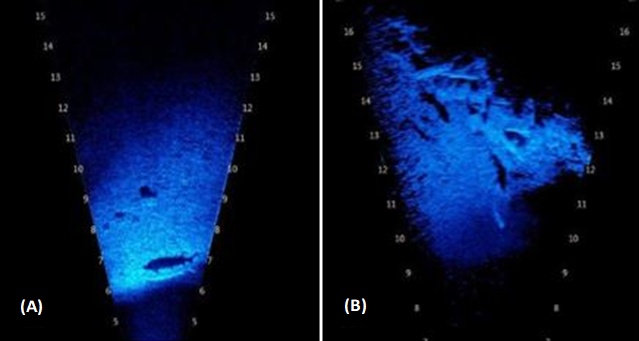
Three White Sturgeon were captured, tagged, and relocated to the SJR. Two sturgeon were captured on 22 June and one on 24 June 2021. After the relocation, CDFW monitored the same pool in the Tuolumne River throughout the summer by using an Adaptive Resolution Imaging Sonar (ARIS, Explorer 1800) for the presence of any remaining sturgeon. The ARIS captured images of one sturgeon on 8 August 2021 and another image of two sturgeon three weeks later (Fig. 3). We did not attempt to capture either sturgeon due to increased handling stress related to summer air temperatures and shallow depths at the relocation site. CDFW continued to confirm the presence of these fish until September, when Water Hyacinth (Eichhornia crassipes) covered the pool and prevented CDFW from monitoring with a boat and ARIS. CDFW was able to resume monitoring in December after precipitation increased flows, moving the large patch of vegetation downstream; however, no sturgeon were detected with the ARIS.
By using acoustic receivers positioned throughout the SJR and in the SFE, CDFW was able to monitor the sturgeons’ movements after relocation. United States Fish and Wildlife Service (USFWS) and CDFW operate and maintain an array of Vemco (VR2W 69 kHz) acoustic receivers ranging from the entrance of the SFE, at Antioch and Benicia Bridge, throughout the SJR and within its tributaries (Fig. 2). These arrays assist in observing the migration patterns of sturgeon. Detection histories revealed that one of the three fish migrated downstream directly to the bay where it was detected at Antioch and Benicia receivers in July of 2021. Contrary to the first fish, the second sturgeon migrated 30 rkm upstream from the release site in the SJR and was detected by receivers near this vicinity for the remainder of the summer. The third tagged sturgeon has yet to be detected on any receivers within the SJR or SFE. It is possible that this third sturgeon could have traveled towards the SR without being detected and attempts will be made to gain acoustic data from other surveys within the SR. Currently, there is a lack of acoustic receiver coverage within the delta, between Mossdale Crossing and the Antioch Bridge receivers. Increasing staff and funding will also allow CDFW to fill gaps in current acoustic monitoring and extend coverage between Mossdale Crossing and the SFE.
This monitoring effort documents the first tagging event of White Sturgeon in any tributary to the SJR and increases the knowledge of environmental factors experienced by White Sturgeon in the Tuolumne River. Although no spawning has been documented in the SJR tributaries (Faukner and Jackson 2014), the relocated White Sturgeon likely migrated into the Tuolumne River during the appropriate migratory spawning timeframe for White Sturgeon. Drought stressor monitoring funding made this rescue and monitoring possible, and this effort helps expand the knowledge of White Sturgeon habitat use and migration patterns within the SJR and associated tributaries. Continuous monitoring and resources, dedicated to better understanding White Sturgeon life history, are needed to properly manage the sturgeon fishery in the lower SJR and its tributaries.
Acknowledgments
We would like to thank CDFW staff members of the La Grange field office for their time and efforts put forth during the monitoring, capturing, tagging, and relocation process. Special thanks to J. Kelly and M. Beccio from CDFW for sharing their expertise on the adult sturgeon acoustic tagging procedure. We are grateful for A. Demarest and crew members of the United States Fish and Wildlife Services for their field efforts and coordination with collecting and sharing acoustic telemetry data. We would like to acknowledge M. Beccio, G. Murphey, and S. Tsao for review and comments during the preparation of this manuscript.
Literature Cited
- Anderson, J. T., G. Schumer, P. J. Anders, K. Horvath, and J. E. Merz. 2018. Confirmed observation: a North American Green Sturgeon (Acipenser medirostris) recorded in the Stanislaus River, California. Journal of Fish and Wildlife Management 9(2):624–630.
- California Department of Fish and Wildlife (CDFW). 2018. Statewide drought response – Stressor monitoring, summary report 2014–2017. California Department of Fish and Wildlife, Sacramento, CA, USA.
- California Department of Fish and Wildlife (CDFW). 2019. White Sturgeon, Acipenser transmontanus, enhanced status report. California Department of Fish and Wildlife, Sacramento, CA, USA.
- California Department of Water Resources (DWR). 2023. Chronological reconstructed Sacramento and San Joaquin Valley water year hydrologic classification indices. Available from: http://cdec.water.ca.gov/cgi-progs/iodir/WSIHIST (Accessed: 26 February 2024)
- Cech, J. J., S. J. Mitchell, and T. E. Wragg. 1984. Comparative growth of juvenile white sturgeon and striped bass: effects of temperature and hypoxia. Estuaries 7:12–18. https://doi.org/10.2307/1351952
- Faukner, J. R., and Z. J. Jackson. 2014. 2013 San Joaquin River sturgeon spawning survey. U. S. Fish and Wildlife Service, Stockton Fish and Wildlife Office, Anadromous Fish Restoration Program, Lodi, CA, USA.
- Ficke, A. D., C. A. Myrick, and L. J. Hansen, 2007. Potential impacts of global climate change on freshwater fisheries. Reviews in Fish Biology and Fisheries 17:581–613. https://doi.org/10.1007/s11160-007-9059-5
- Heublein, J. C., R. Bellmer, R. D. Chase, P. Doukakis, M. Gingras, D. Hampton, J. A. Israel, Z. J. Jackson, R. C. Johnson, O. P. Langness, S. Luis, E. Mora, M. L. Moser, L. Rohrbach, A. M. Seesholtz, T. Sommer, and J. S. Stuart. 2017. Life history and current monitoring inventory of San Francisco Estuary sturgeon. Technical Memorandum NMFS-SWFSC-589, U.S. Department of Commerce, National Oceanic and Atmospheric Administration, Washington D.C., USA. Available from: https://doi.org/10.7289/V5/TM-SWFSC-589
- Israel, J., A. Drauch, and M. Gingras. 2009. Life history conceptual model for White Sturgeon (Acipenser transmontanus). Delta Regional Ecosystem Restoration Implementation Plan (DRERIP). Prepared by California Department of Fish and Game, Stockton and University of California, Davis, CA, USA.
- Jackson, Z. J, J. J. Gruber, and J. P. Van Eenennaam. 2016. White sturgeon spawning in the San Joaquin River, California and effects of water management. Journal of Fish and Wildlife Management 7(1):171–180. https://doi.org/10.3996/092015-JFWM-092
- Kohlhorst, D. W., L.W. Botsford, J. S. Brennan, and G. M. Cailliet. 1991. Aspects of the structure and dyamics of an exploited central California population of White Sturgeon (Acipenser transmontanus). Pages 277–283 in P. Williot, editor. Acipenser: Actes du Premier Colloque International sur L’esturgeon. Cemagref, Bordeaux, France.
- Miller, E. A., G.P. Singer, M. L. Peterson, E. D. Chapman, M. E Johnston, M. J. Thomas, R. D. Battleson, M. Gringras, and A. P. Klimley. 2020. Spatio-temporal distribution of Green Sturgeon (Acipenser medirostris) and White Sturgeon (A. transmontanus) in the San Francisco Estuary and Sacramento River, California. Environmental Biology of Fishes 103:577–603.
- Modesto Irrigation District (MID) and Turlock Irrigation District (TID). 2022. 2021 Lower Tuolumne River annual report. Report to the Federal Energy Regulatory Commission, Washington, D.C., USA Available from: https://www.tuolumnerivertac.com/documents.htm
- Schaffter, R. G. 1997. White Sturgeon spawning migrations and location of spawning habitat in the Sacramento River, California. California Fish and Game 83:1–20.
- Weber, T. A., A. M. Dichiera, and C. J. Brauner. 2024. Resetting thermal limits: 10-year-old white sturgeon display pronounced but reversible thermal plasticity. Journal of Thermal Biology 119:103807. https://doi.org/10.1016/j.jtherbio.2024.103807.