

FULL RESEARCH ARTICLE
Barbara Clucas* and Sydney L. McCluskey
California State Polytechnic University, Humboldt, Department of Wildlife, 1 Harpst Street, Arcata, CA 95521, USA https://orcid.org/0000-0003-2812-0920 (BC) https://orcid.org/0000-0003-4619-3509 (SLM)
*Corresponding Author: barbara.clucas@humboldt.edu
Published 21 May 2025 • doi.org/10.51492/cfwj.111.8
Abstract
Effective survey methods to detect small mammal species are often needed to develop conservation and management plans in forested ecosystems. The ability to use non-invasive methods to identify small mammal species in the field is particularly useful as live trapping can be time consuming and potentially harmful to the study species. We tested a camera trap method in a coastal redwood (Sequoia sempervirens) forest for small mammals, originally designed by Gracanin et al. (2019) and called the “selfie trap”, that uses a camera trap with a modified lens in a baited PVC tube. We determined if we could use this camera trap set-up on the ground to accurately identify small mammals to species to assess species diversity in a forested ecosystem as well as if it could withstand disturbance from larger mammals (e.g., bears). We surveyed for small mammals in areas of old-growth and second-growth coastal redwood forests in northwestern California. We detected 10 small mammal species and were able to identify most individuals to species including squirrel, chipmunk, mice, woodrat, shrew, vole and mole species. This camera trap set up also detected approximately 77% of small mammal species known to potentially occur in the area. Moreover, although larger mammals could interact with the camera trap set up, their disturbance was limited to when they were interacting with the trap, and the bait and camera set-up remained functional for subsequent small mammal detections. Thus, this method could be used instead of live trapping in complex forested ecosystems to effectively determine small mammal species presence, diversity, and activity levels, avoiding disturbance from large mammals.
Key words: camera traps, detection, non-invasive surveys, selfie trap, small mammals, species diversity, species identification
| Citation: Clucas, B., and S. L. McCluskey. 2025. Camera trap method effectively identifies small mammal species in forested habitats. California Fish and Wildlife Journal 111:e8. |
| Editor: Kate Morozova, Habitat Conservation Planning Branch |
| Submitted: 15 October 2024; Accepted: 19 February 2025 |
| Copyright: ©2025, Clucas and McCluskey. This is an open access article and is considered public domain. Users have the right to read, download, copy, distribute, print, search, or link to the full texts of articles in this journal, crawl them for indexing, pass them as data to software, or use them for any other lawful purpose, provided the authors and the California Department of Fish and Wildlife are acknowledged. |
| Funding: This project was funded by a Bureau of Land Management Wildlife Resource Management grant awarded to B. Clucas and by additional funds from the Department of Wildlife at Cal Poly Humboldt. |
| Competing Interests: The authors have not declared any competing interests. |
Introduction
The use of camera traps to survey non-invasively for large to medium-sized mammals began in the 1990s (e.g., Karanth and Nichols 1998) and has become an increasingly common technique in wildlife research (Kucera and Barrett 2011; Burton et al. 2015). More recently, camera traps have also been used to survey small mammal species such as rodents and lagomorphs (reviewed in McCallum 2013) and have been shown to have comparable or greater ability to detect species compared to live trapping (e.g., De Bondi et al. 2010; Thomas et al. 2020). Advances in camera technology have increased the reliability of this survey method for small mammals, helping to overcome triggering issues and trigger speeds (Glen et al. 2013), while a remaining challenge is the ability to identify small mammals to species, particularly when species similar in appearance overlap in distribution.
Camera trap studies on small mammals have employed a range of modifications to increase detection and enhance photo quality for identification (e.g., McCleery et al. 2014; Martin et al. 2017; Gracanin et al. 2019) compared to the typical camera use and placement for medium to large mammals (i.e., mounting the camera horizontally to face out into the environment). Several of these methods used vertically-mounted cameras facing down to the ground (e.g., Tennant et al. 2020; Thomas et al. 2020) or cameras mounted to the top of a bucket with openings at the bottom of the bucket to allow small mammals to enter (McCleery et al. 2014; Martin et al. 2017). Most use bait or lure to attract the small mammals to a particular spot that will provide an optimal distance from the camera to both increase trigger probability and photo quality, as well as modifications to the camera focal distance (McCleery et al. 2014; Gracanin et al. 2019; Tennant et al. 2020; Thomas et al. 2020; Gracanin et al. 2022). In some cases, the modified focal distance was accomplished by having the camera manufacturers adjust it internally (McCleery et al. 2014), while others modified the lens externally (Gracanin et al. 2019, 2022, Nardotto and Bertolin 2024). All these methods increased detection of small mammals in a variety of environments and aided in species identification and in some cases individual identification by coat patterns (Gracanin et al. 2019, 2022).
Possible challenges to using more traditional camera methods to determine species diversity of small mammals in a forested ecosystem are difficulty distinguishing individuals from forest floor vegetation and debris, difficulty observing individual features to distinguish species similar in appearance, and disturbance of camera set-up and/or bait by larger mammals (e.g., bears). The objective of our study was to test a camera trap method in a forested ecosystem that uses a camera inside a baited tube with a modified lens to determine if we could detect small mammals and identify them accurately to species as well as avoid disruption from larger mammals. This camera trap method was originally designed by Gracanin et al. (2019) to detect small mammals in Australia as well as identify individuals by coat pattern (named the “selfie trap”; see also Gracanin et al. 2022). We adjusted the selfie trap setup by adding a cable lock to the tube so that it could be secured to a tree on the ground and the camera and bait functioning would be less likely to be disrupted by larger mammals.
We evaluated using the camera traps inside baited tubes technique for surveying for small mammals in old-growth and second-growth coastal redwood (Sequoia sempervirens) forests in northwestern California. Redwood forest floors vary in composition across old-growth and second-growth stands but are typically characterized by complex structure which can affect the ability to clearly see small mammals when using camera traps. We specifically evaluated the effectiveness of the method by comparing the number of small mammal species detected to those known to occur in Headwaters Forest Reserve. We also tested its ability to record clear, close-up videos of the small mammals as well as its ability to withstand disturbance from non-target species. American black bears (Ursus americanus) and fisher (Pekania pennanti) are known to occur in Headwaters Forest Reserve and have previously interacted with camera trap set-ups (Clucas and Atkins 2022).
Methods
Study Area
We conducted our study in the Headwaters Forest Reserve (UTM: 10 T 410446 E 4496300 N), which is located approximately 20 km south of Eureka in northwestern California (Fig. 1). The US Bureau of Land Management (BLM) manages the reserve in collaboration with the California Department of Fish and Wildlife (CDFW). Established in 1999, the reserve is a 3,023.8-ha forested area that contains approximately 40% of old-growth coastal redwood stands surrounded by stands of second growth (BLM and CDFW 2003, 2017; Fig. 1). The second-growth stands include those cut pre-1985 and between 1986–1997, and the logging efforts also left about 80 km of logging roads (McFarland et al. 2003). Other prominent tree species in the reserve include Douglas-fir (Pseudotsuga menziesii) and tanoak (Lithocarpus densiflorus), as well as red alder (Alnus rubra), western hemolock (Tsuga heterophylla), grand fir (Abies grandis), Sitka spruce (Picea sitchensis), and western redcedar (Thuja plicata) (Jimerson and Jones 2000). The elevation of the Headwater Forest Reserve varies from 30 m to 563 m and the reserve experiences both coastal and inland climate conditions (McFarland et al. 2003). Temperatures range from about 1 to 9º C in the winter and 6 to 15º C the rest of the year, with the majority of precipitation occurring in the winter.
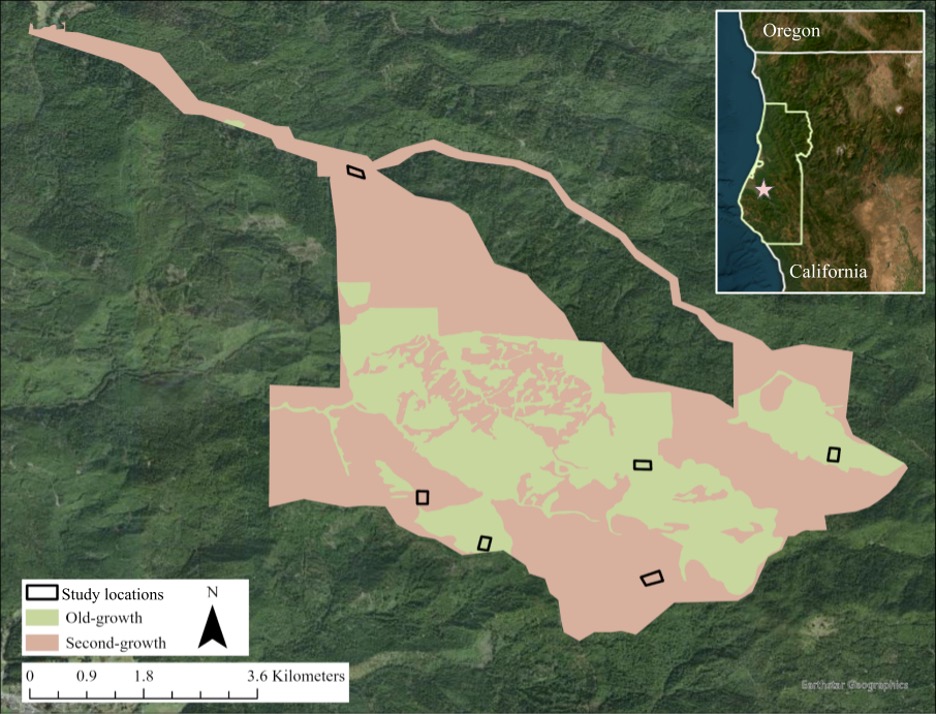
Headwaters Forest Reserve contains a diverse assemblage of small mammal species (Clucas and Atkins 2022; B. Clucas, Cal Poly Humboldt, unpublished data) including Humboldt’s flying squirrel (Glaucomys oregonensis), Douglas’ squirrel (Tamiasciurus douglasii), Shadow chipmunk (Neotamias senex), dusky-footed woodrat (Neotoma fuscipes), western deer mice (Peromyscus sonoriensis) and several shrew species (Sorex spp.). Larger mammalian species known to occur in the reserve that might disturb camera and bait setups include American black bears, fishers, andblack-tailed deer (Odocoileus hemionus).
Data Collection
We surveyed for small mammals in six study locations in Headwaters Forest Reserve from 9 June 2020 to 16 August 2020; three study locations were in old growth redwood stands and three were in second growth (Fig. 1). Each general study location was predetermined in ArcMap and a 150-m by 300-m camera trap grid was established as part of a larger small mammal monitoring study in Headwaters Forest Reserve. Grids were placed where it was feasible to set up (i.e., accessible, not on a steep slope or intersecting a creek). In each study location, we set up five camera traps in tubes using predetermined UTM points. Final site selection and placement of the camera trap depended on where we could locate a tree or log that we could secure the tube to with a cable lock. Adjacent cameras ended up being approximately 100 m apart, with maximum spacing of approximately 300 m. This spacing may result in individuals of some small mammal species being detected on multiple cameras while others not due to variation in home range sizes and daily/nightly movements (e.g., those with relatively larger versus smaller home range sizes and daily/nightly movements, respectively; Hammond and Anthony 2006), which occurs in multispecies studies.
We surveyed one study location at a time; the camera trap setups were deployed for eight nights at a given study location (Clucas and Atkins 2022) and then removed and taken out of the field to clean the tube and bait container and switch out SD card and batteries. We then deployed the camera traps 9–10 days later at the next study location. This process was repeated until each location was surveyed, alternating between old growth and second growth. The methods for this study were approved by the Humboldt State University IACUC protocol number 19/20.W.2-A (now Cal Poly Humboldt).
Camera Trap Setup
The camera trap set-ups were constructed following general guidelines for the selfie trap provided by Gracanin et al. (2019) with minor adjustments. For the PVC piping, we used blue sewer pipe cut in length of 500 mm with 150 mm diameter openings on both ends (Figs. 2, 3a, 4; hereafter the pipe will be referred to as a tube). A hole was drilled approximately 250 mm from one end of the tube where the bait holder would be secured in place by a bolt and nut. Bait holders were constructed using a 3D printer following specifications from Gracanin et al. (2019) (Fig. 3a,d). We adjusted the PVC tube by drilling two holes through its sides and its cap so we could insert a cable lock (Fig. 4b).
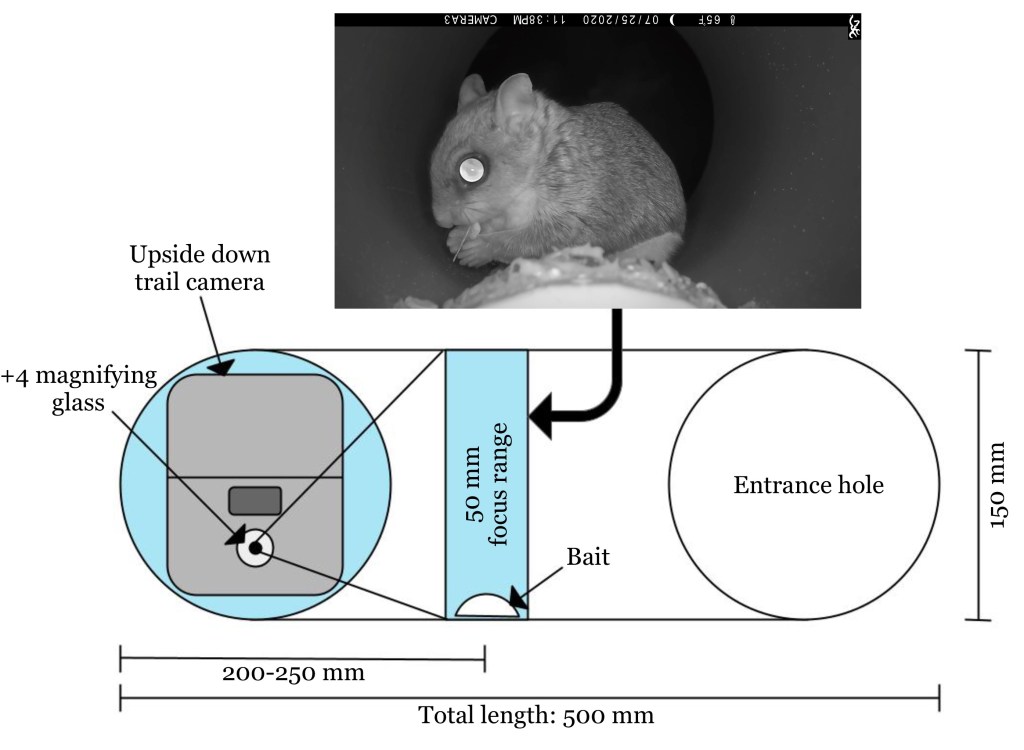


Browning HD infrared cameras (Model # BTC-5HDE, Browning Corporation, Birmingham, Alabama, USA) were modified with +4 magnification lens (obtained from non-prescription glasses) adhered with epoxy over the camera lens to adjust the camera’s focus range to 200-250 mm (Gracanin et al. 2019; Figs. 2, 3). During a pilot study we cut the lens to size (Fig. 3a); however, we found that adhering a full lens worked well too (Fig. 3b), and we used this method in this study. To fit this particular camera trap model and hold it in place when in the tube, three rectangular slits were cut into the tube at the end that would be capped (Fig. 3c). Cameras were set to record videos following Gracanin et al. (2019), and we recorded 10-second videos with a 20-second delay between triggers. Ten seconds was found to be sufficient time for multiple views of the small mammals for better species identification. We used 32 GB memory cards to ensure enough memory space for the eight-night survey period.
When deploying the tube traps, we would first fill the bait container with peanut butter suet (C&S Peanut Delight No Melt Suet Dough) and then bolt the container into place. We then would set the camera on, position it into the tube, and put a 15-cm (6-in) PVC cap on to secure the camera and tube (Fig. 3). Due to the positioning of the camera in the tube and its lens level, we had the camera taking videos upside down so that it would capture the bottom part of the tube where the bait holder was located (Figs. 3d, 5). We used a cable lock to secure the tube trap to the base of a tree and/or log with enough slack that the tube naturally lay flat on the group, but not too much slack that it could be moved around substantially (Fig. 4). To attach the cable to the tube trap, we would insert it through the hole on one side of the tube cap, through the camera attachment holes and then out the other hole on the side of the tube (Fig. 4b). Once the tube trap was set up, additional bait (bird seed, mealworms, apples, oats, and peanut butter) was scattered sparingly on top of the bait container with a small trail out to the open end of the tube.

Data Analysis
Research assistants trained to identify small mammal species found in Headwaters Forest Reserve reviewed each video using a specific identification key. Videos with animals were first categorized by species and by site, recording all videos when the animal species was unknown. A second reviewer then reviewed all the videos a second time to confirm species identifications and to try to identify species in videos marked unknown. Finally, a third review of the videos marked as unknown was conducted by SLM. We calculated the number of independent camera detections as an index for independent detections, which we defined as camera events separated by at least five minutes (Burton et al. 2015; Parsons et al. 2021). For each study location, we determined the small mammal species richness and independent camera detections and total number of video detections by species.
Results
We detected 10 different small mammal species across the 30 camera trap sites over the 240 survey nights and 5,534 total videos captured (Table 1; see Fig. 5 for example still shots). All 10 species were captured in the second growth study areas and 7 species were captured in the old growth study areas. Overall, shrews were detected at the most sites (67–80% of the sites) and most frequently, followed by Humboldt’s flying squirrels (57% of the sites), while Douglas’ squirrels and Pacific jumping mice were only detected at 1 out of the 30 sites and had very few total detection events (1 and 4, respectively).
Table 1. Mammal species detected with camera traps across second-growth sites (n = 15) and old-growth sites (n = 15) by number of sites detected (out of 15) and individual detection events (ID) and total detections (D) in Headwaters Forest Reserve in northwestern California, June to August 2020.
| Speciesa | Old-Growth Sites | Old-Growth ID (D) | Second-Growth Sites | Second-Growth ID (D) | Total Sites | Total ID (D) |
| Humboldt’s flying squirrel | 11 | 152 (752) | 6 | 30 (140) | 17 | 182 (892) |
| Douglas’ squirrel | 0 | 0 (0) | 1 | 1 (1) | 1 | 1 (1) |
| Shadow chipmunk | 5 | 105 (278) | 6 | 185 (593) | 11 | 290 (871) |
| Western red-backed vole | 4 | 13 (21) | 6 | 116 (357) | 10 | 129 (378) |
| Western deermouse | 5 | 122 (407) | 5 | 42 (169) | 10 | 164 (576) |
| Pacific jumping mouse | 0 | 0 (0) | 1 | 4 (36) | 1 | 4 (36) |
| Dusky-footed woodrat | 1 | 2 (2) | 2 | 35 (44) | 3 | 37 (46) |
| Fog shrew | 10 | 367 (752) | 14 | 419 (765) | 24 | 786 (1517) |
| Trowbridge’s shrew | 10 | 121 (191) | 10 | 387 (623) | 20 | 508 (814) |
| Shrew mole | 0 | 0 (0) | 5 | 63 (100) | 5 | 63 (100) |
| Pacific fisher | 6 | 12 (41) | 0 | 0 (0) | 6 | 12 (41) |
| American black bear | 5 | 8 (24) | 1 | 3 (33) | 6 | 11 (57) |
| Black-tailed deer | 1 | 1 (3) | 2 | 2 (2) | 3 | 3 (5) |
There were 118 videos with mammals in them that were categorized as unknown species (2.2% of total videos with mammal detections). Most of these videos involved situations where the individual was outside of the tube, or the video only captured a piece of the individual such as the side of the body or tail, as well as some videos of shrews that could not be identified down to species. However, in most cases, there were additional videos at that site immediately before or after the unknown videos where the shrew species could be identified.
Of other terrestrial and arboreal small mammals known or thought to occur in the area (excluding bat species), we did not detect three species on camera: mountain beavers (Aplodontia rufa), brush rabbits (Sylvilagus bachmani) and red tree voles (Aborimus longicaudas). We saw brush rabbits along the roads approaching all study locations and mountain beavers in one of the study locations, but we never saw signs of red tree voles. Thus, our camera traps detected 10 out of the 13 (77%) small mammal species thought to occur in Headwaters Forest Reserve (Clucas and Atkins 2022; B. Clucas, Cal Poly Humboldt, unpublished data; D. Anthon, BLM personal communication).
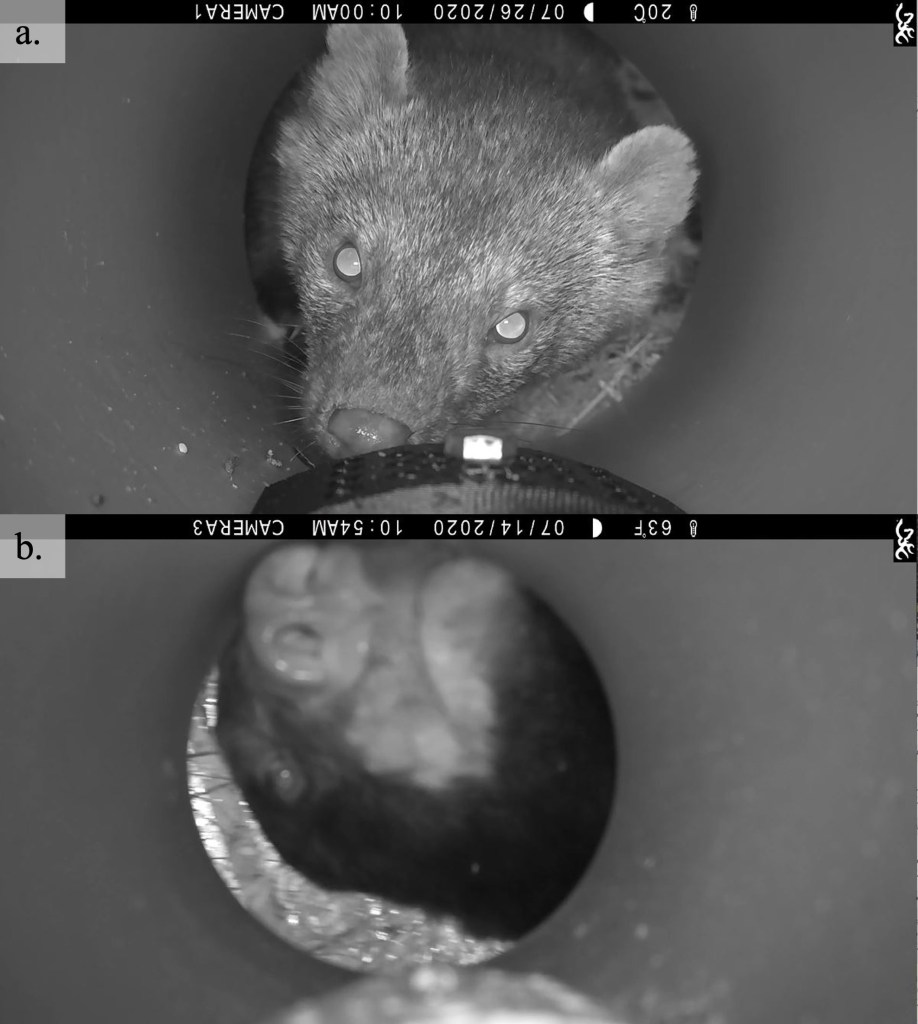
We detected three species that could have potentially disrupted the camera trap set up: black bear, fisher, andblack-tailed deer (Table 1). Deer did not interact with the set-up but were photographed passing the camera. Fishers did interact with the set-up, and were able to take some of the bait but did not disturb the camera set up (Fig. 6a). The black bears were the most disruptive, moving the tube around (Fig. 6b); however, after the bear left, the camera and tube set-up continued to work and captured more videos of small mammals.
Discussion
We effectively detected most small mammal species in a complex coastal redwood forest using the “selfie trap” camera trap method on the ground originally designed by Gracanin et al. (2019) to target small mammals in Australia. Species identification was facilitated by the up-close videos taken as well as the video allowing for multiple views of the individual as it moved into and around inside the tube (Fig. 5). We detected all known small mammal species in Headwaters Forest Reserve with the exceptions of mountain beavers, brush rabbits and red tree voles; however, we did not necessarily expect to detect these three species based on their diet and the bait we utilized (Chapman 1974; Swingle et al. 2004). Although mountain beavers have been baited with apple before (Lovejoy 1972), they are often below ground in their burrows and are rarely observed far from their burrows (Carraway and Verts 1993). We only detected Douglas’ squirrels on camera at one site, although we did observe and hear this species in all study locations. It may be that this species spends less time on the ground than the other small mammals in this area. However, previous camera trap studies in Headwaters Forest Reserve using cameras in trees and similar bait also did not detect many Douglas’ squirrels (Clucas and Atkins 2022), so they may have been less attracted to the bait or wary of the camera set-up. Baited hair-snare tubes in Douglas-fir dominant forests had much fewer samples for Douglas’ squirrels (less than 50%) than other squirrel species (Fimbel and Freed 2008), which may suggest they are wary of entering tubes. However, more research is needed to determine why Douglas’ squirrels are not often detected with camera traps in this area.
Larger mammal species such as black bears and fisher also interacted with the camera trap set up (Fig. 6). However, their disturbance to the tube was limited to when they were interacting with it and the camera and bait container set up remained functional for subsequent small mammal detections. While the bait trail and additional bait in the tube was taken or displaced by these larger mammals, they were not able to remove the bait container with the peanut butter suet, thus it continued to attract small mammals. With traditional camera trap methods when the camera is fully exposed, bears can often destroy the camera, and even when cameras are in a metal lockbox, bears could still move the lockbox in such a way that prevents future detections of small mammals (personal observation). Alternative deterrents for bears could involve installing electric fencing (e.g., Otto and Rolof 2015) around camera set-ups, but this would be expensive, time-consuming, and could potentially impact non-target species. Although not the objective of this study, this camera trap method could also be used for medium-sized mesocarnivores such as fisher to obtain clear images for mark-resight studies using ear tags or other markers, or for individual identification based on facial coat patterns for some species (e.g., Gracanin et al. 2019) such as using head stripes in skunks (Spilogale spp; Theimer et al. 2017). Similar tube-like camera trap set-ups have been used to detect and identify individual mustelids in Europe (Mos and Hofmeester 2020; Hofmeester et al. 2024).
Similar to the selfie trap method originally used to target marsupials in Australia (Gracanin et al. 2019), we demonstrated that this method can be utilized on the ground in a forested ecosystem to establish presence/absence, species richness and relative measures of activity of small mammalian species. Second-growth redwood forest study locations had slightly more species detected than old-growth and some species varied in their activity levels (as measured by individual detections) between forest age locations. For example, Humboldt’s flying squirrels were detected at more sites in old-growth study areas than second-growth and had higher activity levels in old-growth study areas, which is similar to what previous studies have shown for this area (Clucas and Atkins 2022). It may also be possible to use this method to estimate density of small mammals when individuals are marked or have individually unique markings. With the advantage that the camera method can provide clear images of small mammals, if individuals are marked so they can be identified to individuals (Gracanin et al. 2022), density estimates can be more accurate. Indeed, Gracanin et al. (2022) found that using mark-resight with the selfie trap for sugar gliders (Petaurus breviceps) and brown antechinus (Antechinus stuartii) better estimated their density than traditional live trapping because the probability of detecting individuals with camera traps was higher than live trapping. Further considerations will be needed if trying to determine density, such as the spacing of the cameras in the trapping grid in relation to species average home range size and movement (White et al. 1982, Hammond and Anthony 2006).
The success of using camera traps for species identification can require knowledge of what species are found in the area. Thus, some limitations may be encountered with regards to species identification. Depending on the species present in a geographic area, there may be multiple related species that are difficult to distinguish, or hybridization of species can confound identification. For example, chipmunks (Neotamias spp.) in the western United States are morphologically similar and some species are sympatric and can hybridize making accurate species identification challenging (Frare et al. 2017). Such morphological similarity or hybridization could lead to misidentification when reviewing camera data (Meek et al. 2013). Frare et al. (2017) even found a 13.7% misidentification rate of western chipmunks when using live trapping and the animals were examined physically in the hand. Nevertheless, creating a detailed identification key when identifying small mammal species from camera trap photos, as was done in this study to help distinguish shrew species, has been shown to reduce misidentification (McKibben and Frey 2021). However, there may be some nearly identical sympatric species that cannot be distinguished without examining specimens or doing genetic work (e.g., certain shrew species; McAliley et al. 2007). Thus, prior or concurrent studies using live trapping, and potentially genetic work, may be required to establish what small mammal species are in a geographic area and which are feasible to distinguish when using the camera traps.
We have several recommendations for the use of camera traps in tubes to survey for small mammals in forested areas. First, similar to Gracanin et al. (2019) we recommend testing the distance at which to place the bait container in the tube with the modified camera lens prior to deploying the field to find the best distance to produce the clearest videos when the animal is by the bait container as it may vary depending on the lens and camera brand or model (see also Meek and Cook 2022; Nardotto and Bertolin 2024 for other modified lens methods). Second, depending on the small mammal species of interest, testing various baits in a pilot study may be necessary. In addition, the feasibility of using camera traps in tubes may vary in some field conditions, as it involves having sufficient personnel to carry the equipment. We were surveying in coastal redwood forests which are particularly challenging to traverse off trail. We used an external pack frame to carry the five tubes, strapping them down with bungee cords, to reach remote study locations, carrying the cameras and cables in a separate pack. Finally, it is possible that this camera trap method could be used in other habitats or be used off the ground as originally demonstrated by Gracanin et al. (2019). If used in areas without trees to cable-lock the tube to (e.g., desert or recently burned or logged forests), we suggest using a U-shaped rebar to secure the cable to the ground.
Depending on the objectives of the study or field monitoring, camera traps could potentially be used instead of live trapping thus reducing risk of injury or death of study species and the cost in time and funds of live trapping. While there is an initial investment cost of the cameras and equipment and the time and cost of reviewing videos to consider, camera trapping can be more effective for detecting cryptic and elusive species and when the welfare of the species is crucial (e.g., surveying species of conservation concern) (Tennant et al. 2020; Paez et al. 2021).
Acknowledgements
We would like to thank A. Gracanin for providing construction details and D. Anthon (Bureau of Land Management) for facilitating access to Headwaters Forest Reserve. Special thanks to E. Espino for helping conduct the pilot study, R. Archambault, A. Canepa, T. Farwell, X. Gil, and C. Moura for all their help with field work, and to C. Collier, X. Gil, H. Miller, E. Russel, and B. Ryals for aiding in camera photo data analysis. Finally, we would like to thank Hooven & Co in Humboldt County for donating the PVC pipes used in this study. This project was funded by a Bureau of Land Management Wildlife Resource Management grant awarded to B. Clucas and by additional funds from the Department of Wildlife at Cal Poly Humboldt.
Literature Cited
- Bureau of Land Management and California Department of Fish and Wildlife (BLM and CDFW). 2017. Headwaters forest restoration resource management plan amendment and environmental assessment/ mitigated negative declaration. BLM Arcata Field Office, Arcata, CA, USA. https://eplanning.blm.gov/public_projects/lup/71600/110179/134998/Headwaters_RMP_Amendment.pdf
- Burton, A. C., E. Neilson, D. Moreira, A. Ladle, R. Steenweg, J. T. Fisher, E. Bayne, and S. Boutin. 2015. Wildlife camera trapping: a review and recommendations for linking surveys to ecological processes. Journal of Applied Ecology 52:675–685.
- Carraway, L. N., and B. J. Verts. 1993. Aplodontia rufa. Mammalian Species 431:1–10.
- Chapman, J. A. 1974. Sylvilagus nuttallii. Mammalian Species 56:1–3.
- Clucas, B., and Z. Atkins. 2022. Using camera traps to survey Humboldt’s flying squirrels in old- and second-growth redwood forests. Northwestern Naturalist 103:11–19.
- De Bondi, N., J. G. White, M. Stevens, and R. Cooke. 2010. A comparison of the effectiveness of camera trapping and live trapping for sampling terrestrial small-mammal communities. Wildlife Research 37:456–465.
- Frare, C. F., M. D. Matocq, C. R. Feldman, A. M. White, P. N. Manley, K. D. Jermstad, and E. R. Hekkala. 2017. Landscape disturbance and sporadic hybridization complicate field identification of chipmunks. Journal of Wildlife Management 81:248–258.
- Glen, A. S., S. Cockburn, M. Nichols, J. Ekanayake, and B. Warburton. 2013. Optimizing camera traps for monitoring small mammals. PLOS ONE 8(6):e67940. https://doi.org/10.1371/journal.pone.0067940
- Gracanin, A., V. Gracanin, and K. M. Mikac. 2019. The selfie trap: a novel camera trap design for accurate small mammal identification. Ecological Management and Restoration 20:156–158.
- Gracanin, A., T. E. Minchinton, and K. M. Mikac. 2022. Estimating the density of small mammals using the selfie trap is an effective camera trapping method. Mammal Research 67:467–482.
- Hammond, E. L., and R. G. Anthony. 2006. Mark–recapture estimates of population parameters for selected species of small mammals. Journal of Mammalogy 87:618–627.
- Hofmeester, T. R., N. Erath, J. Mos, and H. Thurfjell. 2024. Mustelid mugshots: photographing facial masks of European polecats (Mustela putorius) for individual recognition and density estimation using camera traps. Mammal Research 69:435–443.
- Jimerson, T. M., and J. K. Jones. 2000. Vegetation classification and mapping of the Headwaters Forest Reserve. USDA Forest Service, Pacific Southwest Region, Eureka, CA, USA.
- Karanth, K. U., and J. D. Nichols. 1998. Estimation of tiger densities in India using photographic captures and recaptures. Ecology 79:2852–2862.
- Kucera, T. E., and R. H. Barrett. 2011. A history of camera trapping. Pages 9–26 in A. F. O’Connell, J. D. Nichols, K. U. Karanth, editors. Camera Traps in Animal Ecology: Methods and Analyses. Springer, Berlin, Germany.
- Lovejoy, B. P. 1972. A capture-recapture analysis of a mountain beaver population in western Oregon. Dissertation, Oregon State University, Corvallis, OR, USA.
- Martin, S. A., R. M. Rautsaw, F. Robb, M. R. Bolt, C. L. Parkinson, and R. A. Seigel. 2017. Set AHDriFT: applying game cameras to drift fences for surveying herpetofauna and small mammals. Wildlife Society Bulletin 41:804–809.
- McAliley, L. R., M. B. O’Neill, and R. J. Baker. 2007. Molecular evidence for genetic subdivisions in the desert shrew, Notiosorex crawfordi. Southwestern Naturalist 52:410–417.
- McCallum, J. 2013. Changing use of camera traps in mammalian field research: habitats, taxa, and study types. Mammal Review 43:196–206.
- McCleery, R. A., C. L. Zweig, M. A. Desa, R. Hunt, W. M. Kitchens, and H. F. Percival. 2014. A novel method for camera-trapping small mammals. Wildlife Society Bulletin 38:887–891.
- McFarland J., D. L. Largent, and S. Magnuson. 2003. Headwaters Forest Reserve nonvascular plant survey final report. Unpublished report prepared for the U.S. Department of Interior Bureau of Land Management and the Humboldt State University Foundation, Arcata, CA, USA.
- McKibben, F. E., and J. K. Frey. 2021. Linking camera‐trap data to taxonomy: identifying photographs of morphologically similar chipmunks. Ecology and Evolution 11:9741–9764.
- Meek, P. D., K. Vernes, and G. Falzon. 2013. On the reliability of expert identification of small-medium sized mammals from camera trap photos. Wildlife Biology in Practice 9:1–19.
- Meek, P. D., and C. R. Cook. 2022 Using magnification lenses on camera traps to improve small mammal identification. Australian Mammalogy 44:413-8.
- Mos, J., and T. R. Hofmeester. 2020. The Mostela: an adjusted camera trapping device as a promising non-invasive tool to study and monitor small mustelids. Mammal Research 65:843–853.
- Nardotto, A., and C. Bertolin. 2024. Camera traps equipped with macro lenses as a tool for monitoring arboreal small mammals: a case study in an agroecosystem (NE Italy). Natural History Sciences 11(2). https://doi.org/10.4081/nhs.2024.759
- Paez, M. A., M. Sundaram, and J. R. Willoughby. 2021. Comparison of minimally invasive monitoring methods and live trapping in mammals. Genes 12:1949.
- Parsons, M. A., A. E. Orloff, and L. R. Prugh. 2021. Evaluating live trapping and camera-based indices of small-mammal density. Canadian Journal of Zoology 99:521–530.
- Swingle, J. K., E. D. Forsman, and S. G. Sovern. 2004. A method for live trapping tree voles. Northwestern Naturalist 85:134–135.
- Tennant, E. N., B. L. Cypher, L. R. Saslaw, T. L. Westall, J. L. Mohay, E. C. Kelly, and C. L. Van Horn Job. 2020. Evaluation of noninvasive survey methods for detecting endangered shrews. Wildlife Society Bulletin 44:610–616.
- Theimer, T. C., D. T. Ray, and D. L. Bergman. 2017. Camera angle and photographic identification of individual striped skunks. Wildlife Society Bulletin 41:146–150.
- Thomas, M. L., L. Baker, J. R. Beattie, and A. M. Baker. 2020. Determining the efficacy of camera traps, live capture traps, and detection dogs for locating cryptic small mammal species. Ecology and Evolution 10:1054–1068.
- White, G. C., D. R. Anderson, K. P. Burnham, and D. L. Otis . 1982. Capture–recapture and removal methods for sampling closed populations. Los Alamos National Laboratory Report LA-8787-NERP. Los Alamos National Laboratory, Los Alamos, NM, USA.