

RESEARCH NOTE
Zachary P. Frey1, Anny Peralta-García2, Jorge H. Valdez-Villavicencio2, Norma S. González-Gutiérrez2, and Jeff A. Alvarez3*
1 Independent Researcher, Martinez, CA 94553, USA
2 Conservación de Fauna del Noroeste, Ensenada, Baja California, Mexico https://orcid.org/0000-0003-1214-1524 (APG) https://orcid.org/0000-0001-9612-0303 (JHVV)
3 The Wildlife Project, Sacramento, CA 95818, USA https://orcid.org/0000-0003-1875-6327
*Corresponding Author: jeff@thewildlifeproject.com
Published 21 May 2025 • doi.org/10.51492/cfwj.111.11
Key words: cattle guards, entrapment, herpetofauna, road ecology, sensitive species, wildlife-friendly road design
| Citation: Frey, Z. P., A. Peralta-García, J. H. Valdez-Villavicencco, N. S. González-Gutiérrez, an J. A. Alvarez. 2025. Observations of wildlife entrapment in cattle guards, with special consideration for special-status herpetofauna. California Fish and Wildlife Journal 111:e11. |
| Editor: Kimiora Ward, Wildlife Branch |
| Submitted: 3 May 2024; Accepted: 9 January 2025 |
| Copyright: ©2025, Frey et al. This is an open access article and is considered public domain. Users have the right to read, download, copy, distribute, print, search, or link to the full texts of articles in this journal, crawl them for indexing, pass them as data to software, or use them for any other lawful purpose, provided the authors and the California Department of Fish and Wildlife are acknowledged. |
| Competing Interests: The authors have not declared any competing interests. |
Wildlife entrapment has been reported to kill large numbers of wildlife. Harris et al. (2019) suggested that 20 million birds are killed annually due to anthropogenic causes that include entrapment. Wildlife can commonly become entrapped in ditches, trenches, roadside drains, and similar excavations, and succumb to exposure or entombment (Germano et al. 1993; Enge et al. 1996; Doody et al. 2003; McInroy and Rose 2015). Doody et al. (2003) conducted inspections of an 800-km open pipeline trench in Australia on a daily basis, and over a two-year period found more than 7,400 individual vertebrates of 103 different species. In other cases, individuals that become entrapped include threatened, endangered, or declining species (Kornilev et al. 2006; Currylow et al. 2015; Alvarez et al. 2021; Cava et al. 2022). These impacts may be small during short-term monitoring events, but over long periods of time they may be an additional stressor to already declining populations.
Cattle guards (or cattle grids) are another cause of wildlife entrapment that have received little attention. These structures are placed within roads to allow vehicles to pass, but not large ungulates. Cattle guards typically consist of a depression in the ground with a series of bars across it. Depending on the design, these depressions can act as pitfall traps for many small animals such as rodents, amphibians, and reptiles, which are often unable to escape, resulting in mortality from starvation, drowning, predation, or prolonged exposure to unfavorable environmental conditions.
There is a paucity of information on how cattle guards can affect wildlife, specifically how often and in what numbers these animals are trapped. Here we provide the first published report on wildlife entrapment by cattle guards in California and northwestern Baja California, México (Fig. 1).
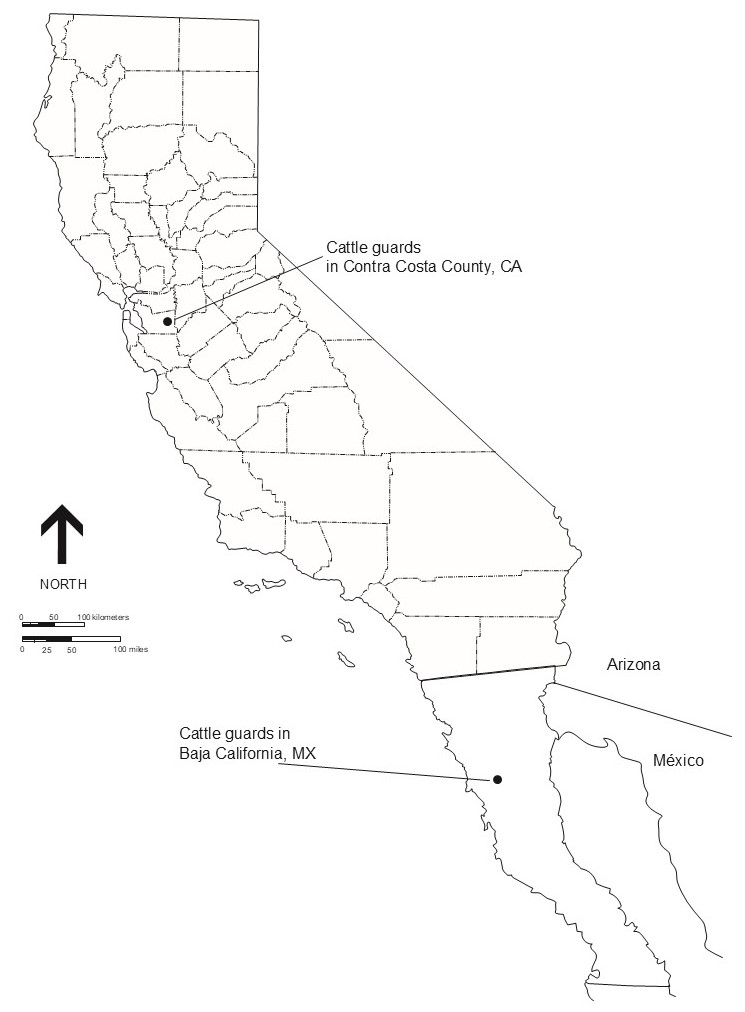
The study area in California included four cattle guards within a 5-km2 area in Contra Costa County, east of the San Francisco Bay. The cattle guards were associated with large tracts of grazing lands and were primarily constructed by land-owning ranchers prior to the 1990s. The surrounding habitat was made up of dry land farming (primarily rye grass) and extensive grazed annual grasslands, with widely interspersed freshwater stock ponds within rolling hill topography.
In northwestern Baja California, we examined 10 cattle guards east of the town of San Telmo. The cattle guards were distributed along a 26-km long contiguous section of highway leading from the town of Punta Colonet east to the Sierra San Pedro Mártir. The surrounding habitat was dominated by mixed chaparral with widely spaced patches of grazed annual grasslands, and with very widely spaced cattle stock ponds.
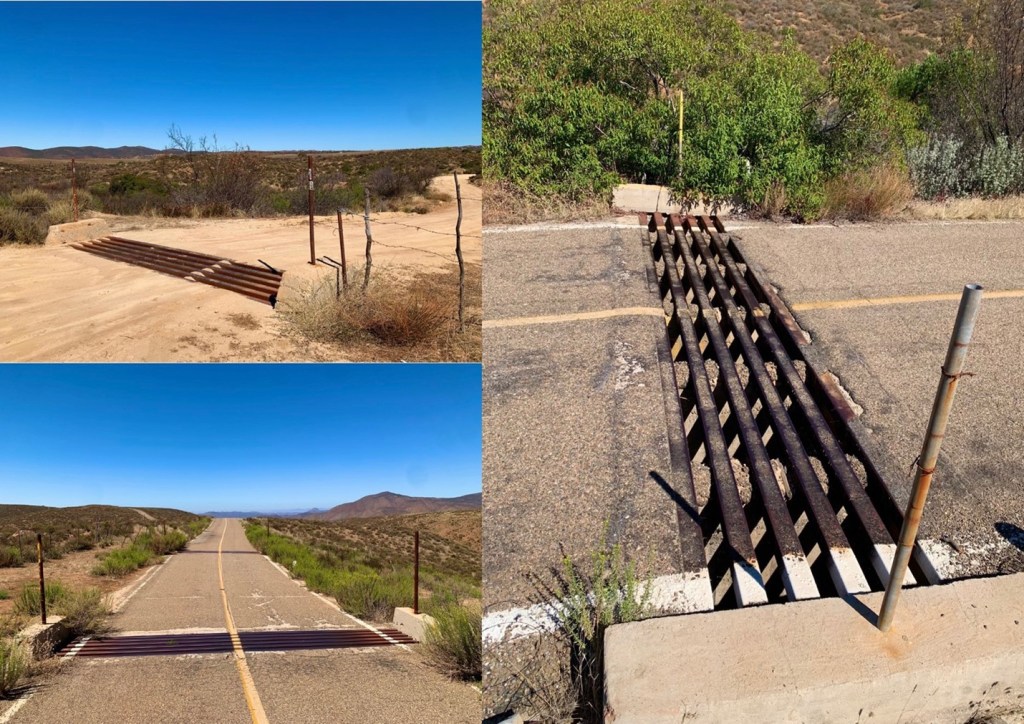
Typically, cattle guards were made up of 6–14 pipes (or similar) that were arranged perpendicular to the direction of roadway traffic and spaced roughly 10 cm apart (Fig. 2). Below the pipes was a pit that was excavated to a depth ranging from 60 to 100 cm in California, or 45 to 150 cm in Baja California. These depressions were lined by a concrete box which held the cross pipes in place but also created a chamber that functioned as a large pitfall trap.
We initially visited cattle guards to make use of them as passive samplers of local wildlife for a separate study but eventually began recording the diversity of live and dead specimens to assess impacts of cattle guard entrapment. We checked cattle guards in California opportunistically for entrapped wildlife 24 times from 2015–2023 (i.e., 96 samples over a nine-year period). We timed these samples very irregularly with a maximum of 145 days between checks. We checked Baja California cattle guards 15 times from 2018–2023 (i.e., 150 samples over five years), revisiting each cattle guard a minimum of once annually with a maximum of 370 days between checks. We conducted surveys only during spring and summer seasons. During each sample, we closely inspected the cattle guard, identified all entrapped vertebrates to the nearest taxonomic level and recorded them as dead or alive. We captured live vertebrates and released them into uplands away from the cattle guards whenever possible.
We pooled data from all cattle guard samples across years within a region (Table 1). We encountered entrapped wildlife in more than 90% of our samples: during a total of 246 individual cattleguard checks we observed at least one animal in 223 samples. Most entrapped animals were dead (136 of the 177 observed animals) and were identified based only on dried skin, fur, and skeletal remains (Fig. 3). Ninety-six percent of all small mammals were found dead, as were 50% of spadefoot toads. Most dead animals showed clear signs of being scavenged by invertebrates or other entrapped wildlife.

Table 1. Entrapped vertebrates detected during 246 opportunistic surveys of cattle guards in Contra Costa County, California and San Telmo, Baja California from 2015–2023. SSC denotes California Species of Special Concern (considered rare or declining).
| Location | Species | N | Status |
| Contra Costa County, CA | Western toad (Anaxyrus boreas) | 56 | common |
| Contra Costa County, CA | California tiger salamander (Ambystoma californiense) | 1 | federally threatened |
| Contra Costa County, CA | Western rattlesnake (Crotalus oreganus) | 1 | common |
| Contra Costa County, CA | Deer mouse (Peromyscus maniculatus) | 1 | common |
| Contra Costa County, CA | San Joaquin pocket mouse (Perognathus inornatus) | 2 | common |
| Contra Costa County, CA | Long-tailed weasel (Mustela frenata) | 1 | common |
| San Telmo, Baja California | Western spadefoot (Spea hammondii) | 6 | SSC |
| San Telmo, Baja California | Coast horned lizard (Phrynosoma blainvillii) | 8 | SSC |
| San Telmo, Baja California | Orange-throated whiptail (Aspidoscelis hyperthyrus) | 1 | SSC |
| San Telmo, Baja California | Western fence lizard (Sceloporus occidentalis) | 2 | common |
| San Telmo, Baja California | Baja California coachwhip (Masticophis fuliginosus) | 1 | SSC |
| San Telmo, Baja California | Coast patch-nosed snake (Salvadora hexalepis) | 1 | SSC |
| San Telmo, Baja California | Red diamond rattlesnake (Crotalus ruber) | 1 | SSC |
| San Telmo, Baja California | California kingsnake (Lampropeltis californiae) | 1 | common |
| San Telmo, Baja California | Greater roadrunner (Geococcyx californianus) | 2 | common |
| San Telmo, Baja California | Lesser nighthawk (Chordeiles acutipennis) | 1 | common |
| San Telmo, Baja California | Desert cottontail (Syvilagus audubonii) | 10 | common |
| San Telmo, Baja California | San Diego pocket mouse (Chaetodipus fallax) | 2 | common |
| San Telmo, Baja California | Dulzura kangaroo rat (Dipodomys simulans) | 72 | common |
| San Telmo, Baja California | Botta´s pocket gopher (Thomomys bottae) | 5 | common |
| San Telmo, Baja California | Mouse (Family Muridae) | 2 | common |
In California, 62 individual animals from six species were entrapped in the cattle guards. The western toad (Anaxyrus boreas) represented 90% of the trapped vertebrates in California (Table 1). We also found >50 western fence lizards (Sceloporus occidentalis) and common side-blotched lizards (Uta stansburiana) that utilized the cattle guards but were not trapped and are not included in our data.
At the Baja California site, we observed 115 entrapped individuals from 15 species (Table 1). All species we encountered in Baja California also occur in California, and six are species of concern in the state. The species most commonly entrapped in Baja California cattle guards was the Dulzura kangaroo rat (Dipodomys simulans), most of which were dead specimens (n = 66). The large number of kangaroo rats found in cattle guards may be attributed to their regional abundance or may be related to their vulnerability relative to the gap size in cattle guards. We also found six live Dulzura kangaroo rats, on separate visits, that were able to dig burrows at the bottom of cattle guards and seek refuge (Fig. 3b). They were subsequently captured using Sherman live-traps and released. The frequency of entrapment of kangaroo rats may be particularly concerning in that California has 21 species or subspecies of kangaroo rat that are considered special status (e.g., California Species of Special Concern, listed under the federal Endangered Species Act or the California Endangered Species Act; CDFW Special Animals List). These kangaroo rats, along with many other species, occur in areas with innumerable cattle guards.
On one occasion, a federally threatened species of amphibian, a California tiger salamander (Ambystoma californiense), was trapped in a California cattle guard that was flooded with rainwater (Fig. 3a). On another occasion, also in California, we found 6 larvae and approximately 40 dead post-metamorphic western toads that were likely hatched from eggs that were laid in the cattle guard when it was inundated in winter. Based on our observations, flooded cattle guards may be an ecological trap for some amphibians by drawing them to an artificial pool habitat that has different drying rates than wetlands in the surrounding landscape.
Our opportunistic surveys show that some types of cattle guards indiscriminately collect a diversity of wildlife, including special-status species, that are unable to escape. Typically, we would find numerous dead animals on the first visit of the season with only up to two live individuals that we could capture and release. We can only speculate on the specific cause of death of each individual, but all were likely related to entrapment. These cattleguards appear to function like a large road-based pit fall trap that is rarely checked and from which animals are very rarely released. This indiscriminate form of trapping may have a localized impact on species in the area and a negative impact on the persistence of declining species, particularly smaller species. Cattle guards are used internationally (Hoy 1982) so this phenomenon has potential to be wide-ranging in scope. We can assume that many animals were entrapped, died, and their remains became undetectable during our disparate visits, making our numbers an underestimate of the frequency of these occurrences. The seasonal nature of our cattle guard checks (during spring and summer only) also likely reduced the number of species and specimens detected. Further, we made no attempt to quantify or identify invertebrates within the cattleguards. This group requires investigation as well since some species may be in decline or considered special-status. Although a simple observational report, this study suggests that unless cattleguards are replaced with wildlife friendly versions, these structures have potential to kill large numbers of some wildlife taxa over many decades.
Our work here illustrates the need for a systematic assessment of cattle guard impacts to wildlife in multiple regions, with a focus on impacts to local populations of declining species in areas where threatened or endangered species exist. We found that 33% (7 of 21) of the species entrapped across all samples were special-status in California, including federally threatened species. Roadways have been previously documented to have significant impacts on wildlife populations (Marsh and Jaeger 2015; Dean et al. 2019), and cattle guards may have a compounding effect that needs to be assessed and addressed.
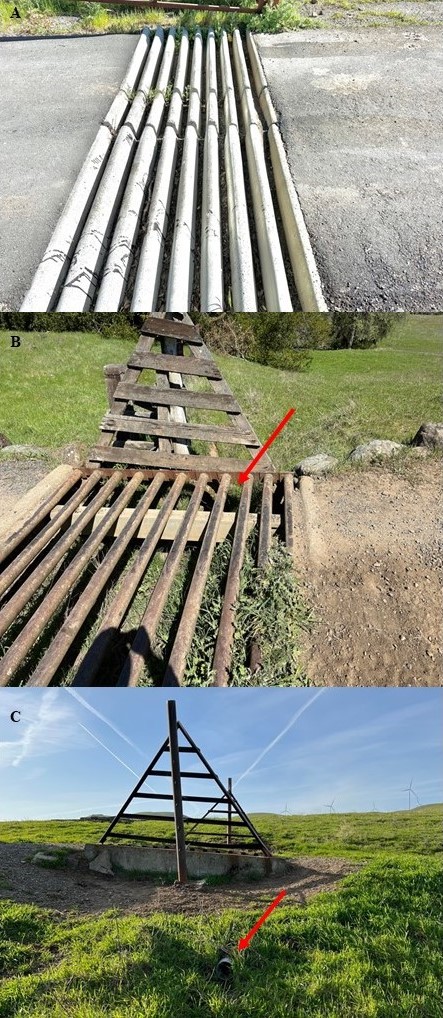
Although cattle guards can be designed to be functionally wildlife friendly, we have only observed this in Sonoma County, CA. One such design uses undulating concrete forms that mimic the horizontal bars in form and function but allow wildlife to walk out of the open edges (Fig. 4a). Other designs simply have open sides that allow water and debris to be flushed out, and wildlife to self-release (Fig. 4b). Another design includes a pipe installed on the sides that allows water and smaller wildlife species to leave the pit-portion of the cattle guard (Fig. 4c). We suggest that existing cattle guards be retrofitted to make them more wildlife-friendly. Retrofitting cattle guards in areas supporting threatened and endangered wildlife that may be vulnerable to entrapment can likely reduce mortality of protected species. We trialed a method of placing ramps (metal and wood) in some cattle guards to provide an escape mechanism for wildlife, but did not explicitly test their effectiveness. At the Baja California site, all ramps were immediately removed by people in the area, making this approach unlikely to work in some cases. We suggest that existing cattle guard pits could be retrofitted to minimize entrapment by filling them with gravel to the level of the horizontal crossbars/pipes. Alternatively, a small (15 cm long x 10 cm wide) ramp could be placed in each gap at the ends of and between crossbars/pipes to facilitate wildlife self-release.
We recommend extensive systematic year-round testing, within many areas, to determine the extent of the potential hazard cattle guards pose to wildlife. We also strongly encourage land managers to retrofit or fill cattle guard chambers to reduce entrapment potential.
Acknowledgments
Our work in California was conducted under Scientific Collecting Permit No. 000040. Work conducted in Baja California was conducted under permits: SGPA/DGVS/013217/18, 02494/20, 01370/22, and 03979/23. We are grateful to J. T. Wilcox of the Sonoma Mountain Ranch Preservation Foundation for access to the Mitsui Ranch to examine wildlife-friendly cattle guards. We are also grateful to D. Noce and R. Kelty for assisting with trapping and releasing live Dulzura kangaroo rats at our México site. Three anonymous reviewers offered constructive suggestions for the manuscript, for which we are very grateful.
Literature Cited
- Alvarez, J. A., J. T. Marty, K. Christopherson, P. Craig, D. Weber, and C. D. Vang. 2021. An unanticipated ecological trap: entrapment of the California tiger salamander in technogenic structures as a confounding stressor for a threatened species. Herpetological Review 52:274–278.
- Cava, Z. A., K. M Garten, S. M. Foster, and J. A. Alvarez. 2022. Observations of extreme dehydration and rehydration leading to recovery of a threatened California tiger salamander. California Fish and Wildlife Journal 108:e9.
- Currylow, A., A. D. Walde, F. Filazaha, A. Mandimbihasina, and L. Woolaver. 2015. Ploughshare tortoise (Astochelys yniphora) natural entrapment. Herpetological Notes 172(8):485–487.
- Dean, W. R. J., C. L. Seymour, G. S. Joseph, and S. H. Foord. 2019. A review of the impacts of roads on wildlife in semi-arid regions. Diversity 11:81.
- Doody, J. S., P. West, J. Stapley, M. Welsh, A. Tucker, E. Guarino, M. Pauza, N. Bishop, M. Head, S. Dennis, G. West, A. Pepper, and A. Jones. 2003. Fauna by-catch in pipeline trenches: Conservation animal ethics, and current practices in Australia. Australian Zoologist 32:410–419.
- Enge, K. M., D. T. Cobb, G. L. Sprandel, and D. L. Francis. 1996. Wildlife captures in a pipeline trench in Gadsden County, Florida. Florida Scientist 59:1–11.
- Germano, D. J., E. Cypher, and R. McCormick. 1993. Use of a barrier to exclude blunt-nosed leopard lizards from a construction zone. Transactions of the Western Section of the Wildlife Society 29:16–19.
- Harris, M., B. Clucas, J. Stanek, and M. Whitefield. 2019. Wildlife mortalities in open-topped pipes in central California. Western Wildlife 6:50–60.
- Hoy, J. F. 1982. The Cattle Guard: Its History and Lore. University Press of Kansas, Lawrence, KS, USA.
- Kornilev, Y. V., S. J. Price, and M. E. Dorcas. 2006. Between a rock and a hard place: response of the eastern box turtle (Terrapene carolina) when trapped between railroad tracks. Herpetological Review 37:145–148.
- Marsh, D. M., and J. A. G. Jaeger. 2015. Direct effects of roads on small animal populations. Pages 42–56 in K. M. Andrews, P. Nanjappa, and S. P. D. Riley. 2015. Roads and Ecological Infrastructure. Johns Hopkins University Press, Baltimore, MD, USA.
- McInroy, C. and T. A. Rose. 2015. Trialing amphibian ladders within roadside gully pots in Angus, Scotland: 2014 impact study. The Herpetological Bulletin 132:15–19.