

ESSAY
Mike Stake* and Kelly Sorenson
Ventana Wildlife Society, 9699 Blue Larkspur Lane, Suite 105, Monterey, CA 93940, USA https://orcid.org/0009-0005-7354-0328 (MS) https://orcid.org/0009-0000-9410-2531 (KS)
*Corresponding Author: mikestake@ventanaws.org
Published 22 May 2026 • doi.org/10.51492/cfwj.112.1
Key words: .22 long rifle, California condor, Gymnogyps californianus, lead-free, lead poisoning, non-lead ammunition, rimfire
| Citation: Stake, M., and K. Sorenson. 2026. A small-caliber shortage might be a big problem for California hunters, ranchers and California condor recovery. California Fish and Wildlife Journal 112:e1. |
| Editor: Ryan Bourbour, Wildlife Branch |
| Submitted: 17 July 2025; Accepted: 6 November 2025 |
| Copyright: ©2026, Stake and Sorenson. This is an open access article and is considered public domain. Users have the right to read, download, copy, distribute, print, search, or link to the full texts of articles in this journal, crawl them for indexing, pass them as data to software, or use them for any other lawful purpose, provided the authors and the California Department of Fish and Wildlife are acknowledged. |
| Competing Interests: The authors have not declared any competing interests. |
Continued cases of lead poisoning among California condors (Gymnogyps californianus), after California laws began requiring the use of non-lead ammunition when shooting wildlife, has hunters, conservationists, and lawmakers searching for answers. Researchers maintain that lead poisoning remains the greatest threat to the recovery of California condors (Rideout et al. 2012; Finkelstein et al. 2012; Bakker et al. 2024) and have identified the ingestion of lead from spent ammunition as the primary source for these scavengers (Church et al. 2006). In a central California condor population ranging from southern Santa Clara County to San Luis Obispo County, we documented 25 condor fatalities due to lead toxicosis in 2020–2024, or an average of 5% annual mortality due to lead during that five-year period (USFWS 2024). This regularity of fatalities due to lead exposure seemed unlikely when the Ridley-Tree Condor Preservation Act was approved in 2007, requiring the use of non-lead ammunition within the condor range of California. The law was extended statewide in 2019 and required non-lead ammunition for shooting any wildlife species with any firearm in the state. Nevertheless, the lead threat remains for scavengers. Continued lead poisoning of condors has some wondering if lead ammunition is still being used, despite the law, and what else needs to be done to solve the lead poisoning problem.
State regulations and poor non-lead availability of the popular .22 LR
Recent state restrictions imposed on ammunition purchasers and inconsistent market availability of non-lead ammunition have complicated the efforts of hunters and ranchers to comply with California’s non-lead requirement. Starting in 2019, the Safety for All Act required all ammunition purchases to be approved by the Department of Justice and all transfers to be conducted face-to-face with licensed ammunition vendors. The face-to-face requirement restricted internet sales, because the ammunition could no longer be shipped directly to the consumer’s address. Hunters were then compelled to purchase ammunition in local stores, but they found availability was limited for some of the non-lead calibers they sought.
Availability of non-lead ammunition has been particularly problematic for small-caliber rimfire. Thomas (2013) reviewed non-lead hunting rifle ammunition with respect to availability, price, and effectiveness, and found that virtually all calibers had a non-lead counterpart. His review, however, did not include small-caliber rimfire, such as .22 Long Rifle (LR), .22 Winchester Magnum Rimfire (WMR) and .17 Hornady Magnum Rimfire (HMR), commonly used to control small non-game mammals (e.g., ground squirrels, Sciuridae). While development and availability of non-lead centerfire ammunition brands for big game hunting have generally increased, shooters have not seen such an increase for small-caliber non-lead rimfire. In early 2024, the only two companies that were manufacturing non-lead .22 LR (CCI and Norma) discontinued production, leaving no choices in this caliber available on the market at that time.
This absence is highly concerning, given that .22 LR is widely considered the most commonly-used rifle caliber. We conducted a survey of local hunters in 2017 which confirmed widespread use of .22 LR in central California. Our 20-question survey was designed primarily to solicit feedback to non-lead ammunition and our free ammunition giveaway. While attitudes among hunters who had received ammunition through our program might not reflect the attitudes of the entire hunting community, our question regarding their use of .22 LR was based on habits rather than attitudes. Of the 213 hunters who responded to our question about whether or not they regularly used a .22 LR, 177 (83%) answered yes. We did not define “regularly” in our survey, but the majority claiming that they regularly shot .22 LR is evidence of the prevailing use of this caliber, at least locally. Frequent use of calibers like .22 LR targeting non-game mammals is particularly concerning because the carcasses are not usually retrieved by the shooter, making them easily accessible to scavenging condors and other wildlife.
Do condors ingest lead from spent .22 LR ammunition?
Although studies have linked lead poisoning to spent ammunition through radioisotope analyses (Finkelstein et al. 2012), these studies have not identified the type of ammunition or the calibers most prevalent. Because lead-core bullets fragment substantially upon impact, and are unlikely to retain their original size and shape, spent bullets are rarely identifiable to type or caliber. However, there have been a few instances when the calibers have been identified or narrowed down to a small range of types (S. Kirkland, U.S. Fish and Wildlife Service, pers. comm.). Those few include two recovered bullets consistent with .22 rimfire. In 2012, we opportunistically discovered an intact .22-caliber lead bullet shank from the digestive track of condor #318 after that bird had died from lead poisoning (Fig. 1). From this observation, we concluded that other condors might also be inadvertently ingesting fragments of lead .22 bullets when consuming targeted varmints such as ground squirrels and coyotes (Canis latrans), and that rimfire calibers should be considered in addition to big game calibers as a potential source of lead poisoning. If non-lead ammunition for one of the most widely-used rifle calibers, the .22 LR, remains off the market, as it has been recently, it would not be surprising if some shooters are still shooting lead. These shooters might otherwise follow the law if their local stores were able to stock non-lead .22 LR.
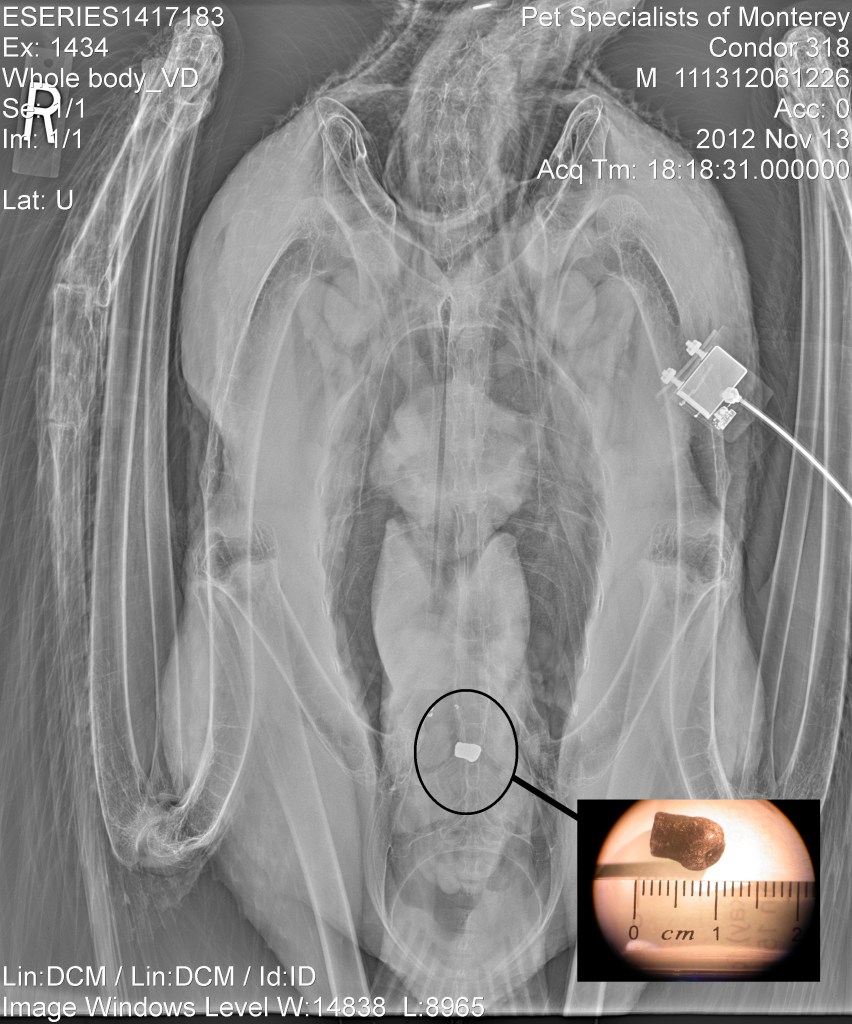
Is non-lead rimfire available in local stores in California?
Given that there are relatively fewer non-lead rimfire brands on the market than lead, and the state law requiring hunters to purchase ammunition through a face-to-face transfer at their local stores, we monitored availability of non-lead rimfire among several retailers in the condor range of central California. We selected 14 stores that made their product inventories available online to the public. From August 2023 through March 2025, we queried availability approximately weekly for all seven of the non-lead .22 LR, .17 HMR, and .22 WMR rimfire brands that were being manufactured during that time. We posted availability on our website Rimfire Roundup (www.rimfireroundup.com) to help local shooters find these brands available in stock. We found a non-lead .22 LR brand available in stock at a store for only 21% of our 1,098 queries (average 78 queries per store). Half of the 14 stores did not have non-lead .22 LR available during any of our queries (Table 1). Availability decreased from 36% for queries in 2023 to 18% in 2024, and again to 9% in 2025. This decline coincided with the discontinuation of non-lead .22 LR by CCI and Norma. Until another non-lead .22 LR brand is released to the mainstream market, we expect that percentage to continue falling as stores sell their remaining stock. We found that availability of non-lead .17 HMR rimfire was also limited during this time, with only 44% of our 1,098 queries showing a non-lead product in stock for this caliber. Non-lead .22 WMR availability was better, being available in stock for 71% of our 1,098 queries. We did not document availability of lead rimfire at these stores for comparison, nor the availability of other types of ammunition. As a licensed ammunition vendor who regularly purchases and distributes ammunition, we have not experienced the same inconsistent availability and limited selection of products on the market for other calibers in recent years as we have for non-lead .22 LR and .17 HMR. If hunters and ranchers regularly shooting these calibers are experiencing difficulty finding non-lead brands available at their local stores, the use of rimfire for pest control on local farms and ranches might be having a considerable impact on condor lead exposure. The fact that varmint control also occurs year-round might also be amplifying the problem.
Table 1. Availability of non-lead .22 LR, .17 HMR, and .22 WMR rimfire in 14 central California stores from August 2024 to March 2025. We indicate if ammunition was in stock (Yes) or out of stock (No) during weekly inquiries to the store.
| Store | .22 LR Yes | .22 LR No | .22 LR % Yes | .17 HMR Yes | .17 HMR No | .17 HMR % Yes | .22 WMR Yes | .22 WMR No | .22 WMR % Yes |
| 1 | 14 | 65 | 18% | 15 | 64 | 19% | 68 | 11 | 86% |
| 2 | 59 | 19 | 76% | 22 | 56 | 28% | 67 | 11 | 86% |
| 3 | 12 | 67 | 15% | 9 | 70 | 11% | 54 | 25 | 68% |
| 4 | 9 | 70 | 11% | 17 | 62 | 22% | 62 | 17 | 78% |
| 5 | 0 | 80 | 0% | 57 | 23 | 71% | 72 | 8 | 90% |
| 6 | 0 | 78 | 0% | 42 | 36 | 54% | 72 | 6 | 92% |
| 7 | 0 | 80 | 0% | 48 | 32 | 60% | 68 | 12 | 85% |
| 8 | 0 | 80 | 0% | 39 | 41 | 49% | 69 | 11 | 86% |
| 9 | 63 | 16 | 80% | 8 | 71 | 10% | 69 | 10 | 87% |
| 10 | 58 | 21 | 73% | 12 | 67 | 15% | 69 | 10 | 87% |
| 11 | 0 | 78 | 0% | 77 | 1 | 99% | 25 | 53 | 32% |
| 12 | 0 | 78 | 0% | 53 | 25 | 68% | 20 | 58 | 26% |
| 13 | 0 | 76 | 0% | 70 | 6 | 92% | 0 | 76 | 0% |
| 14 | 16 | 59 | 21% | 11 | 64 | 15% | 66 | 9 | 88% |
| Total | 231 | 867 | 21% | 480 | 621 | 44% | 781 | 317 | 71% |
A premium price for non-lead rimfire
The problem of availability of non-lead rimfire is exacerbated by the higher cost. Although Thomas (2013) acknowledged that non-lead ammunition costs more, he did not consider that difference to be a major impediment for game shooters making the switch. However, that is likely not the case for many non-game shooters, who shoot at a relatively higher volume of targets than a typical big game hunter. For them, even a small difference in cost per bullet can add up. With non-lead .22 LR ammunition still unavailable on the market in 2025, Cutting Edge Bullets released a limited run of non-lead .22 LR, called the CuRx. Retailing about $45 for a 50-round box, these might be too expensive for the average shooter, who is used to paying 5-10 times less. As of the end of 2025, the CuRx had not become available with other retailers, and shooters were unlikely to find non-lead .22 LR in their local stores among the lead options available on the shelf. Even if shooters were willing to spend extra to purchase the Cutting Edge CuRx, they would be unable to receive direct shipment from that company due to state regulations requiring face-to-face ammunition transfers.
Are there alternatives to non-lead .22 LR?
How can hunters and ranchers comply with California laws requiring the use of non-lead ammunition for shooting wildlife when their only legal point of transfer for ammunition, their local vendors, are stocked nearly exclusively with lead ammunition for a couple of the most common rifle calibers? Legal options for the ethical hunter can be costly and unappealing. Shooters who load their own ammunition can still purchase the components (e.g., bullets, primer, casing, etc.) online and have them shipped to their address, but relatively few will spend the time and money required to load .22 in the quantity they desire. Additionally, the cost for components needed to handload a non-lead .22 cartridge can be at least five times the cost of the factory-loaded lead equivalent, not including the time and equipment needed. Other calibers, such as the new .21 Sharp released by Winchester, offers a non-lead alternative that is similar to .22 LR, but widespread adoption over the traditional .22 LR is yet to be seen. Some ranchers use airgun pellets as an alternative to rifle ammunition, and these pellets are available in a .17 and .22 caliber. We consider promotion of non-lead pellets as an alternative especially worthwhile given the death of condor #1224 in northern California due to the ingestion of a lead pellet (Tiana Williams, Yurok Tribe, personal communication). In their efforts to comply with the non-lead requirement in the face of .22 LR shortages, shooters in California might seek other alternatives, such as rodenticides, for the control of non-game mammals that they consider pests on their properties. However, rodenticides also secondarily poison non-target wildlife (Hosea 2000; Stapp et al. 2024) and the practice might lack the same appeal to landowners as recreational shooting, or “plinking”, which has become a prominent cultural pastime in some rural communities.
Solutions to improve availability and accessibility of non-lead rimfire
Solutions to the problems with non-lead rimfire availability and accessibility need to be sought at a higher level. Manufacturers need incentives for developing and producing quality non-lead rimfire, particularly from the state, because California is the only state requiring non-lead for the shooting of any wildlife. State incentives for manufacturers, like Cutting Edge Bullets, can help them speed the development of non-lead rimfire and streamline manufacturing, thereby allowing more cost effective and competitive pricing. State incentives could also be provided directly to retailers and shooters in the form of subsidies. The state could also provide an exemption from excise taxes for non-lead purchases. An 11% statewide excise tax on all ammunition purchases, both lead and non-lead, was signed into law in 2023 (Assembly Bill 28) and implemented in 2024. This tax, in addition to regular sales tax, added to the burden that shooters switching to non-lead rimfire already carried from increased cost differences and limited ordering options. Reducing this burden for hunters and ranchers by exempting non-lead ammunition purchases from the excise tax could increase affordability of non-lead rimfire options, like the Cutting Edge CuRx, while incentivizing non-lead use. Incentivizing non-lead use could signal manufacturers to increase availability.
The law requiring the use of non-lead ammunition when shooting wildlife in California has not yet achieved the desired effect of resolving the lead threat for condors (Schulz et al. 2023). If this continues, the consequences can be severe. Without a reduction in lead poisoning, the California condor population will continue to require extraordinary management efforts in perpetuity to avoid extinction in the wild (Finkelstein et al. 2012). Changing this pattern does not just depend on hunters and ranchers but the circumstances impacting their switch to non-lead ammunition. Expectations of a rapid transition to non-lead ammunition by hunters and ranchers have been too high, given the higher cost of non-lead, the regulations requiring face-to-face transfers in stores, and especially the inconsistent availability of non-lead rimfire in those stores. Instead of compounding the challenges hunters and ranchers face switching to non-lead ammunition through excise taxes and sales restrictions, efforts should focus instead on the main problem of how to improve availability of non-lead rimfire on the market. Hunters and ranchers need better access to non-lead rimfire to advance wildlife protection, as the law intended. The recovery of California condors depends on it.
Literature Cited
- Bakker, V. J., M. E. Finkelstein, D. F. Doak, S. Kirkland, J. Brandt, A. Welch, R. Wolstenholme, J. Burnett, A. Punzalan, and P. Sanzenbacher. 2024. Practical models to guide the transition of California condors from a conservation-reliant to a self-sustaining species. Biological Conservation 291:110447. www.doi.org/10.1016/j.biocon.2024.110447
- Church, M. E., R. Gwiazda, R. W. Risebrough, K. Sorenson, C. P. Chamberlain, S. Farry, W. Heinrich, B. A. Rideout, and D. R. Smith. 2006. Ammunition is the principal source of lead accumulated by California condors re-introduced to the wild. Environmental Science & Technology 40(19):6143–6150.
- Finkelstein, M. E., D. F. Doak, D. George, J. Burnett, J. Brandt, M. Church, J. Grantham, and D. R. Smith. 2012. Lead poisoning and the deceptive recovery of the critically endangered California condor. Proceedings of the National Academy of Sciences 29:11449–11454.
- Hosea, R. C. 2000. Exposure of non-target wildlife to anticoagulant rodenticides in California. Proceedings of the 19th Vertebrate Pest Conference 19:236–244.
- Rideout, B. A., I. H. Stalis, R. Papendick, A. P. Pessier, B. Puschner, M. E. Finkelstein, D. R. Smith, M. Johnson, M. Mace, R. Stroud, J. Brandt, J. Burnett, C. N. Parish, J. Petterson, C. Witte, C. Stringfield, K. Orr, J. Zuba, M. Wallace, and J. Grantham. 2012. Patterns of mortality in free-ranging California condors (Gymnogyps californianus). Journal of Wildlife Diseases 48(1):95–112.
- Schulz, J. H., S. Totoni, S. A. W. Stanis, C. J. Li, M. Morgan, D. M. Hall, E. B. Webb, and R. M. Rotman. 2023. Policy comparison of lead hunting ammunition bans and voluntary nonlead programs for California condors. Wildlife Society Bulletin 47:e1448. www.doi.org/10.1002/wsb.1448.
- Stapp, P., A. McKenzie, D. M. Bucklin, R. A. Baldwin, and N. Quinn. 2024. Patterns of exposure of coyotes to anticoagulant rodenticides in California, USA. Journal of Wildlife Management 89:e22696. www.doi.org/10.1002/jwmg.22696
- Thomas, V. G. 2013. Lead-free hunting rifle ammunition: product availability, price, effectiveness, and role in global wildlife conservation. Ambio 42(6):737–745. www.doi.org/10.1007/s13280-012-0361-7
- U.S. Fish and Wildlife Service (USFWS). 2024. California condor population status report. Ventura fish and Wildlife Office, Ventura, CA, USA.