

RESEARCH NOTE
Robert A. Leidy*
University of California, Berkeley, Department of Environmental Science, Policy & Management, Berkeley, CA 94720, USA  https://orcid.org/0000-0003-3410-2737
*Corresponding Author: raleidy@berkeley.edu
Published 22 May 2026 • doi.org/10.51492/cfwj.112.2
Key words: extinct thicktail chub, Gila crassicauda, Lernaea cyprinacea, non-native parasitic copepod, Sacramento-San Joaquin Delta
| Citation: Leidy, R. A. 2026. Documentation of a non-native anchor worm on the extinct thicktail chub, Sacramento-San Joaquin River Delta, California. California Fish and Wildlife Journal 112:e2. |
| Editor: Mark Gard, Conservation Engineering Branch |
| Submitted: 1 February 2026; Accepted: 17 February 2026 |
| Copyright: ©2026, Leidy. This is an open access article and is considered public domain. Users have the right to read, download, copy, distribute, print, search, or link to the full texts of articles in this journal, crawl them for indexing, pass them as data to software, or use them for any other lawful purpose, provided the authors and the California Department of Fish and Wildlife are acknowledged. |
| Competing Interests: The author has not declared any competing interests. |
The endemic thicktail chub (Gila crassicauda) was last recorded in 1957 in California’s Sacramento-San Joaquin Delta (Delta) by the California Department of Fish and Game and was declared extinct in 1980 (Mills and Mamika 1980). Extensive alterations to aquatic habitats within the thicktail chub’s historical range, such as the Central Valley, Delta, Clear Lake, streams of San Francisco Bay, and the Monterey Bay watershed, in addition to the introduction of non-native fish species, have been postulated as the primary factors contributing to the species’ decline and extinction (Miller 1963; Mills and Mamika 1980; Moyle 2002). Although archaeological evidence indicates the thicktail chub was once widely distributed and abundant (Gobalet et al. 2004), its ecology and the specific drivers of its extinction remain poorly understood.
Lernaea cyprinacea, commonly referred to as the anchor worm, is a parasitic copepod belonging to the family Lernaeidae that infects both fish and amphibians (Kupferberg et al. 2009). Anchor worm was introduced to North America from Europe and Asia (Hoffman 1999). The earliest records in the Midwest date to the 1920s and 1930s, and by the 1940s, the species had expanded its range to northern California and the Central Valley (Tidd 1934; Haderlie 1950). Anchor worm was likely introduced into the Delta as a hitchhiker on non-native fish species such as common carp (Cyprinus carpio), goldfish (Carassius auratus), threadfin shad (Dorosoma petenense), or fathead minnow (Pimephales promelas) (Tidd 1934; Hoffman 1999). Common carp and goldfish were widespread and abundant in the Central Valley and Delta by the early 1880s, and threadfin shad and fathead minnow became prevalent in the Delta by the early 1950s (Dill and Cordone 1997). Infestation by this parasite leads to tissue irritation and inflammation, and secondary infections on the host, which can result in mortality or diminished growth and body condition (Haley and Winn 1959; Khalifa and Post 1976).
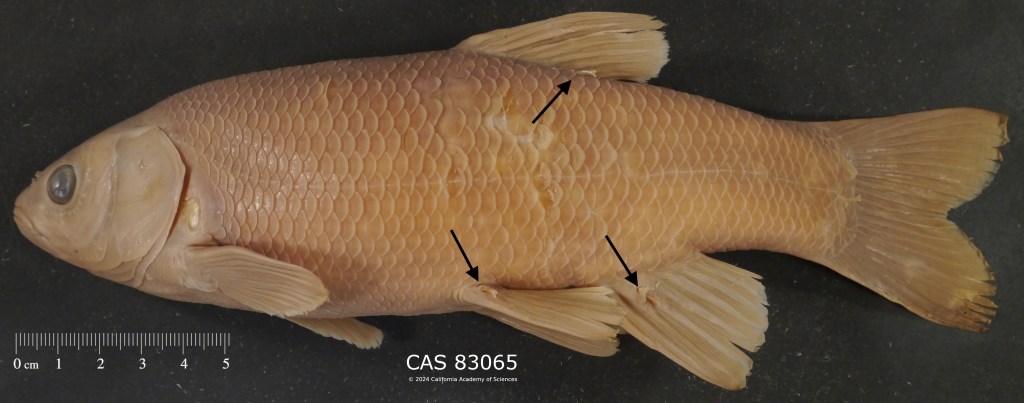
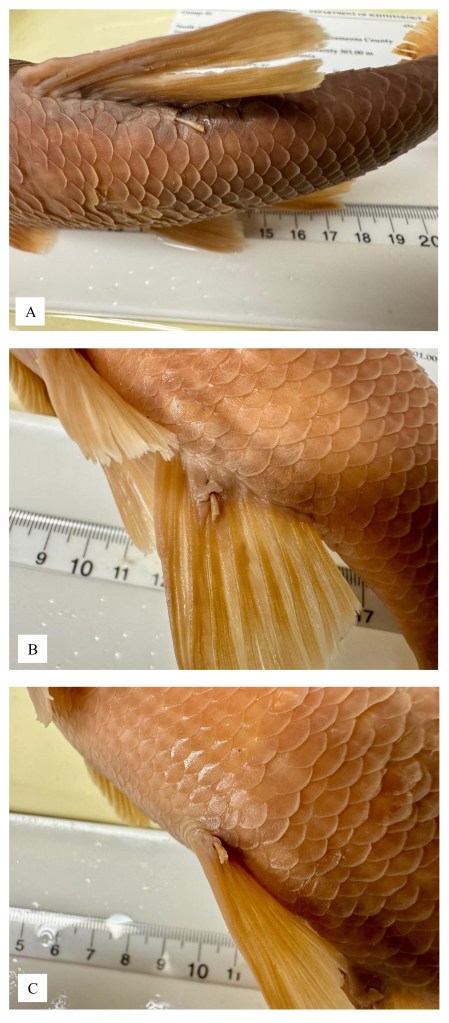
Three adult female anchor worms were identified on the last documented individual of thicktail chub (188 mm SL) housed at the California Academy of Sciences, San Francisco, CA, USA, collected from the Delta on 16 April 1957 (collection number: CAS-ICH 83065) (Fig. 1). This observation is the earliest recorded occurrence of anchor worm in the San Francisco Bay Estuary. On the left side of the fish, single anchor worms were attached posteriorly at the base of the dorsal, anal, and pelvic fins (Fig. 2). A fibrous, tumor-like nodule developed around the insertion points of the heads of the parasites. In each case, the integument was penetrated, but it is unclear whether the muscle tissue was pierced as well. Damage to scales at the parasite insertion site was also observed. Haderlie (1950) reported that the skin and flesh surrounding the anchor worm penetration site often develop bleeding ulcers, a condition not observed in this specimen. The absence of visible bleeding ulcers may be the result of prolonged exposure to preservatives that tends to desiccate tissue. No additional external parasites, lesions, sores, or wounds were observed on the thicktail chub, and the specimen did not appear thin or emaciated.
Anchor worm predominantly infects cyprinid species (Haley and Winn 1959; Lester and Hayward 2006). From 1947 to 1950, Haderlie (1950) documented anchor worm infestations in three native cyprinid species in northern California, excluding the Delta: Sacramento hitch (Lavinia exilicauda), Sacramento blackfish (Orthodon microlepidotus), and hardhead (Mylopharodon conocephalus). In 1972 and 1973, Hensley and Nahhas (1975) reported infestations in two more cyprinid species in the Delta: Sacramento pikeminnow (Ptychocheilus grandis) and Sacramento splittail (Pogonichthys macrolepidotus). Historically, these cyprinid species formed assemblages that included the thicktail chub (Moyle 2002). Given the prevalence of native cyprinids as hosts for the anchor worm, the thicktail chub would also be expected to exhibit susceptibility to infection. Nevertheless, anchor worms were not detected on any of the eight additional thicktail chub specimens examined from collections made between 1936 and 1950 (CAS-ICH 66429(3 specimens), CAS-SU(ICH) 37361(1), CAS-SU(ICH) 29510(3), CAS-SU(ICH) 20456(1)).
After 1938, only five thicktail chub records were documented across its range, all preserved at the California Academy of Sciences. This suggests the species had become extremely rare by 1957 when the last specimen was recorded. Pathogen introduction can alter food web structure, change foraging behavior, and negatively impact fish condition, growth, and mortality (Gozlan et al. 2010; Britton et al. 2011; Britton 2013). In commercial aquaculture, severe infestations of anchor can be lethal, especially when secondary bacterial and fungal infections develop at parasite worm attachment sites (Hoffman 1999). High densities of anchor worms can injure juvenile fish by damaging gills and impairing respiration (Steckler and Yanong 2013). Anchor worm infections are associated with reduced growth rates and poor body condition. Durham et al. (2002) showed that anchor worm infection reduced the body condition of Arkansas River shiners (Notropis girardi), as evidenced by altered weight-length relationships. Bond (2004) found that anchor worm infestation in two native eastern Australian freshwater fish species led to higher mortality and reduced swimming ability, thereby increasing vulnerability to predation. Hoffnagle et al. (2006) also reported that juvenile humpback chub (Gila cypha) from the Lower Colorado River infected with anchor worms had lower body fat than uninfected individuals. The specific impacts of the introduced anchor worm on thicktail chub remain unstudied. Predation risk likely increases when multiple anchor worm infestations weaken individual fish, especially juveniles that may be more vulnerable to the harmful effects of infestation. Combined with habitat loss and the introduction of non-native fish species, anchor worms may have produced chronic and cumulative negative impacts on the body condition on any remaining small populations of thicktail chub. The detection of anchor worm infestation in the extinct thicktail chub suggests that studies of population decline in rare and extinct fish species should consider parasitism alongside habitat loss and the introduction of non-native fish as drivers of decline.
Acknowledgments
Many thanks to J. Fong, California Academy of Sciences, Ichthyology Department, for allowing access to thicktail chub specimens and for providing the image in Figure 1. I am grateful to S. Carlson for reviewing a draft of this manuscript.
Literature Cited
- Bond, N. R. 2004. Observations on the effects of the introduced parasite Lernaea cyprinacea on a lowland population of a small native Australian fish, mountain galaxias Galaxias olidus. Victorian Naturalist 121:194–198.
- Britton, J. R. 2013. Introduced parasites in food webs: new species, shifting structures? Trends in Ecology and Evolution 28:93–99. https://doi.org/10.1016/j.tree.2012.08.020
- Britton, J. R, J. Pegg, and C. F. Williams. 2011. Pathological and ecological host consequences of infection by an introduced fish parasite. PLOS ONE 6(10):e26365. https://doi.org/10.1371/journal.pone.0026365
- Dill, W. A., and A. J. Cordone. 1997. Fish Bulletin 178. History and status of introduced fishes in California, 1871–1996. California Department of Fish and Game, Sacramento, CA, USA. https://escholarship.org/uc/item/5rm0h8qg
- Durham, B. W., T. H. Bonner, and G. R. Wilde. 2002. Occurrence of Lernaea cyprinacea on Arkansas River shiners and peppered chubs in the Canadian River, New Mexico and Texas. Southwestern Naturalist 47:95–98. https://doi.org/10.2307/3672807
- Gobalet, K. W., P. D. Schulz, T. A. Wake TA, and N. Siefkin. 2004. Archeological perspectives on Native American fisheries of California, with emphasis on steelhead and salmon. Transactions of the American Fish Society 133:801–833. https://doi.org/10.1577/T02-084.1
- Gozlan, R. E., J. R. Britton, I. Cowx, and G. H. Copp. 2010. Current knowledge on non‐native freshwater fish introductions. Journal of Fish Biology 76:751–786. https://doi.org/10.1111/j.1095-8649.2010.02566.x
- Haderlie, E. C. 1950. Parasites of the fresh-water fishes of northern California. Dissertation, University of California, Berkeley, CA, USA.
- Haley, J. A., and H. E. Winn. 1959. Observations on a lernaean parasite of freshwater fishes. Transactions of the American Fisheries Society 88:128–129. https://doi.org/10.1577/1548-8659(1959)88[128:OOALPO]2.0.CO;2
- Hensley, G. H., and F. M. Nahhas. 1975. Parasites of fishes from the Sacramento-San Joaquin Delta, California. California Fish and Game 61:201–208. https://www.biodiversitylibrary.org/item/61827#page/1/mode/1up
- Hoffman, G. L. 1999. Parasites of North American Freshwater Fishes. 2nd edition. Cornell University Press, Ithica, NY, USA.
- Hoffnagle, T. L., A. Choudhury, and R. A. Cole. 2006. Parasitism and body condition in humpback chub from the Colorado and Little Colorado rivers, Grand Canyon, Arizona. Journal of Aquatic Animal Health 18:184–193. https://doi.org/10.1577/H05-046.1
- Khalifa, K. A., and G. Post. 1976. Histopathological effect of Lernaea cyprinacea (a copepod parasite) on fish. The Progressive Fish-Culturist 38:110–113.
- Kupferberg, S. J., A. Catenazzi, K. Lunde, J. Lind, and W. J. Palen. 2009. Parasitic copepod (Lernaea cyprinacea) outbreaks in foothill yellow-legged frogs (Rana boylii) linked to unusually warm summers and amphibian malformations in northern California. Ichthyology & Herpetology 2009:529–537. https://doi.org/10.1643/CH-08-011
- Lester, R. G., C. J. Hayward. 2006. Phylum Arthropoda. Pages 466–565 in P. T. K. Woo, editor. Fish Diseases and Disorders. Volume 1: Protozoan and Metazoan Infections. CAB International, Wallingford, UK. https://doi.org/10.1079/9780851990156.0466
- Miller, R. R. 1963. Synonymy, characters, and variation of Gila crassicauda, a rare Californian minnow, with an account of its hybridization with Lavinia exilicauda. California Fish and Game 49:20–29. https://www.biodiversitylibrary.org/item/61611#page/5/mode/1up
- Mills, T. J., and K. A. Mamika. 1980. The thicktail chub, Gila crassicauda, an extinct California fish. California Department of Fish and Game, Sacramento, CA, USA.
- Moyle, P. B. 2002. Inland Fishes of California: Revised and Expanded. University of California Press, Berkeley, CA, USA.
- Steckler, N., and R. P. Yanong. 2013. Lernaea (anchorworm) infestations in fish: FA185, 12/2012. EDIS 2013(2). Gainesville, FL, USA. https://doi.org/10.32473/edis-fa185-2012
- Tidd, W. M., 1934. Recent infestations of goldfish and carp by the “anchor parasite,” Lernaea carassii. Transactions of the American Fisheries Society 64:176–180. https://doi.org/10.1577/1548-8659(1934)64[176:RIOGAC]2.0.CO;2