

Research Note
Steve Pagliughi*
Windward Environmental Consulting, P.O. Box 5163, Clinton, NJ 08809, USA
*Corresponding Author: spagliughi@yahoo.com
Published 22 May 2026 • doi.org/10.51492/cfwj.112.6
Key words: age, growth, otolith, longevity, Spotted Bass, Micropterus punctulatus, California, Whiskeytown Reservoir
| Citation: Pagliughi, S. 2026. Longevity record for Spotted Bass. California Fish and Wildlife Journal 112:e6. |
| Editor: Abimeal Léon, Central Region |
| Submitted: 15 October 2025; Accepted: 2 March 2026 |
| Copyright: ©2026, Pagliughi. This is an open access article and is considered public domain. Users have the right to read, download, copy, distribute, print, search, or link to the full texts of articles in this journal, crawl them for indexing, pass them as data to software, or use them for any other lawful purpose, provided the authors and the California Department of Fish and Wildlife are acknowledged. |
| Competing Interests: The author has not declared any competing interests. |
A review of available literature found the maximum age reported for Spotted Bass (Micropterus punctulatus) was 11 years. Carlander’s (1977) summary reported a maximum age of 7 years (Cooper 1950; Roseberry 1951; Charles 1957) as did Vogele (1975). Eggleton et al. (2013) sampled fish up to eight years old on the Arkansas River. In a study of Alabama reservoirs, DiCenzo et al. (1995) observed fish at least 7 years old in 6 of the 10 reservoirs sampled with a maximum age of 11 years. Other authors reporting a maximum age of 11 years include Risley (2006) on Table Rock Lake (this study also sampled fish up to 10 years old on Bull Shoals Lake), Alford and Heimann (2016) in the Lake Pontchartrain basin, and Webb and Reeves (1975) on Lake Taneycomo in Missouri, based on a personal communication with the Missouri Department of Conservation.
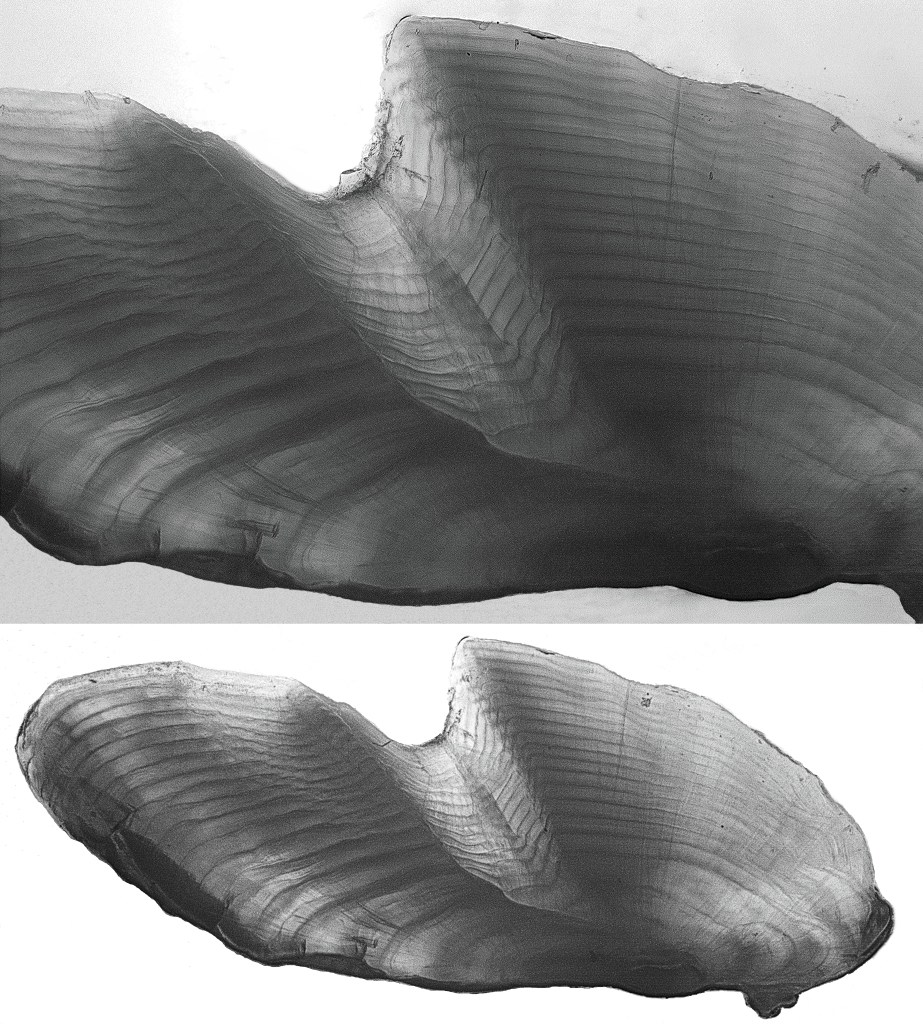
On 19 June 2009, a recreational angler caught a Spotted Bass from Whiskeytown Reservoir, Shasta County, California that weighed approximately 2.95 kg, was 514 mm total length, and had a girth of 378 mm. Sagittal otoliths taken from this fish were sectioned along the transverse plane, mounted on microscope slides, ground, and polished consistent with methods described by Pagliughi (2002). Images of the otolith sections were taken using an AmScope high speed color camera (model No. MU1803-HS) mounted to a compound microscope and modified using version 10 of AmScope imaging software. Examination of the images confirmed 17 clearly defined annuli and an 18th annulus (Fig. 1) forming on the structure edge making this fish 18 years-old per the age designation convention described by DeVries and Frie (1996). Although the 18th annulus was not fully formed, the age of this fish can confidently be assigned 18 because it was harvested in June, is a large fish, annual water temperatures in Whiskeytown Reservoir are comparatively cold, and the translucent section of the otolith between the 17th annulus and the structure edge is fairly wide.
Many large Spotted Bass have been caught in California since their introduction in 1933 (Dill and Cordone 1997) including several International Game Fish Association certified world records. Whiskeytown Reservoir annually produces trophy-sized Spotted Bass. Many of the California reservoirs that have produced large Spotted Bass are oligotrophic, located in mountainous regions, and have relatively cold year-round water temperatures. To my knowledge, data characterizing the age of Spotted Bass from California waters are not available. For these reasons, the 18-year-old Spotted Bass reported in this paper may not be a particularly unusual age for this species in California reservoirs.
Literature Cited
- Alford, J. B., and B. Heimann. 2016. Spotted bass population structure and diet in wadeable and non-wadeable streams draining the Lake Pontchartrain basin. Journal of the Southeastern Association of Fish and Wildlife Agencies 3:17–24.
- Carlander, K. D. 1977. Handbook of Freshwater Fishery Biology, Volume 2. Iowa State University Press, Ames, IA, USA.
- Charles, J. R. 1957. Final report on population manipulation studies on three Kentucky streams. Proceedings of the Annual Conference, Southeastern Association of Game and Fish Commissioners 11:155–185.
- Cooper, W. A., Jr. 1950. Age, growth and food habits of the largemouth black bass (Micropterus salmoides) and the spotted bass (Micropterus punctulatus) in north and east Texas lakes. Thesis, North Texas State College, Denton, TX, USA.
- DeVries, D. R., and R. V. Frie. 1996. Determination of age and growth. Pages 483–512 in B. R. Murphy and D. W. Willis, editors. Fisheries Techniques. 2nd edition. American Fisheries Society, Bethesda, MD, USA.
- DiCenzo, V., M. J. Maceina, and W. C. Reeves. 1995. Factors related to growth and condition of the Alabama subspecies of spotted bass in reservoirs. North American Journal of Fisheries Management 15:794–798.
- Dill, W. A., and A. J. Cordone. 1997. History and status of introduced fishes in California, 1871–1996. Fish Bulletin 178. California Department of Fish and Game, Sacramento, CA, USA.
- Eggleton, M. A., B. G. Batten, C. R. Peacock, and S. E. Lochmann. 2013. Spotted bass population characteristics and relationships with macrohabitat variables in the Arkansas River, Arkansas. Proceedings of the Southeastern Association of Fish and Wildlife Agencies 66:49–56.
- Risley, J. T. 2006. Growth and population assessment of spotted bass (Micropterus Punctulatus) in Beaver, Table Rock, and Bull Shoals Lakes, Northern Arkansas-Southern Missouri. Thesis, Missouri State University, Springfield, MO, USA.
- Pagliughi, S. W. 2002. Age and growth of largemouth bass at Freshwater Lagoon, Humboldt County, California. Thesis, Humboldt State University, Arcata, CA, USA.
- Roseberry, D. A. 1951. Fishery management of Clayton Lake, an impoundment on the New River in Virginia. Transactions of the American Fisheries Society 80:194–209.
- Vogele, L. E. 1975. The spotted bass. Pages 21–33 in H. Clepper, editor. Black Bass Biology and Management. Sport Fishing Institute, Washington, D.C., USA.
- Webb, J. F., and W. C. Reeves. 1975. Age and growth of Alabama spotted bass and northern largemouth bass. Pages 204–215 in H. Clepper, editor. Black Bass Biology and Management. Sport Fishing Institute, Washington, D.C., USA.