

RESEARCH NOTE
María del Carmen Rodríguez-Medrano1, Zurisaday Ramírez-Mendoza1, Oscar Sosa-Nishizaki1, Nicholas C. Wegner2, John R. Hyde2, Owyn Snodgrass2, Heidi Dewar2, Scott A. Aalbers3, and Chugey A. Sepulveda3*
1 Centro de Investigacion Cientifica y de Educacion Superior de Ensenada (CICESE), Biological Oceanography Department, Carretera Tijuana-Ensenada 3918, Zona Playitas, Ensenada, Baja California 22860, Mexico https://orcid.org/0009-0001-9767-1198 (MCRM) https://orcid.org/0000-0002-6824-666X (ZRM) https://orcid.org/0000-0002-3043-768X (OSN)
2 National Oceanic and Atmospheric Administration, National Marine Fisheries Service, Southwest Fisheries Science Center, 8901 La Jolla Shores Drive, La Jolla, CA 92037, USA https://orcid.org/0000-0002-8447-1488 (NCW) https://orcid.org/0000-0002-2658-3254 (JRH) https://orcid.org/0009-0007-0656-4252 (OS) https://orcid.org/0000-0002-8202-1387 (HD)
3 Pfleger Institute of Environmental Research, 315 Harbor Drive South, Unit B, Oceanside, CA 92054, USA https://orcid.org/0000-0003-4510-501X (SAA) https://orcid.org/0000-0002-2987-7880 (CAS)
*Corresponding Author: chugey@pier.org
Published 8 October 2026 • doi.org/10.51492/cfwj.112.8
Key words: age, calcified structures, growth, Lampris incognitus, management, teleost
| Citation: Rodríguez-Medrano, M. C., Z. Ramírez-Mendoza, O. Sosa-Nishizaki, N. C. Wegner, J. R. Hyde, O. Snodgrass, H. Dewar, S. A. Aalbers, and C. A. Sepulveda. 2026. Determining the preferred structure for aging smalleye Pacific opah in the Eastern North Pacific. California Fish and Wildlife Journal 112:e8. |
| Editor: Laura Rogers-Bennett and Morgan Ivers-Duran, Marine Region |
| Submitted: 11 February 2026; Accepted: 27 March 2026 |
| Copyright: ©2026, Rodríguez-Medrano et al. This is an open access article and is considered public domain. Users have the right to read, download, copy, distribute, print, search, or link to the full texts of articles in this journal, crawl them for indexing, pass them as data to software, or use them for any other lawful purpose, provided the authors and the California Department of Fish and Wildlife are acknowledged. |
| Funding: This work was supported by The Offield Family Foundation, The George T. Pfleger Foundation, The Harris Foundation and Builders Vision. Funding was also provided by NOAA SWFSC contract # 1305M323PNFFR0278. |
| Competing Interests: The authors have not declared any competing interests. |
Estimating age and growth is fundamental to understanding fish life history and fishery productivity, supporting both single-species and ecosystem-based management (Campana 2001; Kerns and Lombardi-Carlson 2017). Age can be estimated through length-frequency analysis or growth observations from fish of known age (Phelps et al. 2017) but is most commonly determined by counting growth increments in calcified structures, including otoliths, vertebrae, and fin spines or rays (Casselman 1983; Phelps et al. 2017). While aging procedures are often similar across species, both the precision and accuracy of age estimates can vary due to differences in the morphology, composition, development, and growth of calcified structures (Beamish and Fournier 1981; Campana et al. 1995; Whitledge 2017). Therefore, multiple structures are often compared and evaluated to determine their suitability for age estimation within a given population. For example, in many pelagic fishes, otoliths are comparatively small and delicate, requiring the use of other calcified structures for aging (Beamish 1981; Sun et al. 2001, 2002; Young and Drake 2004; Millot et al. 2023). Identifying the most suitable structure thus requires detailed comparison among potential aging structures (Isely and Grabowski 2007; Kerns and Lombardi-Carlson 2017), yet such studies remain lacking for many fish species.
The smalleye Pacific opah (Lampris incognitus) is a large, laterally compressed pelagic fish that has increasingly become a valuable component of high-seas pelagic fishing operations in the North Pacific (Ito 2023). In recent decades, opah landings have risen in both U.S. and Mexican longline fisheries, with up to 800 tons landed in Hawaiʻi annually (Cooper et al. 2022). Despite its growing importance to regional fisheries, opah age and growth parameters remain poorly understood, and the species continues to be managed as incidental catch without a formal fishery management plan.
Though originally believed to be a single globally distributed species, the opah (L. guttatus) has now been divided into at least five distinct species, including two in the North Pacific (Underkoffler et al. 2018). Despite overlapping distributions in the North Pacific, the smalleye Pacific opah can be distinguished from the bigeye Pacific opah (Lampris megalopsis) by morphometric differences in both eye and pectoral fin size, as well as through genetic testing (Hyde et al. 2014; Underkoffler et al. 2018).
At least three previous studies have produced mixed recommendations on which calcified structures are optimal for aging opah (Lampris spp.). The most comprehensive study to date was conducted by Francis et al. (2004), who noted that the otoliths were “unsuitable for aging” and primarily focused on using the second ray of the dorsal fin to age opah sampled off New Zealand (likely L. australensis or L. megalopsis). However, because dorsal-fin ray sections were difficult to interpret and readability scores were uniformly poor, Francis et al. (2004) recommended that future aging studies evaluate other hard parts, including the vertebrae and cleithra, a large bone of the pectoral girdle. Similarly, Hawn et al. (2002) concluded that dorsal-fin rays were the preferred aging structure for opah collected off Hawai’i (likely L. megalopsis or L. incognitus) and noted that opah otoliths are composed of vaterite, making them fragile and difficult to work with. However, Hawn et al. (2002) did not provide a detailed justification or comparative data among these or other calcified structures. Additionally, Sinis (2004) conducted a preliminary aging analysis using cycloid scales of a single opah specimen (L. guttatus) from the Mediterranean but reported that growth rings were inconsistent and not visible on all scales.
Considering the recent reclassification from a single worldwide opah species (L. guttatus) into five distinct species (Hyde et al. 2014; Underkoffler et al. 2018), it remains unclear whether any prior aging studies have specifically examined the smalleye Pacific opah considered here. Underkoffler et al. (2018) suggest that L. incognitus is likely restricted to the central and eastern Pacific; therefore, Hawn et al. (2002) may have included this species in their aging study. In any case, challenges in accurately aging opah appear to transcend species and may extend across the order Lampridiformes, as Midway and Wagner (2016) also reported difficulty interpreting otolith growth rings in oarfish (Regalecus russellii) and suggested that dorsal-fin rays may be more reliable for age determination.
Given its growing economic importance and the lack of biological information available for management, the purpose of this pilot study was to assess and compare calcified structures suitable for aging the smalleye Pacific opah. This collaborative work between U.S. and Mexican scientists is intended to promote future biological research and improve the capacity for international management of the opah resource.
We examined 10 smalleye Pacific opah in this study, including four individuals used for preliminary dissections in Phase 1 and six additional individuals evaluated during Phase 2. Individuals were verified as smalleye Pacific opah based on morphometric measurements (FL to eye ratio) and confirmed through genetic analysis conducted at the SWFSC (Hyde et al. 2014; Cooper et al. 2022).
Following a thorough literature survey, we performed preliminary dissections of four smalleye Pacific opah to extract hard parts (Phase 1), including dorsal-fin rays, vertebrae, otoliths, and cleithra. We used Phase 1 samples to identify the calcified structures most practical for age evaluation, but these samples were not used to estimate age. Phase 1 assessment of all fin rays from the single dorsal fin revealed that the first and second rays of the dorsal fin exhibited the clearest and most distinguishable growth rings, making them the most appropriate for aging. Also, during Phase 1, an assessment of the entire vertebral column from a single specimen indicated that the optimal location for vertebral extraction was from vertebrae 8 to 13, based on accessibility, enhanced visibility, and the consistency of growth rings relative to other vertebral regions examined. During Phase 1, we sectioned a subsample of vertebrae sagittally into 5-mm sections adjacent to the centrum using an IsoMet low-speed saw, and mounted cross-sections on slides with Cytoseal 60 glue. However, distinct growth rings were not visible in vertebral cross sections; therefore, whole stained vertebrae were subsequently used for aging. Although growth rings were initially visible in paired cleithra without magnification, no consistent pattern was observed during Phase 1; thus, cleithra were not further evaluated.
During preliminary dissections in Phase 1, attempts to remove intact otoliths were largely unsuccessful, and broken structures were difficult to manipulate for visualizing growth rings. Consequently, we refined extraction methods during Phase 2 to more effectively remove intact otoliths. We used sagitta otoliths, subsequently referred to as otoliths, due to their larger size and to maintain consistency with previous opah aging work (Francis et al. 2004).
During Phase 2 of the study, we purchased six additional smalleye Pacific opah (97–111 cm fork length [FL]; estimated weights 20–65 kg) whole from U.S. and Mexican commercial fishing vessels operating out of the ports of San Diego and Oceanside, California, USA, and Ensenada, Baja California, Mexico. Opah were frozen whole and transported to the laboratory at the Centro de Investigación Científica y de Educación Superior de Ensenada (CICESE) to conduct a more standardized assessment of potential aging structures and formal comparison of associated age estimates (Fig. 1i).
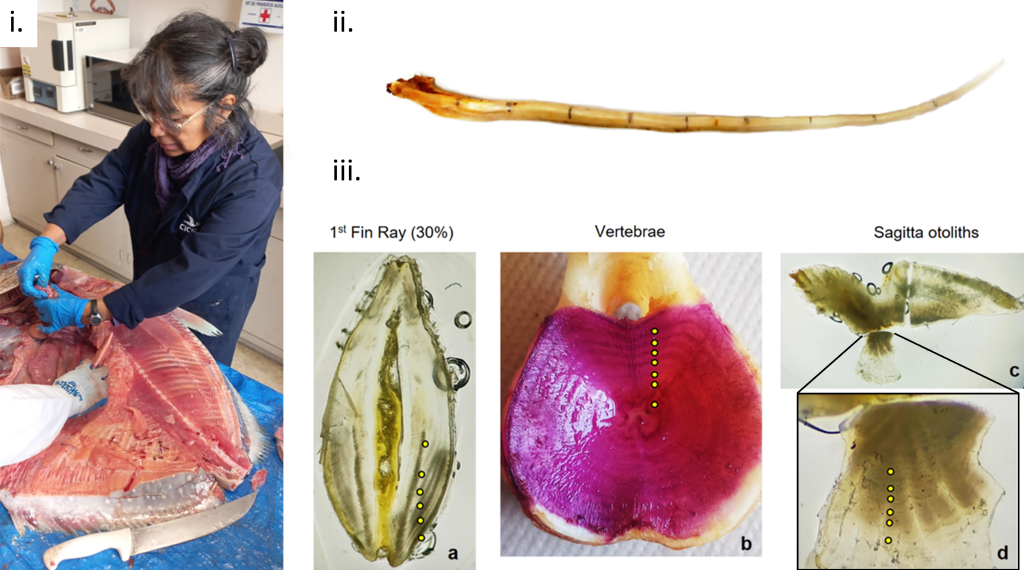
During Phase 2, we separated the entire dorsal fin from the condyle and removed surrounding tissue after the structures were dipped in 70°C hot water for 30 seconds, followed by overnight air-drying. We measured the first and second rays of the dorsal fin and marked at 10% increments from the base to the tip before making transverse cross sections at each mark with an IsoMet low-speed saw (Buehler, Lake Bluff, Illinois, USA; Fig. 1.ii). Cross sections were manually polished using 0.3-micron Buehler Alumina suspension with a Buehler MicroCloth until the growth rings were visible, then mounted on microscope slides with Cytoseal 60 glue. Because visible growth rings on rays of the dorsal fin were most discernible at the 30% and 40% positions, only these cross sections were used for further analyses.
For Phase 2, vertebrae 8 to 13 were extracted from the area below the anterior insertion of the dorsal fin from each of the six specimens. The vertebral muscle and connective tissue were removed with a scalpel, and the attached neural spine and ventral ribs were trimmed. Then, the vertebrae were soaked for 15 minutes in a 3% hydrogen peroxide solution to eliminate excess flesh, followed by rinsing under running water. Whole vertebrae were immersed in alizarin red solution for 15–30 minutes until growth rings were visible (La Marca 1966). They were then rinsed and left to dry for at least 8 hours. The six prepared vertebrae from each fish were visually examined under a dissecting microscope, and those with the clearest growth rings were selected for age determination.
To extract otoliths during Phase 2, a transverse cut was made at the operculum to expose the otic capsules along the ventral surface of the posterior skull. Otoliths were carefully extracted from the otic sacs using a stereoscope to minimize fracturing upon removal. To evaluate growth rings, extracted otoliths were mounted whole on microscope slides using Cytoseal 60 glue. During Phase 2, one set of otoliths fractured upon extraction and was excluded from aging analyses.
Mounted otoliths and dorsal-fin ray cross-sections were visually examined under transmitted light using a Zeiss Stemi 305 stereomicroscope (Zeiss, Oberkochen, Germany) to generate age estimates during Phase 2. Similarly, whole stained vertebrae were visually examined under the same microscope using reflected light. In the absence of age validation studies, two independent readers counted proposed annual growth rings to generate age estimates for each structure, without knowledge of fish size or collection information to prevent bias (Francis et al. 2004). To assess inter-reader consistency (precision) in age estimates from growth-ring counts and to evaluate agreement among structures, we calculated an index of average percent error (APE; Beamish and Fournier, 1981) and a mean coefficient of variation (CV; Campana, 2001) for each calcified structure. Both metrics quantify the level of agreement among age estimates, with lower values indicating greater precision and less discrepancy between readers or structures (Beamish and Fournier, 1981). Precision metrics (index of APE and CV) were calculated using the agePrecision: Compute measures of precision among sets of ages function in the FSA package in RStudio (R Core Team 2024).
Phase‑2 age estimates for six smalleye Pacific opah ranged from 4–7 years, assuming annual growth‑ring deposition (Table 1). Dorsal‑fin rays (Fig. 1.iii.a), vertebrae (Fig. 1.iii.b), and otoliths (Fig. 1.iii.c) all exhibited visible growth rings; however, stained vertebrae provided the most reliable ring counts and are recommended for future aging work when fish marketability is not a constraint. The first and second rays of the dorsal fin provided a more accessible structure that may be suitable for aging studies when less invasive sampling methods are prioritized to maintain fish integrity and preserve the marketability of commercially harvested opah. However, visible growth rings on fin rays may be affected by polishing protocols or by the possible reabsorption of early growth rings as fish age (Pfennig et al. 2024), which may have contributed to the lower age estimates relative to vertebrae in this study (Table 1). Therefore, broader sampling across size classes is needed to further validate the use of dorsal‑fin rays as a reliable structure for aging opah, particularly for larger individuals.
Table 1. Comparison of age estimates for six smalleye Pacific opah (Lampris incognitus) based on the first and second rays of the dorsal fin, vertebrae, and whole sagitta otoliths between two separate readers (R1, R2). The index of average percent error (APE) and coefficient of variation (CV) between the readers are presented for each structure. FL = Fork length in cm
| Sample | Length (FL, cm) | 1st Fin Ray (30%) R1 / R2 | 1st Fin Ray (40%) R1 / R2 | 2nd Fin Ray (30%) R1 / R2 | 2nd Fin Ray (40%) R1 / R2 | Vertebrae R1 / R2 | Otoliths R1 / R2 |
| 1 | 111 | 5 / 6 | 5 / 5 | 6 / 7 | 7 / 6 | 7 / 7 | 5 / 7 |
| 2 | 102 | 4 / 4 | 4 / 4 | 4 / 4 | 4 / 4 | 6 / 6 | 7 / 7 |
| 3 | 99 | 7 / 5 | 6 / 5 | 5 / 5 | 5 / 5 | 5 / 5 | 6 / 6 |
| 4 | 105 | 6 / 6 | 5 / 4 | 6 / 6 | 4 / 5 | 7 / 6 | 7 / 7 |
| 5 | 97 | 6 / 4 | 4 / 4 | 6 / 5 | 5 / 5 | 4 / 4 | 5 / 6 |
| 6 | 104 | 4 / 4 | 5 / 5 | 4 / 5 | 5 / 6 | 6 / 6 | – / – |
| APE (%) | — | 7.6 | 4.7 | 4.6 | 4.6 | 1.2 | 3.3 |
| CV (%) | — | 10.7 | 3.3 | 6.5 | 6.5 | 1.8 | 4.7 |
Whole stained vertebrae produced the most distinct and consistently readable growth rings, with the lowest combined index of APE (1.2%) and CV (1.8%) values between readers (Table 1). Reader agreement was highest between vertebrae and the second ray of the dorsal fin on sections taken at 30% of total ray length (APE = 6.7%; CV = 9.47%; Table 2). Agreement was slightly reduced between vertebrae and the first ray of the dorsal fin on sections taken at 30% (APE = 7.4%; CV = 11.24%) and the second ray of the dorsal fin on sections taken at 40% (APE = 8.1%; CV = 11.24%). Successfully extracted otoliths (n = 5) showed discernible growth rings, but reliability was reduced in fractured structures (Fig. 1.iii.d). In addition to previous concerns about fragility (Francis et al. 2004), their small size, handling difficulty, and potential impacts on marketability limit practical application for use in subsequent aging studies.
Table 2. Comparisons of vertebrae-derived ages with those obtained from analysis of dorsal-fin ray sections and whole sagitta otoliths for six smalleye Pacific opah (Lampris incognitus), using the index of average percent error (APE) and the coefficient of variation (CV).
| Comparisons | APE% | CV% |
| Vertebrae vs. Second ray at 30% | 6.7 | 9.47 |
| Vertebrae vs. First ray at 30% | 7.4 | 11.24 |
| Vertebrae vs. Second ray at 40% | 8.1 | 11.24 |
| Vertebrae vs. Sagitta otolith | 9.1 | 12.58 |
| Vertebrae vs. First ray at 40% | 11.5 | 15.51 |
This pilot study provides a foundation for larger-scale aging research on the poorly studied L. incognitus and related species. Findings from this international collaboration suggest that whole stained vertebrae, followed by the second ray of the dorsal fin on sections taken at 30% of total length, provided the most precise growth-ring counts and associated age estimates for L. incognitus. Considering the challenges of removing vertebrae and otoliths in the field, our preliminary results suggest that the second ray of the dorsal fin may provide a practical alternative for estimating age in opah when maintaining fish integrity for marketability is a priority. However, further age validation is needed, including verification of APE and CV estimates among structures using larger sample sizes and the inclusion of additional independent readers. To support effective transboundary management of this valuable secondary target in U.S. and Mexican longline fisheries, key biological data for opah are needed to address existing knowledge gaps prior to formal stock assessments.
Acknowledgments
This work was supported by The Offield Family Foundation, The George T. Pfleger Foundation, The Harris Foundation and Builders Vision. Funding was also provided by NOAA SWFSC contract # 1305M323PNFFR0278. The authors would like to thank the research teams at the NOAA SWFSC and CICESE for their time and logistical support, as well as Kelsey James for reviewing an initial draft of this manuscript.
Literature Cited
- Beamish, R. J. 1981. Use of fin-ray sections to age walleye pollock, Pacific cod, and albacore, and the importance of this method. Transactions of the American Fisheries Society 110:287–299.
- Beamish, R. J., and D. A. Fournier. 1981. A method for comparing the precision of a set of age determinations. Canadian Journal of Fisheries and Aquatic Sciences 38:982–983.
- Campana, S. E., M. C. Annand, and J. I. McMillan. 1995. Graphical and statistical methods for determining the consistency of age determinations. Transactions of the American Fisheries Society 124:131–138.
- Campana, S. E. 2001. Accuracy, precision and quality control in age determination, including a review of the use and abuse of age validation methods. Journal of Fish Biology 59:197–242.
- Casselman, J. M. 1983. Age and growth assessment of fish from their calcified structures—techniques and tools. Pages 1–18 in E. D. Prince and L. M. Pulos, editors. Proceedings of the International Workshop on Age Determination of Oceanic Pelagic Fishes: Tunas, Billfishes, and Sharks. National Oceanic and Atmospheric Administration, Washington D.C., USA.
- Cooper, R., H. Dewar, B. A. Muhling, S. L. H. Teo, J. Hyde, and K. Bigelow. 2022. Spatiotemporal catch patterns and population distributions of bigeye Pacific opah (Lampris megalopsis) and smalleye Pacific opah (L. incognitus) in the eastern North Pacific Ocean. Fishery Bulletin 120:138–149.
- Francis, M., L. Griggs, and C. Ó. Maolagáin. 2004. Growth rate, age at maturity, longevity and natural mortality rate of moonfish (Lampris guttatus). Final Research Report for the Ministry of Fisheries Research Project TUN2003-01. National Institute of Water and Atmospheric Research, Auckland, New Zealand.
- Hawn, D. R., M. P. Seki, and R. Nishimoto. 2002. An estimation of the life history and ecology of opah and Monchong in the North Pacific. A working document submitted to the 15th Meeting of the Standing Committee on Tuna and Billfish, Honolulu, Hawaii, USA.
- Hyde, J. R., K. E. Underkoffler, and M. A. Sundberg. 2014. DNA barcoding provides support for a cryptic species complex within the globally distributed and fishery important opah (Lampris guttatus). Molecular Ecology Resources 14:1239–1247.
- Isely, J. J., and T. B. Grabowski. 2007. Age and growth. Pages 187–228 in C. S. Guy and M. L. Brown, editors. Analysis and Interpretation of Freshwater Fisheries Data. 1st edition. American Fisheries Society, Bethesda, MD, USA.
- Ito, R. 2023. The Hawaii and California-based Pelagic Longline Vessels Annual Report for 1 January–31 December 2022. Pacific Islands Fisheries Science Center (PIFSC) Data Report DR-23-39. Available from: https://www.fisheries.noaa.gov/resource/data/hawaii-and-california-long line-logbook-reports-2022 (Accessed: 20 Aug 2024)
- Kerns, J. A., and L. A. Lombardi-Carlson. 2017. History and importance of age and growth information. Pages 1–8 in M. C. Quist and D. A. Isermann, editors. Age and Growth of Fishes: Principles and Techniques. American Fisheries Society, Bethesda, MD, USA.
- Midway, S. R., and T. Wagner. 2016. The first description of oarfish (Regalecus russellii Cuvier 1816) (Regalecidae) ageing structures. Journal of Applied Ichthyology 32:113–116.
- Millot, R., L. Vanalderweireldt, L. F. Sandolo, and E. D. H. Durieux. 2023. Age estimates derived from hard parts of swordfish Xiphias gladius from the north-western Mediterranean Sea. Journal of Fish Biology 104:56–68.
- Pfennig, M. B, D. P. Crane, N. G. Smith, and D. L. Buckmeier. 2024. Age estimation and validation in otoliths, spines, and fin rays from four central Texas fishes, North American Journal of Fisheries Management 44:590–606. https://doi.org/10.1002/nafm.10997
- Phelps, Q. E., S. J. Tripp, M. J. Hamel, R. P. Koenigs, and Z. J. Jackson. 2017. Choice of structure for estimating fish age and growth. Pages 81–105 in M. C. Quist and D. A. Isermann, editors. Age and Growth of Fishes: Principles and Techniques. American Fisheries Society, Bethesda, MD, USA.
- Sinis, A. I. 2004. First documented record of Lampris guttatus (Brünnich, 1788) opah, in Greek seas. Journal of Biological Research 2:101–104.
- Sun, C. L., C. L. Huang, and S. Z. Yeh. 2001. Age and growth of the bigeye tuna, Thunnus obesus, in the western Pacific Ocean. Fishery Bulletin 99:502–509.
- Sun, C. L., S. P. Wang, and S. Z. Yeh. 2002. Age and growth of the swordfish (Xiphias gladius L.) in the waters around Taiwan determined from anal-fin rays. Fishery Bulletin 100:822–835.
- Underkoffler, K. E., M. A. Luers, J. R. Hyde, and M. T. Craig. 2018. A taxonomic review of Lampris guttatus (Brünnich 1788) (Lampridiformes; Lampridae) with descriptions of three new species. Zootaxa 4413:551–565.
- Whitledge, G. L. 2017. Morphology, composition, and growth of structures used for age estimation. Pages 9–25 in M. C. Quist and D.A. Isermann, editors. Age and Growth of Fishes: Principles and Techniques. American Fisheries Society, Bethesda, MD, USA.
- Young, J., and A. Drake. 2004. Age and growth of broadbill swordfish (Xiphias gladius) from Australian waters. FRDC Project 2001/014, CSIRO Marine Research, Hobart, Tasmania, Australia.