

FULL RESEARCH ARTICLE
Christopher O’Keefe1,2 and Darren M. Ward1*
1 California State Polytechnic University, Humboldt, Department of Fisheries Biology, 1 Harpst Street, Arcata, CA 95521, USA https://orcid.org/0000-0002-0049-5299 (DMW)
2 California Department of Fish and Wildlife, Fisheries Branch, 1010 Riverside Parkway, West Sacramento, CA 95605, USA
*Corresponding Author: dw193@humboldt.edu
Published 8 October 2026 • doi.org/10.51492/cfwj.112.13
Abstract
The objective of this study was to determine the height of vertical barriers that young-of-the-year steelhead trout (Oncorhynchus mykiss) could jump and to assess how fish length and structural complexity at the spill point affected barrier passage success. We conducted manipulative experiments in a hatchery raceway, with 28 overnight trials testing barrier heights ranging from 24 cm to 44 cm. We repeated trials throughout the growing season to evaluate the effect of fish size on passage success (range of fork lengths: 44–152 mm). We also implemented an additional treatment to determine if structural complexity at the spill point affected barrier passage, comparing a smooth spillway to one obstructed with twigs. Passage success declined with barrier height and increased with fish length. Fish passed barriers up to 6.6 times their body length. Fish size at 50% predicted passage success was 52 mm fork length for the 24 cm barrier and 99 mm fork length for the 44 cm barrier. Structural complexity at the spill point did not detectably affect passage success. Passage success was higher when fish were more crowded, likely due to increased motivation to attempt passage. Treatment effects were consistent over time, but there was considerable unexplained variation in the proportion of fish passing the barriers across replicate trials. The substantial unexplained variation in passage success across trials suggests that experiments with few replicate trials may be difficult to interpret. Our results can inform designs for instream structures and assessment of potential barriers.
Key words: beaver dam analog, fish passage, instream barrier, jump height, juvenile salmonid, Oncorhynchus mykiss, steelhead trout
| Citation: O’Keefe, C., and D. M. Ward. 2026. Experimental evaluation of vertical barrier passage by young-of-the-year steelhead trout. California Fish and Wildlife Journal 112:e13. |
| Editor: Gabe Singer, Fisheries Branch |
| Submitted: 28 August 2025; Accepted: 27 April 2026 |
| Copyright: ©2026, O’Keefe and Ward. This is an open access article and is considered public domain. Users have the right to read, download, copy, distribute, print, search, or link to the full texts of articles in this journal, crawl them for indexing, pass them as data to software, or use them for any other lawful purpose, provided the authors and the California Department of Fish and Wildlife are acknowledged. |
| Funding: Funding was provided by the National Fish and Wildlife Foundation Klamath Basin Restoration fund and NOAA CIMEAS award NA20OAR4320278-T1-01. |
| Competing Interests: The authors have not declared any competing interests. |
Introduction
Young-of-the-year salmonids often move considerable distances upstream to access seasonal rearing habitat in headwaters and tributaries (Hunt 1965; Skeesick 1970; Murphy et al. 1984). In some circumstances, natural (e.g., beaver dams; Malison et al. 2016) and artificial (e.g., perched culverts; Sethi et al. 2022) barriers may prevent them from reaching these upstream areas. Impaired upstream movement is a particular concern when habitat downstream of barriers becomes unsuitable (Sutton and Soto 2012) or when the potential barriers themselves impound water and increase habitat quality upstream of the barrier (Pollock et al. 2022). In these cases, restricting the upstream movement of juveniles could substantially reduce their survival or growth (Sethi et al. 2022). Therefore, evaluating the effects of potential vertical barriers and designing effective habitat enhancement both require knowledge of the barrier heights that are passable by juvenile salmonids.
Assessment and management of barriers for anadromous salmonids have largely focused on large barriers that permanently block adult migration or impair downstream migration of smolts (Roscoe and Hinch 2010). Seasonal barriers to juvenile upstream movement have received less attention (Forty et al. 2016). However, in some jurisdictions, regulations mandate that structures built in streams cannot produce passage barriers for any life stage of anadromous fish at any time (e.g., Cal. St. and Hwy. Code, § 156; Cal. Code Regs., tit. 14, § 225.5). Although these regulations are rarely enforced as strictly as written, they have led to restrictions on barrier height. For example, current state requirements in California include a maximum 15 cm barrier for passage of juvenile anadromous salmonids (Love and Bates 2009) and federal rules include a maximum 30 cm barrier for passage of juvenile anadromous salmonids (NMFS 2023).
Early experimental work showed that juvenile salmonids are capable of leaping over barriers more than five times their own body length in height (Stuart 1962), but passage rate was lower for higher jumps (Symons 1978). In fact, maximum jump heights are predictable from estimates of burst swimming speed, which generally scale directly with body length (Powers and Orsborn 1985). More recent studies have shown that juvenile salmonid passage over barriers depends on many other factors besides barrier height. For example, many studies show that larger individuals can pass higher barriers (Brandt et al. 2005; Kondratieff and Myrick 2006; but see Mueller et al. 2008). Condition factor, experience, and origin of individual fish can also influence their ability to pass barriers (Duthie 1987; Gamperl et al. 1991; Kondratieff and Myrick 2006). Passage success also depends on other characteristics of the barrier, flow conditions, and surrounding environment. For example, Brandt et al. (2005) found that narrow waterfalls and shallow plunge pools reduced the barrier passage success of juvenile brook trout (Salvelinus fontinalis).
In addition to general concerns about barriers restricting movement, in this study we were also interested in barriers in the context of in-stream habitat improvement projects that use small dams (e.g., beaver dam analogs or BDAs) to improve fish habitat and engage ecosystem processes to reverse habitat degradation associated with channel incision (Pollock et al. 2014). Despite the demonstrated benefits for salmonids and habitat, implementation of BDAs has been hampered by concerns that they may pose a barrier to juvenile fish, preventing them from accessing the habitat created by the BDA and other upstream habitats. Recent guidelines suggest designing BDAs to provide passage opportunities (Caisley et al. 2024). Field experiments have helped to further alleviate concerns about fish passage at BDAs (O’Keefe 2021; Pollock et al. 2022), but field studies lack the control necessary to confront fish with a wide range of conditions (e.g. barrier height) while controlling other factors. Further, BDAs in natural streams are often complex, with many potential passage pathways over, around, and through the structure (Pollock et al. 2022), so evaluating passage of BDAs in the field does not necessarily provide information about how fish pass the barrier.
We used manipulative experiments in a hatchery to evaluate juvenile steelhead trout (Oncorhynchus mykiss) ability to jump over vertical structures in the size range of BDAs. BDAs differ from culverts and other artificial barriers in that the spill point is often structurally complex, with small twigs and debris interrupting the flow, so we added an additional treatment to determine if structural complexity affected the probability that fish were able to pass a barrier. In addition, our experiment extends previous work on barrier passage because we included smaller fish (minimum size 44 mm) and we tagged all fish with radio-frequency identification tags and used an antenna in the experimental system to track the individual fish movements and the timing of successful passage attempts.
Methods
Study Area
We conducted experiments at a hatchery located on campus at the California State Polytechnic University, Humboldt in Arcata, California (40.874° N, 124.076° W). The hatchery receives water from a small reservoir located above the campus and uses a combination of a recirculation system with internal aeration and filtration and fresh water from a 190 cubic meter storage tank to maintain water quality. The experiments were conducted in an outdoor raceway (30-m long x 1.5-m wide x 1.2-m deep), where we built flashboard-style dams (Kondratieff and Myrick 2005) to test passage.
Experimental Procedures
Experimental procedures were reviewed and approved by the Cal Poly Humboldt institutional animal care and use committee (protocols 2024F36-A and 1718F75-A). Our experimental treatments included barriers of 24, 34, and 44 cm, and a 40 cm barrier where the top of the spillway was fitted with a lattice of woven willow twigs to add structural complexity (Fig. 1). This encompasses the range of heights of typical BDA structures (Pollock et al. 2022). The 40 cm height for the treatment with structural complexity positioned the top of the woven willow twigs at the same height as the 44 cm jump. We chose this experimental design because we did not have time or resources for a fully factorial design with all combinations of barrier height and structural complexity. This incomplete design means that we could not assess potential interactions between barrier height (analyzed as a continuous term) and structural complexity, just whether structural complexity reduced passage success at an intermediate barrier height.
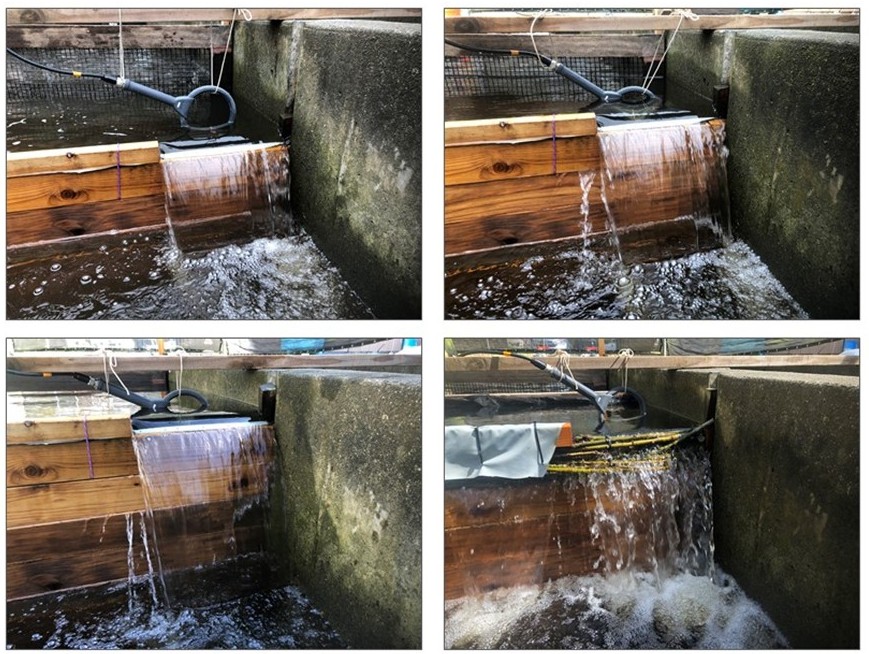
To create the jump treatments, we stacked 10-cm tall boards in the raceway’s flashboard notches. A shorter 5-cm tall board was secured to the top flashboard to concentrate the flow to one side of the dam, creating a spill point with a crest width of 38 cm and a depth of approximately 3–5 cm through the weir notch (Fig. 1). Water depth below the barrier was held constant at 25 cm. We used net walls (0.3 cm mesh) positioned 0.5 m upstream and downstream of the dam to contain fish in the immediate vicinity of the barrier during trials. We controlled flow in the raceway using a valve at the inlet. Flow was kept as consistent as possible across all trials, sufficient to produce a waterfall with a water column that separated from the face of the barrier (Fig. 1). However, flow did vary within and across trial days depending on hatchery operations and demand on the pumps (approximate range: 4–7 L/s). Water temperature was recorded at the start of each trial (approximate range: 14.9–17.1° C; Table 1).
Table 1. Characteristics of each experimental trial, including the date the trial started, the height of the barrier, whether the trial included structural complexity in the form of twigs at the spill point, water temperature at the start of the trial, the number of individual fish recovered at the end of the trial, the average (minimum, maximum) fork length, and the percentage of fish that passed the barrier during the trial.
| Trial | Date | Barrier height (cm) | Structure | Temperature (°C) | Number of fish | Fork length (mm) | % Passing |
| 1 | 2 Jun 2020 | 40 | Yes | 14.9 | 49 | 53.3 (45, 64) | 0% |
| 2 | 3 Jun 2020 | 44 | No | 14.7 | 46 | 54.3 (44, 64) | 0% |
| 3 | 4 Jun 2020 | 24 | No | 15.2 | 39 | 55.5 (49, 61) | 69% |
| 4 | 5 Jun 2020 | 34 | No | 16 | 31 | 56.5 (49, 67) | 6% |
| 5 | 23 Jun 2020 | 34 | No | 16.6 | 50 | 60.9 (47, 78) | 48% |
| 6 | 24 Jun 2020 | 44 | No | 17.1 | 50 | 61.8 (46, 74) | 12% |
| 7 | 25 Jun 2020 | 24 | No | 16.8 | 50 | 62.1 (45, 75) | 60% |
| 8 | 26 Jun 2020 | 40 | Yes | 16.7 | 50 | 63.4 (46, 76) | 30% |
| 9 | 7 Jul 2020 | 34 | No | 16.2 | 50 | 70.4 (58, 87) | 58% |
| 10 | 8 Jul 2020 | 24 | No | 16.8 | 49 | 72.4 (55, 94) | 88% |
| 11 | 9 Jul 2020 | 40 | Yes | 16.9 | 49 | 72.8 (55, 93) | 71% |
| 12 | 10 Jul 2020 | 44 | No | 16.8 | 40 | 72.6 (56, 96) | 60% |
| 13 | 21 Jul 2020 | 44 | No | 16.1 | 48 | 81.8 (70, 97) | 77% |
| 14 | 22 Jul 2020 | 34 | No | 16.5 | 48 | 82.8 (69, 103) | 90% |
| 15 | 23 Jul 2020 | 24 | No | 16.2 | 45 | 80.4 (59, 92) | 87% |
| 16 | 24 Jul 2020 | 40 | Yes | 16.3 | 49 | 83.9 (63, 109) | 65% |
| 17 | 11 Jul 2024 | 40 | Yes | 16 | 30 | 66.3 (50, 103) | 7% |
| 18 | 12 Jul 2024 | 24 | No | 15.9 | 25 | 66.6 (54, 88) | 52% |
| 19 | 16 Jul 2024 | 34 | No | 15.9 | 30 | 72.4 (56, 104) | 40% |
| 20 | 17 Jul 2024 | 44 | No | 16.4 | 42 | 68.7 (53, 104) | 2% |
| 21 | 21 Aug 2024 | 34 | No | 16.9 | 24 | 71 (55, 104) | 4% |
| 22 | 23 Aug 2024 | 40 | Yes | 15.6 | 28 | 77.8 (59, 106) | 4% |
| 23 | 24 Aug 2024 | 24 | No | 16 | 21 | 83.9 (64, 110) | 86% |
| 24 | 25 Aug 2024 | 44 | No | 16.8 | 57 | 76.7 (55, 115) | 2% |
| 25 | 28 Sept 2024 | 44 | No | 15.3 | 38 | 90.9 (65, 152) | 5% |
| 26 | 1 Oct 2024 | 40 | Yes | 16.3 | 34 | 105.5 (77, 136) | 18% |
| 27 | 2 Oct 2024 | 34 | No | 16 | 34 | 92.3 (68, 137) | 47% |
| 28 | 3 Oct 2024 | 24 | No | 15.9 | 32 | 105.3 (78, 136) | 63% |
We tested the four different jump treatments in seven rounds (rounds 1–4: 1 June–24 July 2020; rounds 5–7: 10 July–2 October 2024). Each round included all treatments in randomized order for a total of 28 total trials. The raceway could only accommodate one dam structure, so each round of trials took four days (one treatment per day). The initial rounds of the experiment conducted in 2020 left us with some uncertainty regarding the effect of fish length on passage success for the largest individuals tested (reported in a graduate thesis: O’Keefe 2021), so we added additional trials in 2024 to increase the size range of fish tested (full range: 44–152 mm fork length).
The fish we used for trials were young-of-the-year individuals from the hatchery’s captive steelhead stock. We tagged all fish to be used in experiments with 9 mm passive integrated transponder (PIT) tags. For tagging, we anesthetized fish in a water bath of <100 mg/L tricaine methanesulfonate and inserted the tag through a small incision immediately posterior to the pectoral fin. Tags weighed 65 mg, resulting in tag burdens averaging 2%. Fish <50 mm fork length often exceeded the conservative 2% maximum tag burden criterion, but all fish remained below the less-conservative 7% tag burden criterion (Smircich and Kelly 2014). Further, we tagged all fish at least 7 days before using them in experiments and only used fish in trials if they retained their PIT tags and had fully recovered from the tagging procedure, exhibiting normal swimming behavior and active feeding. During trials, we used a Biomark HPR Plus Reader with a 25 cm racket antenna to detect fish that jumped the barrier. The antenna was suspended beneath the surface approximately 15 cm upstream of the spill point (Fig. 1). The read range of the antenna was approximately 10 cm, so only successful passage attempts were detected.
Experimental fish were held indoors in 1 m diameter flow-through circular tanks and fed daily with pellet food. At the start of each trial, fish were netted from the stock of tagged fish and introduced into the raceway below the barrier at approximately 1100. The following morning at approximately 0900, fish were recaptured from above and below the barrier using hand nets. Fish in the holding tanks were fed before selecting individuals for each round, but they were not fed during trials. Fish recaptured above and below the obstacle were placed into separate buckets for processing. All fish captured were anesthetized and fork length was measured. Some fish were used in more than one trial, but never in the same round, so there was always at least 14 days between trials for individual fish. In 2020, all trials started with 50 fish per trial. In 2024, trials started with 25–60 fish, depending on how many were available in the tagged population while allocating more fish to the treatments with higher jumps to increase precision of estimates when passage was relatively rare. Some fish (ca. 5%) escaped the net enclosures and were excluded from analyses, so the final sample sizes were slightly lower (Table 1).
Statistical Analysis
We analyzed fish passage using Bayesian regression logistic models implemented in R package brms (Bürkner 2017) in R (R v.4.4.1, www.r-project.org, accessed 20 Sept 2024). Whether or not individual fish crossed the barrier during a trial was the binary response variable (family: Bernoulli, link: logit). We considered fish to have passed the barrier if we captured it above the barrier at the conclusion of the trial or if it was detected by the PIT tag antenna above the barrier. We took this approach to account for fish that jumped the barrier but then retreated downstream before the conclusion of the trial. However, across all trials there were only seven instances when a fish was detected on the antenna above the barrier but recaptured below the barrier.
We included the following fixed predictor variables in models: barrier height (continuous), structural complexity (yes/no, categorical), fish fork length (natural log transformed, continuous), the interaction between barrier height and fish length, and the number of fish in the trial. In addition, we included a random effect for trial to account for lack of independence of individuals in the same trial and a random effect for individual identification (PIT tag number) to account for lack of independence for individuals used in multiple trials. We considered two alternate model formulations: barrier height as a categorical effect (confounded with complexity for the 40 cm jump) and a smoothed term for fish length to account for potential non-linearity. However, neither of these alternate formulations produced a better model based on leave-one-out model comparison and they did not change interpretation of results, so they are not presented here.
To evaluate the timing of passage activity, we also constructed a histogram of the timing of successful passage, based on an individual’s first detection on the upstream PIT antenna during each trial.
Results
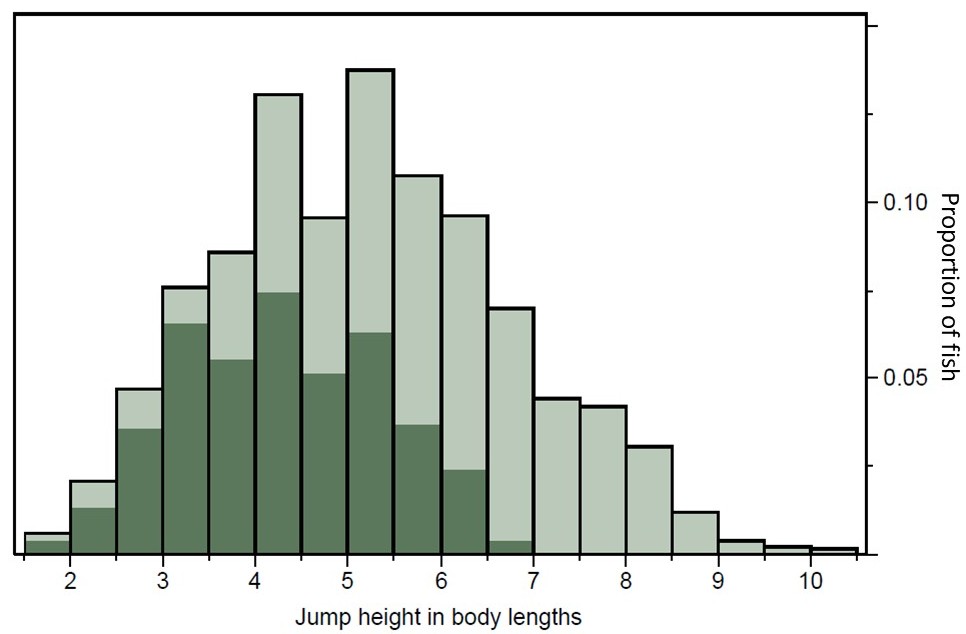
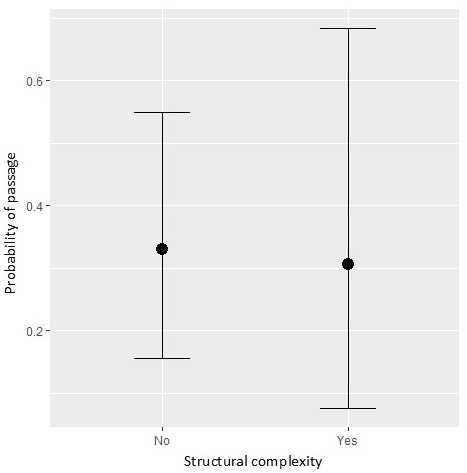
Across all 1138 instances of fish confronted with a barrier during trials, 479 fish passed the barrier (42%). Passage success ranged from 0–90% across all trials (Table 1). Passage probability declined with increasing barrier height and increased with increasing fork length (Table 2, Fig. 2). The increase in passage success with fish length was similar for all barrier heights (no significant interaction term, Table 2; Fig. 2). Overall, fish passed jumps up to 6.6 times their body length in height, with passage success of 50% at 4.7 body lengths (Fig. 3). There was no evidence that structural complexity at the spill point affected passage probability (Table 2, Fig. 4). Passage probability was higher in trials with more fish (Table 2, Fig. 5).
Table 2. Output of the mixed regression model, including linear coefficients and their upper and lower Bayesian credible intervals (CI). P(direction) is an index of the certainty of the direction of the effect; values close to 100% indicate high confidence.
| Term | Coefficient | Lower CI | Upper CI | P(direction) |
| Intercept | –36.7 | –57.8 | –14.4 | 99.9% |
| Barrier height (cm) | –0.19 | –0.37 | –0.02 | 98.6% |
| Structural complexity | –0.11 | –2.1 | 1.8 | 54.8% |
| Log fork length (mm) | 9.07 | 4.2 | 14.2 | 99.9% |
| Barrier height x Log fork length | 0 | –0.02 | 0.02 | 75.6% |
| Number of fish | 0.1 | 0.02 | 0.19 | 99.1% |
| Trial SD (random intercept) | 1.89 | 1.33 | 2.7 | — |
| Individual SD (random intercept) | 0.5 | 0.03 | 1.0 | — |
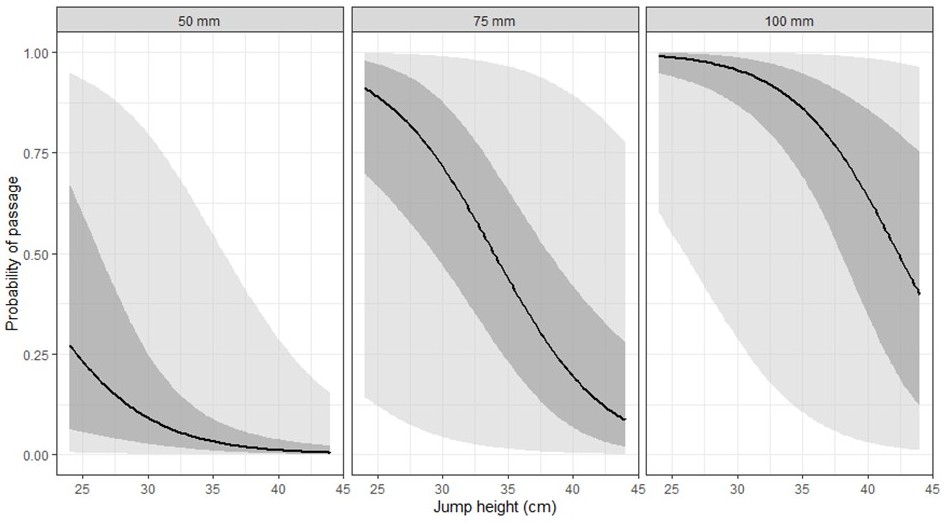
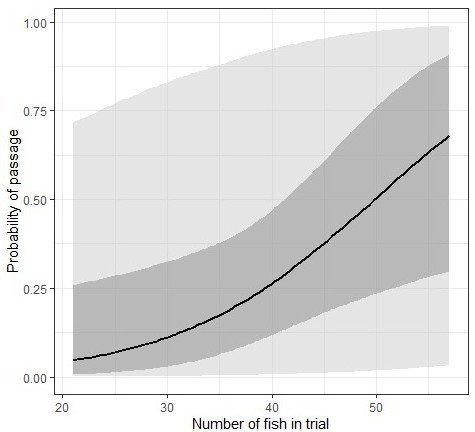
While our experiment and analysis found clear associations between the fixed predictors and passage success, there was considerable unexplained variation, largely across trials (trial random effect in Table 2). The Bayes R2 (Gelman et al. 2019) of the model including the trial random effect is 0.50, but the Bayes R2 with random effects set to zero (i.e. assuming no differences between trials) is only 0.36. This difference can be visualized by comparing the credible intervals for model-predicted passage probabilities that are conditional on a specific trial to predictions for an unknown future trial (Fig. 2, Fig. 5), showing the large uncertainty associated with predicting passage success for individual fish when trial conditions are not constant.
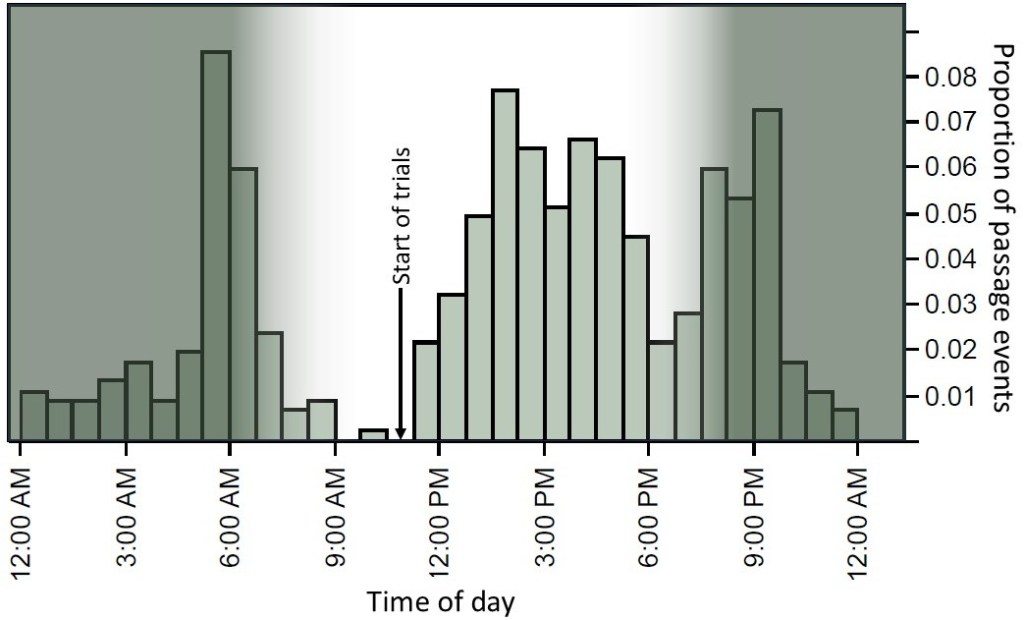
The PIT tag reader detected 472 fish successfully passing the barrier. The timing of successful passage showed three modes: an initial mode in the hours after fish were introduced into the experimental area, a mode at dusk, and a mode at dawn (Fig. 6).
Discussion
We found that young-of-the-year steelhead trout passed barriers up to 6.6 times their body length in height under our experimental conditions (Fig. 3). Even individuals that were 50 mm long were able to regularly pass a 24 cm jump, our lowest height treatment (Fig. 2). Structural complexity at the spill point did not detectably reduce passage success. These results reinforce observations from field studies of fish passage over BDAs (O’Keefe 2021, Pollock et al. 2022) and provide an experimental framework for expanding the range of conditions to evaluate more determinants of passage success at these habitat restoration projects.
Passage success in our study was relatively high compared to previous studies on juvenile salmonids. Symons (1978) found that <40% of juvenile Atlantic salmon (Salmo salar; 75–120 mm FL) and coho salmon (Oncorhynchus kisutch; 71–115 mm FL) passed over a 12 cm barrier, the lowest height in the experiment. Brandt et al. (2005) found that <50% of brook trout (Salvelinus fontinalis; 44–104 mm total length) passed barriers >10 cm. Kondratieff and Myrick (2006) found that <25% of brook trout (100–150 mm total length) passed barriers >20 cm. Mueller et al. (2008) found that 20% of coho salmon (60–135 mm FL) passed over a 20 cm barrier, but passage success dropped to 0% for a 32 cm barrier. However, the high passage rates we observed are consistent with other recent experimental work on juvenile steelhead. White (2019) found that passage success over a 15 cm barrier at 12°C was >50% for steelhead >58 mm FL and passage success over a 30 cm barrier was >50% for steelhead >75 mm FL, although success was lower at colder temperatures. This variation across studies could be due to species-specific jumping behavior as well as differences in experimental procedures.
While we found that the direction and magnitude of effects of barrier height and fish length on passage success were consistent across trials, there was substantial variation in overall passage success across trials of the same treatment (Table 1) as quantified by the random effect of trial in the analysis (Table 2). This variation across trials may be associated with other conditions of the environment or experimental arena that were not included in the analysis. However, most of the factors that have been identified in previous studies as potential determinants of passage success over barriers did not vary substantially across our trials. For example, pool depth can affect jump height (Brandt et al. 2005), but we held pool depth constant across trials. Similarly, temperature can affect jumping behavior (Symons 1978; White 2019), but temperature in our experiments remained within a relatively narrow range of 14.7–17.1°C (Table 1) due to the location of our facility in a moderate coastal climate. We did not measure or evaluate other flow characteristics of the spill or turbulence in the jump pool, but these factors were very different for treatments with and without structural complexity at the spill point, which did not affect passage success.
Unexplained variation across trials poses challenges for experimental evaluation of passage over barriers because it could confound treatment effects in experiments with fewer trials. For example, we had some trials with very low passage rates even though the barrier heights were the same and fish sizes were similar to trials with much higher rates (e.g. compare trials 4 and 21 to trials 5 and 27). If we had run fewer trials, we may have concluded that these treatments had low passage success. One potential explanation for this variation is that there are unmeasured conditions that affect fish’s motivation to attempt to cross the barrier, such that passage success per attempt is not affected but there are fewer attempts. These conditions could include environmental factors, physiological traits of fish, or social cues. For example, other studies have found that movement and activity of juvenile trout vary with hunger (Näslund and Johnsson 2016), cues from available food upstream of the barrier (Kane et al. 2000), and crowding (Tsukamoto et al. 1985; Keeley 2001). We did not consistently measure the rate of attempts to jump the barrier, but in a subset of trials that we recorded with a video camera, we observed that there were many unsuccessful attempts for each successful barrier passage. For future experiments, we suggest that running as many trials as possible and accounting for variation in the number of attempts by using the ratio of successful to unsuccessful attempts as a response may be useful approaches to assess passage success in the face of this unexplained variation. Given that there remains a large amount of unexplained variation in passage success, future work should explicitly address factors that may affect the applicability of results for management. Important considerations include jump heights less than 24 cm, a full factorial design of structural complexity and jump height and comparing wild vs. hatchery origin of experimental stock.
In our experiment, one factor that varied across trials that did affect passage success was the number of fish added at the beginning of the trial. When more fish were added, increasing crowding in the jump pool, passage success was higher. Other studies have shown that increased crowding, either due to increased abundance (Tsukamoto et al. 1985) or decreased volume in the jump pool (Kondratieff and Myrick 2006), is associated with increased jumping activity and passage success. However, Johnson et al. (2012) found no effect of crowding on passage. We suggest that the effect we observed is due to increased motivation to leave the jump pool under crowded conditions leading to increased attempts, not an increase in passage success per attempt. Even after accounting for this crowding effect, there was still substantial unexplained variation across our trials.
Diel conditions such as light intensity may be one factor that affects movement behavior and passage attempts. Because all fish in our experiment were tagged, we could assess timing of successful passage. Many fish passed the barrier in a short window after they were introduced into the experimental arena, but there were additional peaks of passage at both dawn and dusk. Brandt et al. (2005) found that light intensity did not affect juvenile brook trout passage over barriers, but they tested only constant light levels. We conducted experiments outdoors, so light levels followed a natural diel cycle. As many other studies have documented diel movement and habitat use by juvenile salmonids in streams (e.g. Johnson and McKenna, Jr. 2015; Armstrong et al. 2013), we suggest that passage experiments should use a 24-hr experimental period with natural diel light cycles to increase the likelihood that fish experience light conditions that motivate movement and passage attempts. We did not record variation in light availability across days (i.e. cloud cover), but that may be one factor contributing to the unexplained variation across trials.
Our results can inform assessments of potential passage over BDAs and other in-stream structures by juvenile trout. However, real beaver dams, BDAs, and similar complex woody structures used for habitat restoration are more structurally complex and interact with much more variable flows than we included in our experiment. Structurally complex beaver dams and BDAs often have multiple potential passage routes besides jumping over the structure at the spill point. These alternate routes include holes within the structure and spillover side channels that fish could swim through without having to leap over the structure (O’Keefe 2021, Pollock et al. 2022). Increased flows could engage side channels or other routes for fish to pass structures. Our twig structures and stable flows did not represent these additional passage routes, so our experiments may underestimate potential passage at this type of structure. In our initial experiments, we tried to replicate sub-surface pathways for passage as an additional treatment. We found that the sub-surface pathways we created in the hatchery were rarely used by fish (O’Keefe 2021), so we eliminated them from the final design. However, fish use of and preference for different passage routes at different flows merits further research. Our results here are only applicable to passage over barriers by jumping.
Our results show that federal (30 cm) and state (15 cm) criteria for barrier heights should allow passage of juvenile steelhead trout >60 mm FL, with >50% predicted passage success given suitable jump pool depth, flow, and temperature. However, in the context of habitat restoration projects, we emphasize that passability for fish is just one component that determines the costs or benefits of BDAs, beaver dams, and similar structures for fish populations. Our results suggest that many BDAs are likely passable by juveniles under a range of conditions, particularly if they are constructed in a series with a lower jump height at each BDA. However, even if some BDAs do temporarily constrain passage (e.g. during seasonal low flows or early in spring when fish are small), a temporary lack of juvenile passage does not necessarily mean that a barrier is harmful to fish populations (Harvey and Railsback 2021). In the context of BDAs, the potential costs of restricting movement for some seasons or life stages must be weighed against the benefits of enhanced growth and survival in the habitat that the structures create upstream (Pollock et al. 2014, 2022).
Acknowledgements
Funding was provided by the National Fish and Wildlife Foundation Klamath Basin Restoration fund and NOAA CIMEAS award NA20OAR4320278-T1-01. O’Keefe was supported by Roelofs Humboldt Fisheries Scholarship, Joseph Sidney Woldford Fund Scholarship, Fly Fishers Club of Orange County Marine Studies Scholarship, Danielle Zumbrun Memorial Scholarship, Donald Morris Hegy Memorial Scholarship, and the Joseph and Barbara Bania Award. Mark Henderson, Alison O’Dowd, Betsy Stapleton, and anonymous reviewers provided comments on an earlier version.
Literature Cited
- Armstrong, J. B., D. E. Schindler, C. P. Ruff, G. T. Brooks, K. E. Bentley, and C. E. Torgersen. 2013. Diel horizontal migration in streams: juvenile fish exploit spatial heterogeneity in thermal and trophic resources. Ecology 94:2066–2075. https://doi.org/10.1890/12-1200.1
- Brandt, M. M., J. P. Holloway, C. A. Myrick, and M. C. Kondratieff. 2005. Effects of waterfall dimensions and light intensity on age-0 brook trout jumping performance. Transactions of the American Fisheries Society 134:496–502. https://doi.org/10.1577/T03-175.1
- Bürkner, P. 2017. brms: an R package for Bayesian multilevel models using Stan. Journal of Statistical Software 80:1–28. https://doi.org/10.18637/jss.v080.i01
- Caisley, M., E. Portugal, G. Flosi, and W. Arcand. 2024. The use of low-tech process-based stream habitat restoration. Fish Bulletin 185. California Department of Fish and Wildlife, Sacramento, CA, USA.
- Duthie, G. G. 1987. Observations of poor swimming performance among hatchery-reared rainbow trout, Salmo gairdneri. Environmental Biology of Fishes 18(4):309–311.
- Forty, M., J. Spees, and M. C. Lucas. 2016. Not just for adults! Evaluating the performance of multiple fish passage designs at low-head barriers for the upstream movement of juvenile and adult trout Salmo trutta. Ecological Engineering 94:214–224. https://doi.org/10.1016/j.ecoleng.2016.05.048
- Gamperl, A. K., D. L. Schnurr, and E. D. Stevens. 1991. Effect of a sprint-training protocol on acceleration performance in rainbow trout (Salmo gairdneri). Canadian Journal of Zoology 69(3):578–582. https://doi.org/10.1139/z91-087
- Gelman, A., B. Goodrich, J. Gabry, and A. Vehtari. 2019. R-squared for Bayesian regression models. The American Statistician 73:307–309. https://doi.org/10.1080/00031305.2018.1549100
- Harvey, B. C., and S. F. Railsback. 2021. All fish, all the time: A good general objective for fish passage projects? Fisheries 46(3): 119–124. https://doi.org/10.1002/fsh.10549
- Hunt, R. L. 1965. Dispersal of wild brook trout during their first summer of life. Transactions of the American Fisheries Society 94:186–188. https://doi.org/10.1577/1548-8659(1965)94[186:DOWBTD]2.0.CO;2
- Johnson, G. E., W. H. Pearson, S. L. Southard, and R. P. Mueller. 2012. Upstream movement of juvenile coho salmon in relation to environmental conditions in a culvert test bed. Transactions of the American Fisheries Society 141(6):1520–1531. https://doi.org/10.1080/00028487.2012.699013
- Johnson, J. H., and J. E. McKenna, Jr. 2015. Diel resource partitioning among juvenile Atlantic salmon, brown trout, and rainbow trout during summer. North American Journal of Fisheries Management 35:586–597. https://doi.org/10.1080/02755947.2015.1017121
- Kane, D. L., C. E. Behlke, R. E. Gieck, and R. F. McLean. 2000. Juvenile fish passage through culverts in Alaska: a field study. Publication # FHWA-AK-RD-00-03. Alaska Department of Transportation, Statewide Research Office, Fairbanks, AK, USA.
- Keeley, E. R. 2001. Demographic responses to food and space competition by juvenile steelhead trout. Ecology 82(5):1247–1259. https://doi.org/10.1890/0012-9658(2001)082[1247:DRTFAS]2.0.CO;2
- Kondratieff, M. C., and C. A. Myrick. 2005. Two adjustable waterfalls for evaluating fish jumping performance. Transactions of the American Fisheries Society 134(2):503–508.
- Kondratieff, M. C., and C. A. Myrick. 2006. How high can brook trout jump? A laboratory evaluation of brook trout jumping performance. Transactions of the American Fisheries Society 135(2):361–370.
- Love, M., and K. Bates. 2009. Fish passage design and implementation. Part XII in G. Flosi, S. Downie, J. Hopelain, M. Bird, R. Coey, and B. Collins, authors. California Salmonid Stream Habitat Restoration Manual: Volume II. 4th edition. California Department of Fish and Game, Sacramento, CA, USA.
- Malison, R. L., K. V. Kuzishchin, and J. A. Stanford. 2016. Do beaver dams reduce habitat connectivity and salmon productivity in expansive river floodplains? PeerJ 4:e2403.
- Mueller, R. P., S. S. Southard, C. W. May, W. H. Pearson, and V. I. Cullinan. 2008. Juvenile coho salmon leaping ability and behavior in an experimental culvert test bed. Transactions of the American Fisheries Society 137(4):941–950.
- Murphy, M. L., J. F. Thedinga, K. V. Koski, and G. B. Grette. 1984. A stream ecosystem in an old-growth forest in southeast Alaska, Part V:seasonal changes in habitat utilization by juvenile salmonids. Pages 89–89 in W. R. Meehan, T. R. Merrell Jr., and T. A. Hanley, editors. Fish and Wildlife Relationships in Old-Growth Forests, Proceedings of Symposium. American Institute of Fishery Research Biologists, Juneau, AK, USA.
- Näslund, J., and J. I. Johnsson. 2016. State-dependent behavior and alternative behavioral strategies in brown trout (Salmo trutta L.) fry. Behavioral Ecology and Sociobiology 70:2111–2125.
- National Marine Fisheries Service (NMFS). 2023. NOAA Fisheries guidelines for salmonid passage at stream crossings in California. National Oceanic and Atmospheric Administration, National Marine Fisheries Service, Southwest Region, La Jolla, CA, USA.
- O’Keefe, C. G. 2021. Do beaver dam analogues act as passage barriers to juvenile coho salmon and juvenile steelhead trout? Thesis. Humboldt State University, Arcata, CA, USA.
- Pollock, M. M., T. J. Beechie, J. M. Wheaton, C. E. Jordan, N. Bouwes, N. Weber, and C. Volk. 2014. Using beaver dams to restore incised stream ecosystems. BioScience 64(4):279–290.
- Pollock, M. M., S. Witmore, and E. Yokel. 2022. Field experiments to assess passage of juvenile salmonids across beaver dams during low flow conditions in a tributary to the Klamath River, California, USA. PLOS ONE 17(5):e0268088.
- Powers, P., and J. Orsborn. 1985. New concepts in fish ladder design: analysis of barriers to upstream fish migration. Investigation of the physical and biological conditions affecting fish passage success at culverts and waterfalls, Volume IV. BPA Report DOE/BP-36523-1. Department of Energy, Bonneville Power Administration, Portland, OR, USA.
- Roscoe, D. W., and S. G. Hinch. 2010. Effectiveness monitoring of fish passage facilities: historical trends, geographic patterns, and future directions. Fish and Fisheries 11(1):12–33.
- Sethi, S. A., M. P. Carey, J. Gerken, B. P. Harris, N. Wolf, C. Cunningham, F. Restrepo, and J. Ashline. 2022. Juvenile salmon habitat use drives variation in growth and highlights vulnerability to river fragmentation. Ecosphere 13(8):e4192.
- Skeesick, D. G. 1970. The fall immigration of juvenile coho salmon into a small tributary. Research Reports of the Fish Commission of Oregon 2(1):90–95.
- Smircich, M. G., and J. T. Kelly. 2014. Extending the 2% rule: the effects of heavy internal tags on stress physiology, swimming performance, and growth in brook trout. Animal Biotelemetry 2(1):16. https://doi.org/10.1186/2050-3385-2-16
- Stuart, T. A. 1962. The leaping behavior of salmon and trout at falls and obstructions. Freshwater and Salmon Fisheries Research 28. Department of Agriculture and Fisheries for Scotland. Her Majesty’s Stationery Office, Edinburgh, UK.
- Sutton, R., and T. Soto. 2012. Juvenile coho salmon behavioral characteristics in Klamath River summer thermal refugia. River Research and Applications 28(3):338–346.
- Symons, P. E. K. 1978. Leaping behavior of juvenile coho (Oncorhynchus kisutch) and Atlantic salmon (Salmo salar). Journal of the Fisheries Research Board of Canada 35:901–909.
- Tsukamoto, K., K. Uchida, Y. Murakami, M. Endo, and T. Kajihara. 1985. Density effect on jumping behavior and swimming upstream in the ayu juveniles. Bulletin of the Japanese Society of Scientific Fisheries 51(2):323.
- White, D. 2019. Interim juvenile jump test results. Technical Memo. National Oceanic and Atmospheric Administration, National Marine Fisheries Service, West Coast Region, California Coastal Area Office, Santa Rosa, CA, USA.