

FULL RESEARCH ARTICLE
Kristine Lesyna1,4, Miranda B. Haggerty2*, Chugey A. Sepulveda3, Benson Chow4, Shoshana Lescht-Smith5,8, Armand Barilotti6, Helen Killeen7, and Scott Aalbers3
1 University of California, Berkeley, 102 South Hall #4600, Berkeley, CA, 94720, USA
2 California Department of Fish and Wildlife, Marine Region, 3883 Ruffin Road, San Diego, CA, 92123, USA (current) https://orcid.org/0009-0009-9510-6767
3 Pfleger Institute of Environmental Research, 315 Harbor Drive, Oceanside, CA 92054, USA https://orcid.org/0000-0002-2987-7880 (CAS) https://orcid.org/0000-0003-4510-501X (SAA)
4 California Department of Fish and Wildlife, Marine Region, 1123 Industrial Road, Suite 300, San Carlos, CA 94070, USA (former)
5 San Diego State University, 3300 Campanile Drive, San Diego, CA 92064, USA (current) https://orcid.org/0009-0000-9189-094X
6 California Department of Fish and Wildlife, Marine Region, 3030 Old Ranch Parkway, Seal Beach, CA 90740, USA https://orcid.org/0000-0001-6203-1468
7 California Department of Fish and Wildlife, Marine Region, 3637 Westwind Boulevard, Santa Rosa, CA 95403, USA https://orcid.org/0000-0002-6942-7315
8 California Department of Fish and Wildlife, Marine Region, 1933 Cliff Drive, Santa Barbara, CA 93109, USA (former)
*Corresponding Author: miranda.haggerty@wildlife.ca.gov
Published 8 October 2026 • doi.org/10.51492/cfwj.112.11
Abstract
In California, white seabass (Atractoscion nobilis) are managed using a minimum size limit intended to allow fish the opportunity to reproduce before harvest. Current regulations include a minimum size limit of 711 mm total length (TL; 28 in), which was originally informed by a limited macroscopic maturity study conducted in 1930. Using histological methods and an expanded statewide sample (n = 569; 304 females, 265 males), we evaluated maturity schedules of female and male white seabass across California and estimated maturity ogives under multiple definitions. For females, length at 50% maturity (L₅₀) was estimated using a modified functional maturity definition that incorporated regenerating individuals with indicators of previous spawning. Under this definition, female L₅₀ was estimated at 895 mm TL (95% CI: 883–907 mm), substantially exceeding the current minimum size limit, whereas male L₅₀ was estimated at 683 mm TL (95% CI: 636–729 mm). At the current minimum size limit, the modeled proportion of mature females was 0.2% (95% CI: 0.0–0.9%) compared with 68.7% (95% CI: 43.5–86.3%) for males. Female maturity schedules were broadly consistent across regions. This study provides the first histological assessment of white seabass maturity in California and suggests that current size regulations may not fully protect females prior to first reproduction. Updated maturity parameters provide improved inputs for stock assessments and may support future evaluation of size-based management strategies for sustaining white seabass populations.
Key words: Atractoscion nobilis, histology, indeterminate fecundity, length at maturity, L₅₀, maturity ogive, multiple batch spawner, size limit, size at maturity
| Citation: Lesyna, K., M. B. Haggerty, C. A. Sepulveda, B. Chow, S. Lescht-Smith, A. Barilotti, H. Killeen, and S. Aalbers. 2026. Maturity of white seabass in California waters. California Fish and Wildlife Journal 112:e11. |
| Editor: Dylan Stompe, Marine Region |
| Submitted: 20 March 2026; Accepted: 21 April 2026 |
| Copyright: ©2026, Lesyna et al. This is an open access article and is considered public domain. Users have the right to read, download, copy, distribute, print, search, or link to the full texts of articles in this journal, crawl them for indexing, pass them as data to software, or use them for any other lawful purpose, provided the authors and the California Department of Fish and Wildlife are acknowledged. |
| Funding: This research was partially supported by the University of California, San Diego, School of Medicine Microscopy Imaging Core facility, funded in part by NIH grant NINDS P30NS047101. |
| Competing Interests: The authors have not declared any competing interests. |
Introduction
White seabass (Atractoscion nobilis) are an iconic nearshore species that have supported both commercial and recreational fisheries off California for more than a century. The species is the largest sciaenid (croaker) in temperate California waters (Thomas 1968), ranging from Magdalena Bay, Mexico, to as far north as Alaska during warm-water events (Miller and Lea 1972; Vojkovich and Reed 1983). In California, the fishery is concentrated in the Southern California Bight, with additional catch from central and northern regions. White seabass are managed by the California Department of Fish and Wildlife (CDFW) and commercially harvested by set and drift gill nets, hook-and-line, and in trawl fisheries as incidental catch (CDFW 2020). Recreational fisheries primarily target white seabass using hook-and-line from commercial passenger fishing vessels (CPFVs) and private boats, as well as using spearguns while freediving (CDFW 2020). A minimum size limit of 711 mm (28 in) total length (TL) applies to both fishing sectors and all gear types (Vojkovich and Reed 1983). Additional regulations in effect south of Point Conception include a seasonal closure of commercial take from 15 March to 15 June, and a concurrent reduction in recreational bag limits from three fish to one. These regulations are intended to protect white seabass during their peak spawning season and allow fish an opportunity to spawn prior to harvest (CDFG 2002).
White seabass exhibit an extended spawning season in southern California between March and September, as inferred from larval surveys, daily growth rates, and sound production (Moser et al. 1983; Donohoe 1997; Aalbers 2008), although information on spawning activity north of Point Conception remains limited. Our histological examination, using standardized terminology from Lowerre-Barbieri et al. (2011), allowed confirmation that white seabass exhibit asynchronous ovarian development, in which hydrated oocytes are released repeatedly while less-developed oocytes remain in the ovary to mature later, indicating a multiple-batch, indeterminate spawning strategy.
Current management efforts for white seabass in California continue to use minimum size as a tool to promote conservation. The minimum size for retention in the fishery was originally based on size at maturity estimates that were generated by Clark (1930) using macroscopic methods, which may lead to misclassification of reproductive states (Hunter and Macewicz 1985; Brown-Peterson et al. 2011). The incorporation of histological techniques can improve maturity determinations, as it can help distinguish between immature, developing, and regenerating individuals (Lowerre-Barbieri et al. 2011; McMillan 2007). Additionally, recent histological frameworks developed by the Maturity Assessment Reproductive Variability and Life Strategies (MARVLS) group and by Lowerre-Barbieri et al. (2023) provide standardized criteria for reproductive staging and maturity assignments, as well as improving comparability across studies and species. The first white seabass maturity study used a limited sample size of 33 females from southern California—only eight of which were determined to be maturing (Clark 1930). Clark (1930) reported that females began maturing at ~600 mm TL, with 50% not yet mature at ~700 mm, and recommended protecting all fish below 1,000 mm TL to ensure at least one spawning event before harvest. Rather than adopting this recommendation, California Department of Fish and Game (now CDFW) set the statewide minimum size limit closer to the 50% maturity threshold (711 mm, 28 in TL) in 1931. To date, this regulation remains unchanged.
The most recent stock assessment for white seabass used a comprehensive, age-structured modeling approach to determine that the stock was at ~27% of unfished biomass and that the spawning stock biomass had been in decline between 2006 and 2015 (Valero and Waterhouse 2016). The 2016 stock assessment identified the small sample size and limitations of the Clark (1930) work and determined that assessment updates would benefit from the incorporation of more robust size at maturity data. Given that the ontogeny of maturity can change over time (Rasmussen et al. 2020), Valero and Waterhouse (2016) stressed that updated life history parameters are needed to refine stock assessment reference points and evaluate current regulations and management strategies.
The objective of this study was to provide the first histological assessment of white seabass maturity in California waters. Specifically, we estimated length at 5% (L₅), 50% (L₅₀), and 95% (L95) maturity on a statewide scale using multiple maturity definitions and assessed regional differences in maturation. We focused on the L₅₀ maturity threshold because it represents the midpoint of reproductive maturity within a population and provides a standardized benchmark for comparing reproductive schedules across studies and regions. Emphasis was placed on females, which drive spawning potential in white seabass populations, and their maturity schedules provide the most relevant benchmarks for evaluating whether current regulations adequately protect spawning biomass. By integrating standardized reproductive classifications, our work aligns with broader efforts to incorporate reproductive biology into stock assessments and modeling frameworks and helps to support sustainable management of this important California marine resource.
Methods
Study Area and Sample Collection
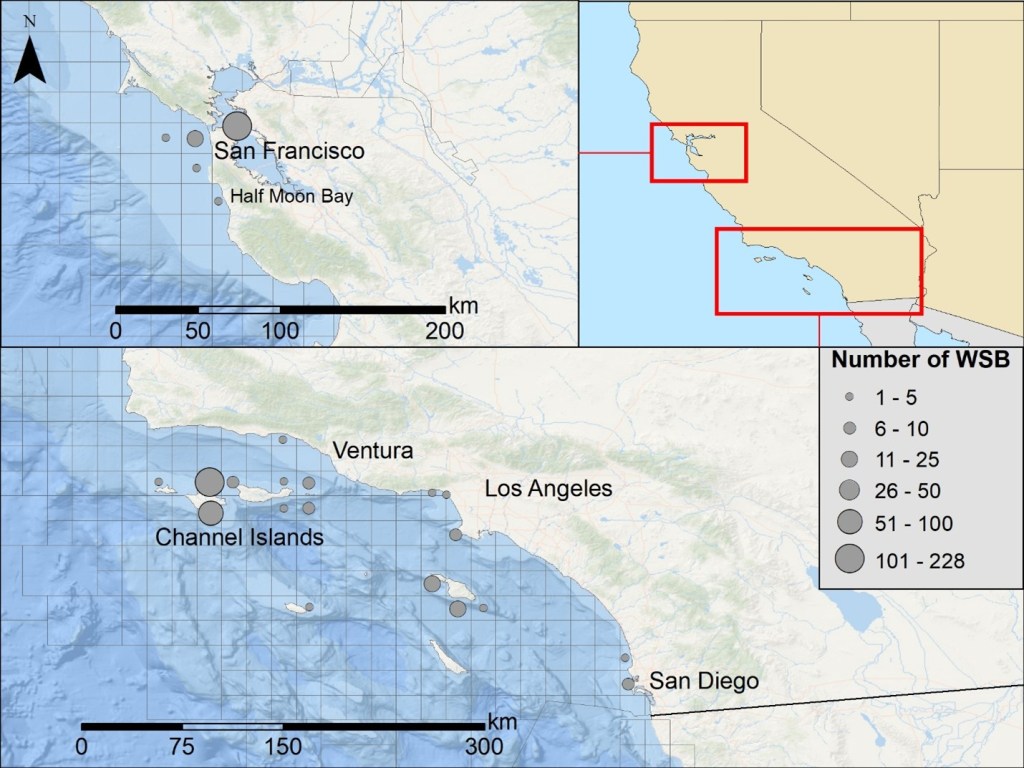
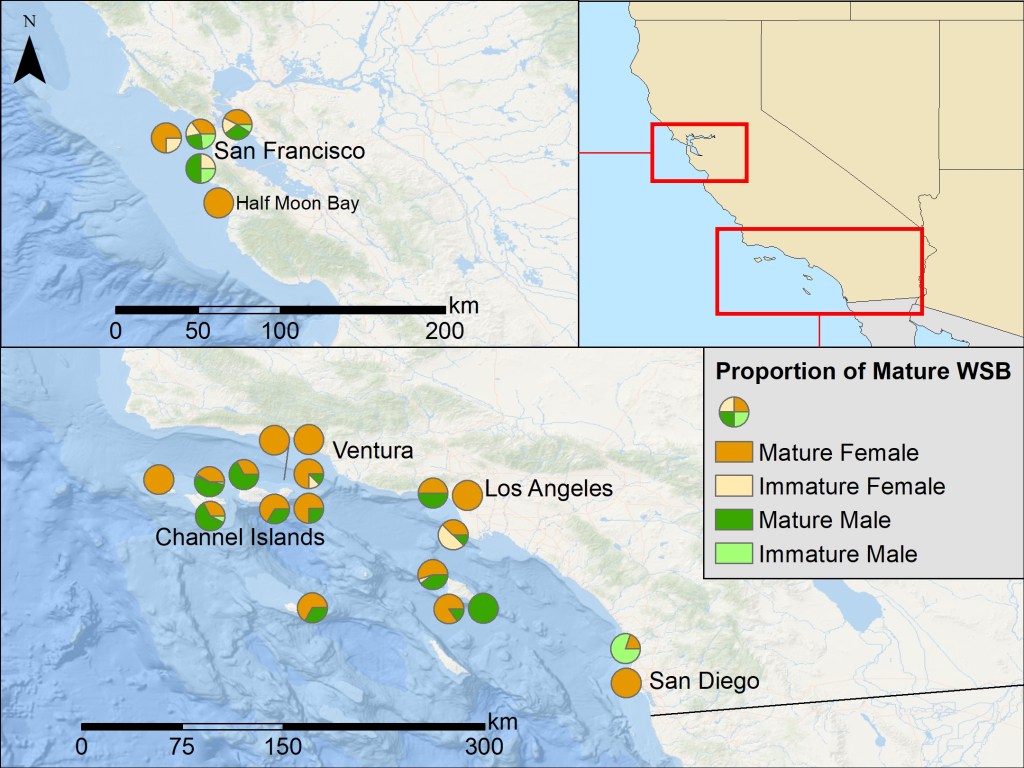
Between 2015 and 2022, we collected a total of 569 white seabass samples (304 females and 265 males) from commercial and recreational fisheries, and research fishing trips along the California coast, spanning northern and southern regions (Fig. 1). To represent the northern region, we sampled in San Francisco Bay and Half Moon Bay between 2019 and 2021 and collected a total of 254 fish, including 152 females and 102 males. We sourced samples from the commercial hook-and-line and trawl fisheries, with sublegal fish collected during onboard observation trips conducted by CDFW and the federal West Coast Groundfish Observer Program. To represent the southern region, CDFW and the Pfleger Institute of Environmental Research (PIER) collected 315 fish between 2015 and 2022 from San Miguel Island to the Mexico border, including 152 females and 163 males. We collected gonads during the spawning season from CDFW’s recreational and commercial hook-and-line and trawl fishery sampling, PIER research activities, and opportunistic CPFV donations, primarily from the Channel Islands. Samples collected from commercial and recreational fisheries did not involve experimental manipulation of live animals, while research collections followed guidelines of the PIER Ethics Protocol #146.155.14-21 and were conducted under Scientific Collection Permit no. SC-2471 and Specific Use Permit ID S-183330009-19163-001 issued through CDFW.
We recorded fork length (FL), total length (TL), head length (HL), and body weight for each specimen whenever possible (Fig. 2). For specimens where only HL was available, we estimated TL from HL using a regression developed from 517 wild white seabass (M. A. Shane, Hubbs-SeaWorld Research Institute, pers. comm.):
TL (mm) = (HL (mm) × 4.6726) – 24.9256 (r2 = 0.99; HL range: 15–305 mm)
After excision and prior to preservation in 10% neutral buffered formalin, we weighed gonads to the nearest gram and assessed their reproductive state macroscopically based on descriptions by Brown-Peterson et al. (2011). Gonads were preserved in formalin for a minimum of two weeks and subsequently transferred to 70% ethanol for storage prior to histological processing.

Histological Sample Processing and Imaging
To classify reproductive condition, we prepared transverse cross sections of fixed ovarian and testicular tissue and submitted them to independent laboratories for processing. Tissues were dehydrated, embedded in paraffin wax, sectioned at ~5 µm thickness using a microtome, mounted on glass slides, and stained with hematoxylin and eosin (H&E) before being returned to us for analysis. An initial batch of ovaries was used to compare transverse sections taken from the anterior, middle, and posterior regions of the ovary lobe. No histological differences were detected among regions, and subsequent analyses used a single transverse section per specimen.
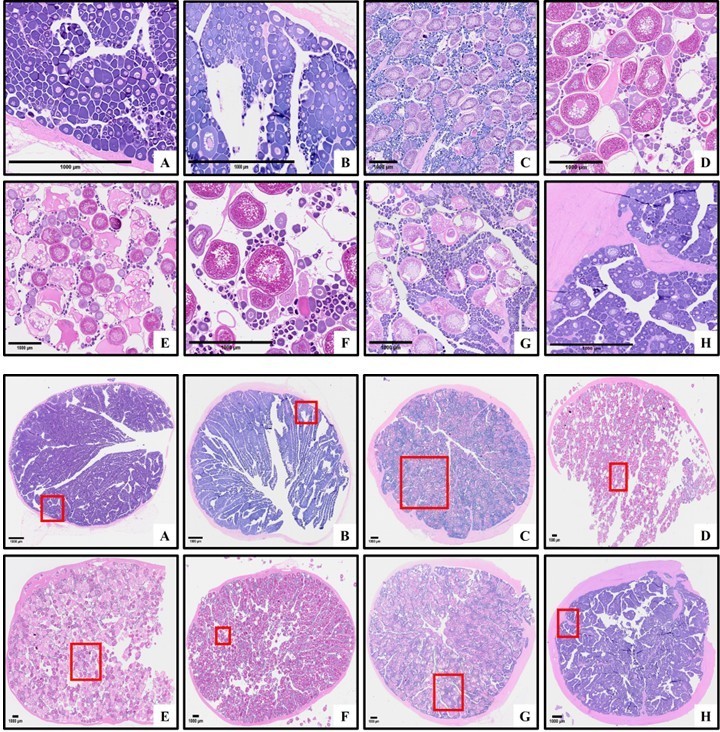
All histological slides were scanned using an Olympus (Evident USA) VS200 universal whole-slide imaging scanner at the University of California San Diego School of Medicine Microscopy Imaging Core facility. This produced high-resolution (20x) digital brightfield images in VSI file format that captured the entire gonad cross section for archival and analytical purposes (Fig. 3). We used QuPath (v0.6.0; Bankhead et al. 2017) to view and annotate digital slides and to assign histological stages for each specimen. To add scale bars (µm), images were exported from QuPath and processed in ImageJ (v1.54k; Schneider et al. 2012).
Histological Staging for Females
We classified ovarian development into reproductive phases following the unified framework outlined by Lowerre-Barbieri et al. (2023). Scanned images were examined for diagnostic histological characteristics, and oocyte developmental stages were identified to assign each individual to a reproductive phase (Table 1, Fig. 3). To evaluate sensitivity of L₅₀ estimates to maturity criteria, we binned reproductive phases into three maturity definitions (Pacicco et al. 2023): (1) Physiological, including early developing and regenerating phases; (2) Functional, including late developing and regressing phases; and (3) Spawning, the most conservative definition requiring evidence of imminent, active, or recent spawning activity. Individuals in the regenerating phase with indicators of previous spawning were incorporated into a fourth curve (4) Functional + Regenerating (FR), which excluded physiological early developing but incorporated physiological regenerating females where previous spawning indicators were identified. We used the FR maturity threshold as the primary maturity benchmark for our analyses.
Table 1. Histological reproductive phases of female white seabass (Atractoscion nobilis) modified from Lowerre-Barbieri et al. (2023), with corresponding maturity curve bins and diagnostic histological characteristics. Abbreviations: CN = chromatin nucleolar; PN = perinucleolar; CA = cortical alveolar; OD = oil droplet; V = vitellogenic; GVM = germinal vesicle migration; GVBD = germinal vesicle breakdown; YC = yolk coalescence; H = hydration; POF = post-ovulatory follicle; AT = atresia; OW = ovarian wall.
| Histological Reproductive Phase | Maturity Curve Bin | Histological Characteristics |
| Immature | Immature | CN and PN oocytes only; no or minimal atresia; no muscle bundles; no large blood vessels; lamellae well organized; ovarian wall thin |
| Early Developing | Physiological | CA, OD1–OD2 present; no or minimal atresia; no muscle bundles or large blood vessels; lamellae well organized; ovarian wall thin |
| Late Developing | Functional | Vitellogenic stages (V1–V3) present; no mass atresia; no POFs |
| Spawning (imminent) | Spawning | GVM present |
| Spawning (active) | Spawning | GVBD, YC, H, and/or fresh POFs present |
| Spawning (spawned) | Spawning | V3 oocytes with POFs |
| Regressing | Functional | Mass α- and β-atresia in vitellogenic oocytes; POFs may be present |
| Regenerating | Physiological | CA and OD1–OD2 present; ovarian wall thickened; muscle bundles and blood vessels present; minimal atresia |
Female Maturity Definitions
We used the FR maturity threshold as the primary maturity benchmark for analyses because it balances biological relevance with interpretability for management. This definition aligns with guidance from the MARVLS framework, which emphasizes identifying individuals that have either spawned previously or are capable of contributing to reproduction within a given season. The physiological maturity definition that included early developing females may overestimate reproductive contribution, as these individuals have initiated oocyte development but may not spawn during the current season. Conversely, the spawning maturity definition is highly conservative and may underestimate reproductive potential by excluding females that are reproductively competent but not actively spawning at the time of capture. The FR definition excludes early developing females, for which timing of first spawning cannot be determined, while including regenerating females that exhibit indicators of prior spawning (e.g., thickened ovarian walls and presence of blood vessels), thereby representing individuals that have demonstrably contributed to reproduction.
Histological Staging for Males
We classified males into a binary maturity status of immature or mature, based on a combination of macroscopic and histological examination. Males were considered mature if running milt was observed during macroscopic examination. For individuals that did not express milt, histological analysis of testicular tissue was used to determine maturity when possible (Fig. 4). The presence of sperm within the lumen or sperm ducts was taken as evidence of maturity, whereas testes containing only early spermatogenic stages were classified as immature (Lowerre-Barbieri et al. 2023). Unlike females, reproductive phases were not assigned to males, as the objective of this study was limited to assessing maturity as a binary state.

Statistical Analyses
We performed all analyses in Python 3.11 using Statsmodels for logistic regression (generalized linear model) fitting and inference, NumPy and Pandas for data management, and Matplotlib for graphics. The SciPy library was used for likelihood ratio tests. Confidence intervals (95%) for logistic regression parameters and L₅₀ estimates were obtained using the delta method and model covariance matrices. Likelihood ratio tests were used to compare nested models evaluating regional differences in maturity schedules and differences between the sexes, with significance assessed at α = 0.05.
We modeled the probability of maturity as a function of TL using generalized linear models (GLMs) with a binomial error distribution and a logit link. Length was included as a continuous predictor. Observed maturity data are shown as individual-level observations (jittered for visualization), and all models were fit using individual-level data. The probability of being mature at length L was estimated as:
P(L)=1/(1+e–(a+bL) )
where a and b are model coefficients. Alternative link functions were not evaluated, as the logit link is standard for modeling binary maturity data and provides interpretable estimates of maturity ogives. Model fit was assessed through visual inspection of fitted curves relative to observed proportions and examination of residual patterns to ensure no major deviations from model assumptions. We estimated the length at 50% maturity (L₅₀ = –a/b) and 95% confidence intervals (CI) using the delta method, which approximates the variance of nonlinear functions of model parameters using the model covariance matrix and a first-order Taylor expansion. We also calculated L₅ and L₉₅, representing the lengths at which 5% and 95% of individuals were mature, respectively. Regional differences between northern and southern California were tested using GLMs with area × length interaction terms, with likelihood ratio tests (LRTs) used to assess statistical significance at α = 0.05.
Supplemental analyses additionally combined maturity ogives with validated growth models to derive estimates for age at maturity, examined spawning seasonality based on histology, and summarized length frequency distributions of white seabass catch (Supplemental Information).
Results
Female Maturity Definitions
To evaluate sensitivity to maturity criteria, we fit statewide logistic ogives for the four maturity definitions evaluated in this study (Fig. 5; Table 2). Physiological maturity occurred at the shortest lengths, with an L₅₀ of 669 mm TL (95% CI: 592–747 mm), reflecting the early onset of oocyte development and the widest and least conservative maturity bin definition. The FR classification, which excludes the physiological early developing reproductive phase, yielded the narrowest confidence intervals with an intermediate L₅₀ estimate of 895 mm TL (95% CI: 883–907 mm). The functional definition alone gave a slightly higher L₅₀ value of 973 mm TL (95% CI: 954–991 mm), while the most conservative spawning definition (i.e. evidence of imminent, current, or recent reproductive activity), produced the highest L₅₀ estimate at 1,126 mm TL (95% CI: 1,079–1,174 mm). Relative to the current minimum size limit (711 mm TL), the physiological maturity curve reached L₅₀ below the legal threshold, whereas the FR, Functional, and Spawning curves reached L₅₀ above it. Confidence intervals were narrowest for the functional and FR classifications, but widened considerably for the physiological and spawning criterion, consistent with fewer observations.
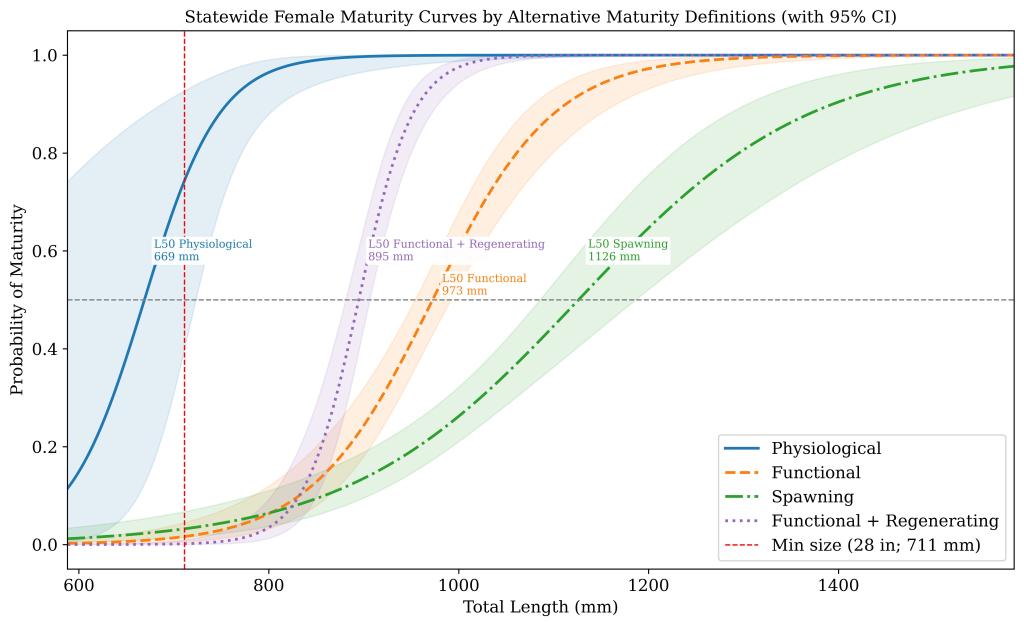
Table 2. Summary maturity metrics for white seabass (Atractoscion nobilis) estimated from statewide and regional logistic maturity ogives.
| Analysis | Group or maturity definition | L₅ / A₅ | L₅₀ / A₅₀ (95% CI) | L₉₅ / A₉₅ | Description |
| Female length at maturity (statewide) | Physiological | 552 mm TL | 669 mm TL (592–747) | 786 mm TL | Earliest onset of oocyte development |
| Female length at maturity (statewide) | Functional + regenerating (FR) | 811 mm TL | 895 mm TL (883–907) | 979 mm TL | Primary maturity benchmark used in analyses |
| Female length at maturity (statewide) | Functional | 784 mm TL | 973 mm TL (954–991) | 1161 mm TL | Includes late developing and regressing females |
| Female length at maturity (statewide) | Spawning | 767 mm TL | 1,126 mm TL (1,079–1,174) | 1485 mm TL | Most conservative maturity definition |
| Male length at maturity (statewide) | Male | 575 mm TL | 683 mm TL (636–729) | 790 mm TL | Statewide maturity ogive |
| Female length at maturity (regional) | Northern California | 834 mm TL | 896 mm TL (882–909) | 958 mm TL | FR maturity definition |
| Female length at maturity (regional) | Southern California | 784 mm TL | 897 mm TL (874–921) | 1010 mm TL | FR maturity definition |
| Age at maturity | Female | 4.3 y | 5.2 y (5.0–5.4) | 6.3 y | Derived from growth-transformed maturity ogive |
| Age at maturity | Male | 2.2 y | 3.2 y (3.0–3.4) | 4.3 y | Derived from growth-transformed maturity ogive |
Length at Maturity
Females.—The 304 female white seabass sampled across northern (n=152) and southern regions (n=152) ranged in size from 588–1,585 mm TL. When female samples were grouped into 25 mm size bins by the FR maturity threshold in a length frequency distribution, most females sampled above ~950 mm TL were mature (Fig. 6). The length frequency distribution illustrates the size range of samples underlying the maturity ogive and highlights the transition from predominantly immature to predominantly mature females across the 800–1,000 mm TL range. The largest immature female sampled was 1,012 mm.

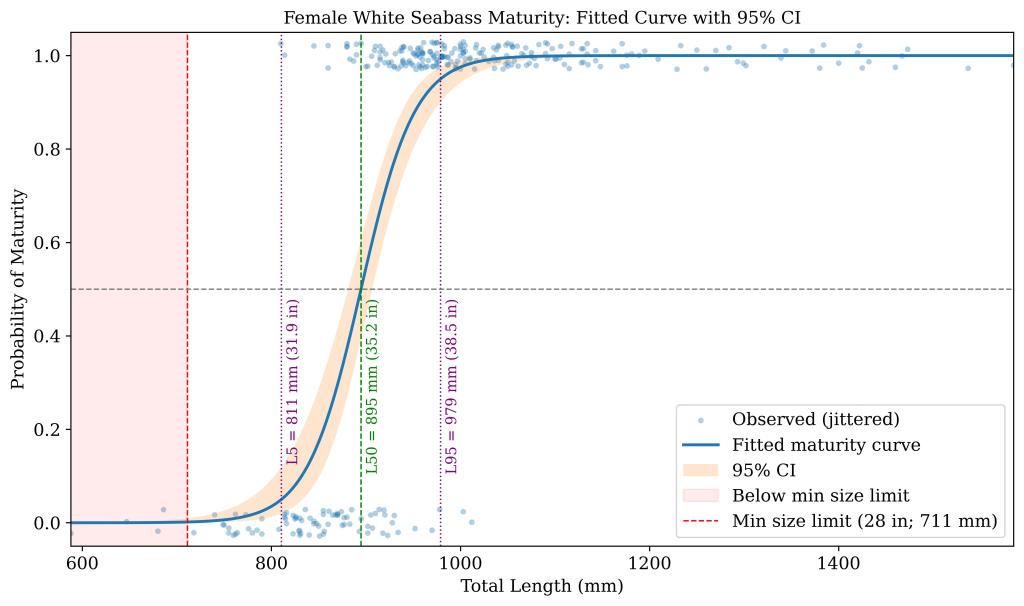
L₅₀ for female white seabass was estimated at 895 mm TL (CI: 883–907 mm) based on a logistic ogive fit to the FR maturity threshold (Fig. 7). The modeled proportion mature at the current minimum size limit of 711 mm TL was 0.2% (CI: 0.0–0.9%). The ogive’s lower and upper reference points were L₅ = 811 mm TL and L₉₅ = 979 mm TL.
Males.—Based on the 265 male white seabass examined (102 north, 163 south) ranging from 345–1,334 mm TL, L₅₀ for male white seabass was estimated at 683 mm TL (95% CI: 636–729 mm) (Fig. 8; Table 2). The modeled proportion of males mature at the current minimum size limit of 711 mm TL was 68.7% (95% CI: 43.5–86.3%). The ogive’s lower and upper reference points were L₅ = 575 mm TL (95% CI: 484–666 mm) and L₉₅ = 790 mm TL (95% CI: 753–827 mm).

Maturation trajectories between sexes were similar, with maturity occurring at smaller lengths in males. Length at maturity ogives differed significantly between males and females (χ² = 191.0, P < 0.001). The sex × predictor interaction was not significant (χ² = 0.80, P = 0.37), indicating that the shapes of the male and female ogives were similar, but the curves were shifted relative to one another.
Geographic Maturity Patterns
Spatial distributions of immature and mature fish differed among regions and habitats (Fig. 9). Samples from San Francisco Bay included both immature and mature individuals, whereas adjacent coastal collections in the northern region were dominated by mature fish. Southern California collections similarly contained mixed maturity states in nearshore areas but were predominantly mature around the Channel Islands.
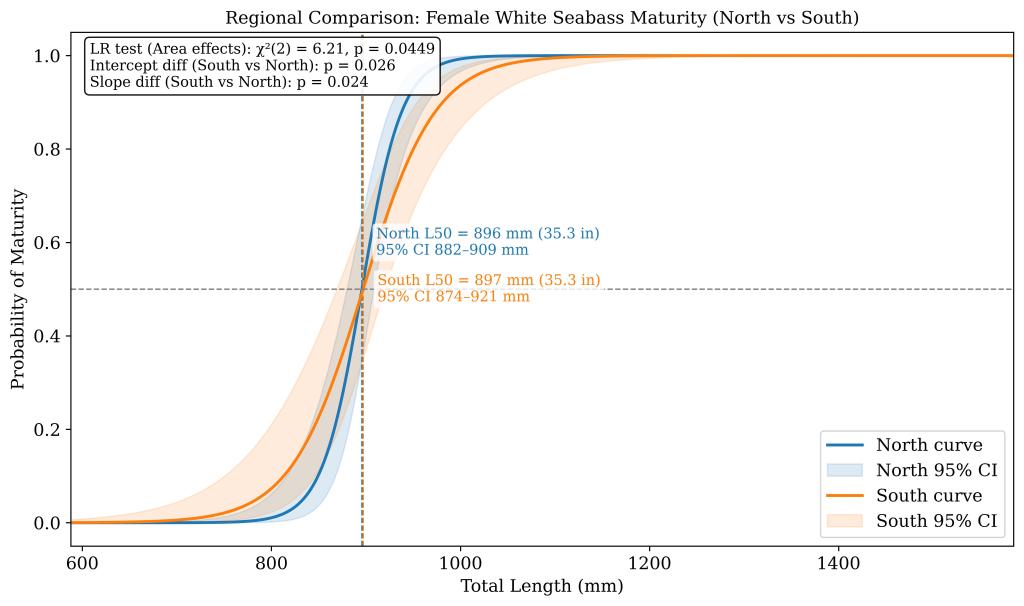
L₅₀ FR maturity estimates were nearly identical between northern and southern California females, at 896 mm TL (95% CI: 882–909 mm) in the north and 897 mm TL (95% CI: 874–921 mm) in the south (Fig. 10; Table 2). Despite this similarity, the likelihood ratio test indicated a significant regional effect (χ²(2) = 6.21, P = 0.0449), driven by differences in both intercept (p = 0.026) and slope (p = 0.024). Supplemental analyses additionally translated maturity schedules to age and examined spawning seasonality using histologically confirmed spawning females (Supplemental Information).
Discussion
White seabass length at maturity estimates generated in this study from histological evidence of spawning capacity suggest that most females begin spawning at a substantially larger length than the current minimum size limit of 711 mm TL (28 in). The transition from predominantly immature to predominantly mature females between 800 and 1,000 mm TL is consistent with the FR maturity ogive (L₅₀ = 895 mm; Fig. 7) and suggests that most females reaching the current minimum size limit have not yet spawned. Physiological maturity occurred near 669 mm TL (95% CI: 592–747 mm), consistent with Clark’s (1930) estimate of <700 mm. However, these early developing females showed no histological evidence of previous spawning and had low gonad weights (<55 g) and gonadosomatic indices (GSI <1.0), suggesting limited reproductive contribution.
In this study, males matured at much smaller sizes than females, a common reproductive trait among marine fishes (Lowerre-Barbieri et al. 2023; Chen et al. 2022). Nearly 70% of males examined were mature at the current minimum size limit with an estimated L₅₀ of 683 mm TL, which was higher than the 566 mm size at maturity reported by Clark (1930). Size at maturity estimates in this study were consistent with the L50 values that were incorporated into the white seabass stock assessment for both males (680 mm) and females (869 mm; Valero and Waterhouse 2016).
Although male and female maturity ogives showed similar shapes, wider confidence intervals for male estimates likely reflect smaller and less evenly distributed sample sizes. Female L₅₀ estimates in this study were comparable with those reported for the closely related geelbeck croaker (Atractoscion aequidens), where females reached 50% maturity near 900 mm TL (Griffiths and Hecht 1995).
Geographic Maturity Patterns
Although regional comparisons suggested broadly similar maturation schedules for female white seabass across California, likelihood ratio testing identified significant regional differences in maturity ogive position and shape. Because regional differences did not result in meaningful changes in L₅₀, the results support use of a single statewide maturity estimate for management.
Observed regional differences may reflect subtle environmental or demographic influences, including regional variation in growth or metabolic rates associated with temperature regimes (Berrigan and Charnov 1994; Dieckmann and Heino 2007). Latitudinal variation in size at maturity has been documented in other marine fishes including Atlantic bluefin tuna (Thunnus thynnus; Fromentin and Powers 2005), butterfish (Odax pullus; Trip et al. 2011), and banded wrasse (Notolabrus fucicola; Trip et al. 2014). Therefore, additional sampling across regions and years would help determine whether the observed differences represent persistent biological variation or reflect sampling limitations.
Future Research Directions
Age at Maturity.—Although length has a stronger association with maturity than age (Ficker et al. 2014), age at 50% maturity (A₅₀) is commonly used to evaluate spawning potential and inform management reference points (McBride 2014; Mainguy et al. 2024). Supplemental analyses derived age at maturity estimates from the primary length-based maturity relationships using published growth models (Supplemental Information; Table 2). These estimates suggested that most males reached maturity by approximately 4 years of age and that most females transitioned to maturity between approximately 4–6 years. The derived age corresponding to the current minimum size limit (3.4 years) was within the range of previous estimates based on ageing white seabass using otoliths (3 years; CDFG 2002) and scales (5 years; Thomas 1968). Using the FR maturity threshold, the derived female A₅₀ estimate of 5.2 years was comparable with the estimated A₅₀ (5 years) reported for A. aequidens, a closely related species that undertakes seasonal spawning migrations upon reaching sexual maturity (Griffiths and Hecht 1995; Boyd 2018). These estimates provide an initial age-based framework for comparing maturity schedules across studies and may support future stock assessment and management applications. Future studies integrating histological staging, direct ageing, and fecundity analyses from the same specimens would reduce uncertainty and improve understanding of regional, temporal, and size-specific variation in reproductive capacity.
Spawning Seasonality across Geographic Range.—Supplemental analyses using histologically confirmed spawning females suggested broadly similar seasonal timing across the sampled range, with elevated GSI values observed during spring and summer in both regions, although the maximum spawning duration was delayed in northern California (Supplemental Information). Observations suggest that existing seasonal regulations overlap with periods of elevated reproductive activity. Expanded year-round sampling would improve understanding of spawning seasonality and reproductive output across the northern extent of the species range.
Fishing Mortality.—The effectiveness of minimum size limits depends not only on the proportion of fish protected prior to maturation, but also on the number of sublegal fish released and associated discard mortality rates within each fishery sector (Muoneke and Childress 1994; Valero and Waterhouse 2016). Based on length-frequency data collected by CDFW from 2008-2025, approximately 15% of the white seabass caught in the recreational fishery currently fall below the minimum legal-size limit and are required to be released, with only a fraction (<1%) of the sampled commercial catch below the current minimum size limit (Supplemental Information). Considering the potential increase in the number of discarded fish under an increased minimum size limit, the rate of post-release mortality has important implications towards the effectiveness of any modified regulations.
White seabass post-release survival has been shown to be influenced by fish size, handling practices, and hooking location. Aalbers et al. (2004) reported relatively high survival (~90%) for juvenile white seabass, while more recently, MacNamara et al. (2025) found that mortality risk increased for larger adults, particularly for internally hooked fish and individuals exceeding ~1000 mm TL. Although MacNamara et al. (2025) showed that mortality rates approached 67% in the largest individuals sampled, variables including live-well retention, transport stress, and barotrauma may have contributed to elevated mortality estimates. Because the potential conservation benefits of increased minimum size limits may be offset under heightened discard mortality scenarios, additional research is needed to quantify post-release survival, particularly following release from recreational and commercial passenger fishing vessel fisheries.
Increasing the minimum size limit toward the female FR maturity threshold (L₅₀ = 895 mm TL) would likely increase the proportion of fish released in both recreational and commercial fisheries based on observed length-frequency distributions. Boyd (2018) modeled an increased spawning stock biomass under a projected increase in the minimum size limit using a management strategy evaluation for A. aequidens, illustrating how size-based regulations may influence reproductive output over time. Similar simulation-based approaches integrating maturity schedules, fishery selectivity, and discard mortality could help evaluate potential tradeoffs and conservation outcomes for white seabass under alternative management scenarios.
Management Implications
Minimum size limits based on L₅₀ maturity estimates have been widely used as precautionary fishery management measures (Cope and Punt 2009; Froese 2004). However, delayed maturity combined with intense fishing pressure on sub-adult size classes has been linked to reduced spawning stock biomass (ASMFC 2022; Luczkovich et al. 2008). Severe population declines and fishery collapses have been documented in several marine fishes when substantial harvest occurs before individuals have an opportunity to reproduce, including Nassau grouper (Epinephelus striatus; Bush et al. 2006), Atlantic cod (Gadus morhua) and common skate (Dipturus batis; Brander 1981; Myers et al. 1997; Bush et al. 2006). Updated maturity estimates provide valuable input for future stock assessments that may be used in conjunction with yield-per-recruit analyses (Waters and Huntsman 1986; Valero and Waterhouse 2016) or management strategy evaluation (Punt et al. 2014; Boyd 2018) to assess estimated population trends under various minimum size regulations and post-release mortality rates.
This study reveals a substantial mismatch between the current minimum size limit for white seabass and the biological benchmarks for female maturity, with <1% of females mature at the legal size of 711 mm TL (28 in). The existing discrepancy suggests that females may be harvested before contributing to the spawning population, potentially increasing the risk of recruitment overfishing. Allowing females an opportunity to spawn prior to harvest has been associated with reduced risk of recruitment overfishing, improved yield per recruit, and maintenance of spawning biomass (Huntsman and Manooch 1978; Lavin et al. 2021).
New information on white seabass length at maturity warrants reevaluation of current fishery regulations and supports the use of the best available science in management decisions. Revised maturity estimates in combination with length-frequency data for each fishery sector can be used to evaluate the estimated effects of alternative minimum size limits under different assumptions of post-release mortality and fishing pressure. Findings from this study provide an opportunity to incorporate contemporary reproductive parameters into future stock assessments and white seabass fishery management plans, and support re-evaluation of length-based management strategies using updated reproductive benchmarks.
Acknowledgments
We thank the Maturity Assessment Reproductive Variability and Life Strategies (MARVLS) group, whose workshops and collaborative framework shaped both the methodological approach and interpretation of maturity results. We also thank samplers from the California Department of Fish and Wildlife (J. Davis, R. Iler, M. Masuda) along with Tom Pfleger and the Pfleger Institute of Environmental Research staff (M. Wang, M. Shaw, T. Fullam) for their assistance with sample collection, as well as the commercial fishermen, CPFV operators, and recreational anglers who generously contributed specimens and otherwise supported sampling efforts. We are grateful to M. Okihiro for providing input to PIER regarding sample processing. We thank C. Mireles, D. Porzio, K. Ramey and V. Taylor for reviewing drafts of this manuscript and K. Newcomer for assistance in creating histological images. We are grateful to the California Fish and Wildlife Journal editors and reviewers for their constructive input. Histological imaging services were supported by the University of California, San Diego, School of Medicine Microscopy Imaging Core facility, funded in part by NIH grant NINDS P30NS047101. Histological processing of gonad samples was provided by North Bay Histology Lab (Novato, California), Harris Histology Services (Tustin, California), and Histology Consultation Services (Everson, Washington).
Literature Cited
- Aalbers, S. A., G. M. Stutzer, and M. A. Drawbridge. 2004. The effects of catch-and-release angling on the growth and survival of juvenile white seabass captured on offset circle and J-type hooks. North American Journal of Fisheries Management 24(3):793–800.
- Aalbers, S. A. 2008. Seasonal, diel, and lunar spawning periodicities and associated sound production of white seabass (Atractoscion nobilis). Fishery Bulletin 106(2):143–152.
- Atlantic States Marine Fisheries Commission (ASMFC). 2022. Red Drum Simulation Assessment and Peer Review Report. A report to the Sciaenids Management Board, National Oceanic and Atmospheric Administration, Washington, D.C., USA. Available from: https://asmfc.org/wp-content/uploads/2025/01/RedDrumSimulationAssmt_PeerReviewReport_2022.pdf
- Bankhead, P., M. B. Loughrey, J. A. Fernández, Y. Dombrowski, D. G. McArt, P. D. Dunne, S. McQuaid, R. T. Gray, L. J. Murray, H. G. Coleman, J. A. James, M. Salto-Tellez, and P. W. Hamilton. 2017. QuPath: Open-source software for digital pathology image analysis. Scientific Reports 7:16878.
- Berrigan, D., and E. L. Charnov. 1994. Reaction norms for age and size at maturity in response to temperature: a puzzle for life historians. Oikos 70:474–478.
- Boyd, D. W. 2018. Fishery, population dynamics and stock assessment of geelbek (Atractoscion aequidens), a commercially important migrant fish species off the coast of South Africa. Thesis, University of Cape Town, South Africa.
- Brander, K. 1981. Disappearance of common skate Raja batis from Irish Sea. Nature, 290:48–49.
- Brown-Peterson, N. J., D. M. Wyanski, F. Saborido-Rey, B. J. Macewicz, and S. K. Lowerre-Barbieri. 2011. A standardized terminology for describing reproductive development in fishes. Marine and Coastal Fisheries 3:52–70.
- Bush, P. G., E. D. Lane, G. C. Ebanks-Petrie, K. I. Luke, B. R. Johnson, C. R. McCoy, J. O. Bothwell, and E. U. Parsons. 2006. The Nassau grouper spawning aggregation fishery of the Cayman Islands: an historical and management perspective. Proceedings of the Gulf and Caribbean Fisheries Institute 57:515–524.
- California Department of Fish and Game (CDFG). 2002. Final White Seabass Fishery Management Plan. California Department of Fish and Game, Sacramento, CA, USA.
- California Department of Fish and Wildlife (CDFW). 2020. White Seabass, Atractoscion nobilis, Enhanced Status Report. Available from: https://marinespecies.wildlife.ca.gov/white-seabass/
- Chen, X., B. Liu, and D. Lin. 2022. Sexual maturation, reproductive habits, and fecundity of fish. Pages 113–142 in X. Chen and B. Liu, editors. Biology of Fishery Resources. Springer, Singapore. https://doi.org/10.1007/978-981-16-6948-4_5
- Clark, F. N. 1930. Size at first maturity of the white seabass (Cynoscion nobilis). California Fish and Game 16(4):319–323.
- Cope, J. M., and A. E. Punt. 2009. Length-based reference points for data-limited situations: applications and restrictions. Marine and Coastal Fisheries: Dynamics, Management, and Ecosystem Science 1:169–186. https://doi.org.10.1577/C08-025.1
- Dieckmann, U., and M. Heino. 2007. Probabilistic maturation reaction norms: their history, strengths, and limitations. Marine Ecology Progress Series 335:253–269.
- Donohoe, C. J. 1997. Age, growth, distribution, and food habits of recently settled white seabass (Atractoscion nobilis) off San Diego County. California Fishery Bulletin 95(4):709–721.
- Ficker, H., R. Mazzucco, H. Gassner, J. Wanzenböck, and U. Dieckmann. 2014. Fish length exclusively determines sexual maturation in the European whitefish Coregonus lavaretus species complex. Journal of Fish Biology 84(4):1164–1170.
- Froese, R. 2004. Keep it simple: three indicators to deal with overfishing. Fish and Fisheries 5(1):86–91.
- Fromentin, J. M., and J. E. Powers. 2005. Atlantic bluefin tuna: population dynamics, ecology, fisheries, and management. ICES Journal of Marine Science 62(5):743–759.
- Griffiths, M. H., and T. Hecht, 1995. On the life history of Atractoscion aequidens, a migratory sciaenid off the east coast of southern Africa. Journal of Fish Biology 47(6):962–985.
- Hunter, J. R., and B. J. Macewicz. 1985. Measurement of spawning frequency in multiple spawning fishes. National Marine Fisheries Service, NOAA Technical Report 36:79–94.
- Huntsman, G. R., and C. S. Manooch, III. 1978. Minimum size limits for reef fishes. Journal of the Southeastern Association of Fish and Wildlife Agencies 32:509–513.
- Lavin, C., G. P. Jones, D. H Williamson, and H. B. Harrison. 2021. Minimum size limits and the reproductive value of numerous, young, mature female fish. Proceedings of the Royal Society B: Biological Sciences 288:20202714. https://doi.org/10.1098/rspb.2020.2714
- Lowerre‐Barbieri, S. K., N. J. Brown‐Peterson, H. Murua, J. Tomkiewicz, D. M. Wyanski, and F. Saborido‐Rey. 2011. Emerging issues and methodological advances in fisheries reproductive biology. Marine and Coastal Fisheries 3(1):32–51.
- Lowerre-Barbieri, S. K., N. J. Brown-Peterson, and D. M. Wyanski, H. Moncrief‐Cox, K. Kolmos, H. Menendez, B. Barnett, and C. Friess. 2023. A unified framework and terminology for reproductive traits integral to understanding fish population productivity. Marine and Coastal Fisheries 15(6):e10276. https://doi.org/10.1002/mcf2.10276
- Luczkovich, J. J., R. C. Pullinger, S. E. Johnson, and M. W. Sprague. 2008. Identifying sciaenid critical spawning habitats by the use of passive acoustics. Transactions of the American Fisheries Society 137(2):576–605.
- Mainguy, J., M. Bélanger, G. Ouellet-Cauchon, and R. de Andrade Moral. 2024. Monitoring reproduction in fish: assessing the adequacy of ogives and the predicted uncertainty of their L50 estimates for more reliable biological inferences. Fisheries Research 269:106863.
- MacNamara, R., M. Shane, V. Bach Muñoz, and M. Drawbridge. 2025. Assessing postrelease mortality in hook-and-line fishing of a large coastal sciaenid, the white seabass (Atractoscion nobilis). Fishery Bulletin 123(2):119–126.
- McBride, R. S. 2014. The continuing role of life history parameters to identify stock structure. Pages 77–107 in S. X. Cadrin, L. A. Kerr, and S. Mariani, editors. Stock Identification Methods. 2nd edition. Academic Press, Cambridge, MA, USA.
- McMillan, D. B. 2007. Ovarian follicles. Pages 67–208 in D. B. McMillan, editor. Fish histology—female reproductive system. Springer-Verlag, NY, New York, USA.
- Miller, D. J., and R. N. Lea. 1972. Guide to the coastal marine fishes of California. Fish Bulletin 157. California Department of Fish and Game, Sacramento, CA, USA.
- Moser, H. G., D. A. Ambrose, M. S. Busby, J. L. Butler, E. M. Sandknop, B. Y. Sumida, and E. G. Stevens. 1983. Description of early stages of white seabass (Atractoscion nobilis) with notes on distribution. California Cooperative Oceanic Fisheries Investigations Report 24:182–193.
- Myers, R. A., J. A. Hutchings, and N. J. Barrowman. 1997. Why do fish stocks collapse? The example of cod in Atlantic Canada. Ecological Applications 7(1):91–106.
- Muoneke, M. I., and W. M. Childress. 1994. Hooking mortality: a review for recreational fisheries. Reviews in Fisheries Science 2:123–156.
- Pacicco, A. E., N. J. Brown-Peterson, D. J. Murie, R. J. Allman, D. Snodgrass, and J. S. Franks. 2023. Reproductive biology of yellowfin tuna (Thunnus albacares) in the northcentral U.S. Gulf of Mexico. Fisheries Research 261:106620. https://doi.org/10.1016/j.fishres.2023.106620
- Punt, A. E., F. Hurtado-Ferro, and A. R. Whitten. 2014. Model selection for selectivity in fisheries stock assessment. Fisheries Research 158:124–134. https://doi.org/10.1016/j.fishres.2013.06.003
- Schneider, C. A., W. S. Rasband, and K. W. Eliceiri. 2012. NIH Image to ImageJ: 25 years of image analysis. Nature Methods 9(7):671–675.
- Shane, M. A., R. MacNamara, L. F. Bellquist, and M. A. Drawbridge. 2025. Otolith ageing of white seabass (Atractoscion nobilis): known‐age validation, reader performance and sex‐specific growth patterns. Journal of Fish Biology 107(1):180–187.
- Thomas, J. C. 1968. Management of the white seabass (Cynoscion nobilis) in California waters. Fish Bulletin 142. California Department of Fish and Game, Sacramento, CA, USA.
- Trip, E. D. L., K. D. Clements, D. Raubenheimer, and J. H. Choat. 2011. Reproductive biology of an odacine labrid, Odax pullus. Journal of Fish Biology 78:741–761.
- Trip, E. D., K. D. Clements, D. Raubenheimer, and J. H. Choat. 2014. Temperature‐related variation in growth rate, size, maturation, and life span in a marine herbivorous fish over a latitudinal gradient. Journal of Animal Ecology 83(4):866–875.
- Valero, J., and L. Waterhouse. 2016. White seabass (Atractoscion nobilis): 2016 Stock Assessment Review Panel Report. Scripps Institution of Oceanography, La Jolla, CA, USA.
- Vojkovich, M., and R. J. Reed. 1983. White seabass, Atractoscion nobilis, in California-Mexican waters: status of the fishery. California Cooperative Oceanic Fisheries Investigations Report 24:79–83.
- Waters, J. R., and G. R. Huntsman. 1986. Incorporating mortality from catch-and-release into yield-per recruit analyses of minimum-size limits. North American Journal of Fisheries Management 6:463–471.